


The work received early coverage from mindbodygreen, which reported that the study centered on memory integration and the combining of distinct experiences into a bigger picture [1]. Nature summarized the central result with the headline that stress impairs the brain's ability to link memories and dampens insight, noting that imaging offered a possible explanation for why the ability to make inferences declines after an episode of acute stress, such as a job interview [2].
Neuroscientist Brice Kuhl of the University of Oregon, who was not involved in the study, described the effect in comments carried by the Sri Lanka Guardian: under stress, "the brain was less likely to spontaneously connect new inputs with stored experiences" [3]. Earlier reporting on related work stated that stress does not prevent the brain from taking in new information but substantially reduces the brain's ability to link that information to existing knowledge [4].
Background: Stress and Memory Integration
Prior research has established broad links between stress and memory problems, although the underlying mechanisms remain incompletely understood. The Mayo Clinic states that the body treats stress as a threat even when a person does not consciously perceive one, because the brain is hard-wired to look for threats and protect against them [5]. The American Brain Foundation reported that acute stress can enhance retention of information in working memory, while chronic stress can weaken it [6].
Stress hormones are one frequently cited pathway. Calm, a meditation and wellness platform, noted that chronic stress might keep stress hormones such as cortisol elevated for extended periods, which could possibly begin to disrupt brain function [7]. Research summarized by the National Library of Medicine's PMC database describes stress as capable of causing an imbalance in neural circuitry that supports cognition, decision-making, anxiety and mood [8].
Earlier coverage of stress-hormone research, including a 2009 review of the influence of stress hormones on fear circuitry, documented long-standing scientific interest in how these chemicals shape brain function [9]. Neuroscientist Bruce McEwen's work on the physiology and neurobiology of stress and adaptation placed the brain at the center of the body's stress response [10]. Investigators have also examined how the stress response itself can become dysregulated, with research describing links between early adversity and alterations in the hippocampus and amygdala, areas central to processing fear and memory [11].
Details of the New Study
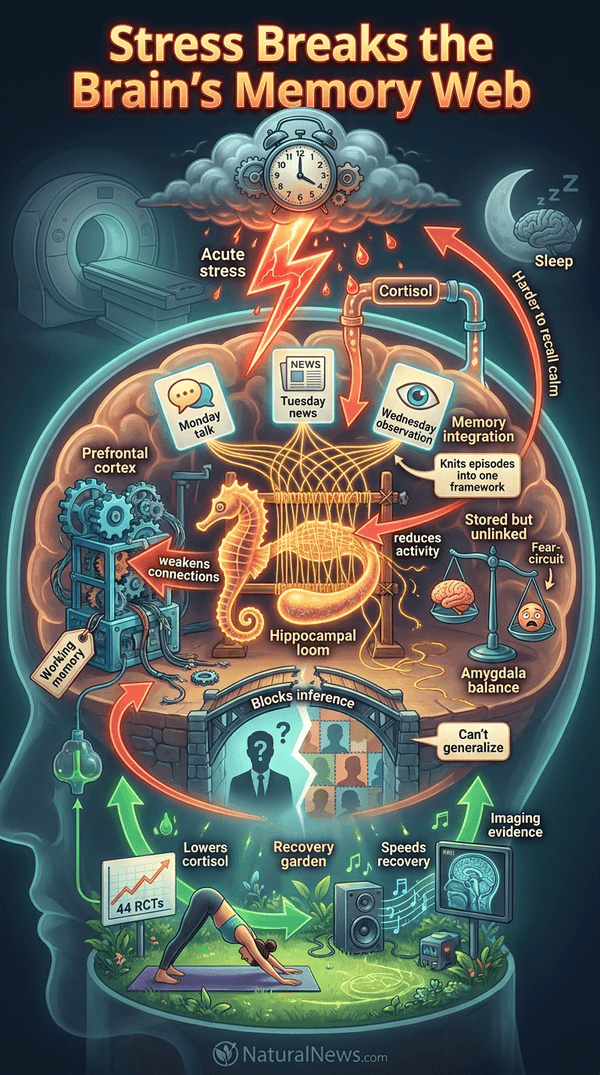
The study used brain imaging to compare participants who were deliberately placed under stress against those who were not. Researchers found that after the stressful experience, participants' brains showed significantly reduced activity in the hippocampus, the key region responsible for memory, according to an account published in September 2026 [12].
The Guardian's Sri Lanka edition reported that the brain was less likely to spontaneously connect new inputs with stored experiences [3].
Coverage acknowledged limits in what the findings establish. Science X, in a May 2026 report, noted that most research on stress and memory has focused on storage and recall, and that far less is known about how stress affects the brain's ability to connect related experiences and draw inferences [13].
Implications and Expert Reactions
Independent commentary has framed the result as an addition to a growing body of evidence on stress and cognition. Kuhl's description of the effect, as reported by the Sri Lanka Guardian, presented the finding as a reduced tendency for the brain to connect new inputs with stored experiences [3]. A commentary published on Substack argued that the act of recalling a hundred prior episodes of anxiety to calm oneself in the present is itself a form of memory integration, and that it likely leans on hippocampal activity that stress appears to dampen when stress is running highest [14].
The broader literature points in the same direction. A Truvaga blog post stated that chronic stress weakens the connections in the prefrontal cortex, a region involved in staying on task, weighing options, and thinking through problems [15]. Harvard Health reported that stress can affect memory and cognition and put a person at higher risk for Alzheimer's disease and dementia, and that stress management tools can help [16]. The American Brain Foundation has published guidance on the impact of chronic stress, PTSD, the role of sleep in stress, and strategies for managing stress [17].
Proposed interventions have also been studied. An analysis of 44 randomized controlled trials covering 3,284 adults found that yoga produced a moderate, consistent drop in cortisol, the body's primary stress hormone, when compared with aerobic exercise, strength training, high-intensity interval training and qigong [18]. A study reported in September 2026 found that listening to relaxing music was followed by a greater improvement in positive mood and a faster return of heart rate and nervous system arousal to normal levels than a calming natural sound, with functional MRI used to track brain activity during recovery [19]. Neither the researchers nor independent commentators made specific clinical recommendations on the basis of the new study.
Conclusion
The study's authors concluded that acute stress impairs a central mechanism of memory integration, according to the University of Hamburg release [20]. The finding suggests stress may hinder the brain's ability to connect separate experiences into a coherent whole, a process that supports problem-solving and insight [1].
Early evidence suggests stress may also affect how flexibly memories are used, and while memory storage and recall have been widely studied, far less is known about how stress affects the brain's ability to connect related experiences and draw inferences from them [13]. Related research has linked stress to structural brain changes and memory decline, while other work has reported that persistent financial hardship is associated with poorer performance on cognitive tests by the early 50s [21][22].
References
- Stress May Prevent Your Brain From Making Important Connections. https://www.mindbodygreen.com/articles/stress-may-prevent-your-brain-from-making-important-connections-how-stress-affects-memory-integration
- Stress impairs your brain’s ability to link memories. https://www.nature.com/articles/d41586-026-01644-z
- When Stress Breaks Memory Links. https://slguardian.org/when-stress-breaks-memory-links/
- Study: Stress Interferes with Brain’s Memory Integration, Reducing Problem-Solving Ability. https://www.beatdepression.news/2026-06-22-study-stress-interferes-with-brain-memory-integration.html
- Chronic stress puts your health at risk. https://www.mayoclinic.org/healthy-lifestyle/stress-management/in-depth/stress/art-20046037
- The Brain and Stress. https://www.americanbrainfoundation.org/the-brain-and-stress/
- 5 ways stress can impact your memory (and what to do about it). https://www.calm.com/blog/stress-and-memory
- Neurobiological and Systemic Effects of Chronic Stress. https://pmc.ncbi.nlm.nih.gov/articles/PMC5573220/
- Handbook of Life Course Health Development by Neal Halfon, Christopher B Forrest, Richard M Lerner, Elaine M Faustman
- Differential Expression of Molecular Markers of Synaptic Plasticity in the Hippocampus, Prefrontal Cortex, and Amygdala in Response to Spatial Learning, Predator Exposure, and Stress-Induced Amnesia. Journal of Neuroscience
- Two Science-Backed Strategies for Trauma Recovery: Movement and Memory Processing. https://www.naturalnews.com/2026-08-27-two-science-backed-strategies-for-trauma-recovery.html
- When Stress Stops the Brain Connecting the Dots. https://burningdownthepatriarchy.substack.com/p/why-stress-breaks-the-bridge-and
- Why does stress let your brain learn but prevent you from thinking .... https://sciencex.com/news/2026-05-stress-brain-logically.html
- Why Stress Makes It Hard to Connect the Dots. https://judbrewer.substack.com/p/why-stress-makes-it-hard-to-connect
- What Chronic Stress Does to Memory, Focus, and Brain Health. https://www.truvaga.com/blog/what-chronic-stress-does-to-memory-focus-and-brain-health/
- Protect your brain from stress - Harvard Health. https://www.harvardhealth.org/mind-and-mood/protect-your-brain-from-stress
- How Stress Affects the Brain - American Brain Foundation. https://www.americanbrainfoundation.org/how-stress-affects-the-brain/
- Study finds gentle yoga, not intense exercise, best for lowering stress hormones. https://www.naturalnews.com/2026-10-12-gentle-yoga-best-for-lowering-stress-hormones.html
- Music May Aid Recovery From Acute Stress, Study Finds. https://www.naturalnews.com/2026-09-16-study-music-may-aid-acute-stress-recovery.html
- Limited Connections: How Stress Affects Our Brain: Newsroom: University of Hamburg. https://www.uni-hamburg.de/en/newsroom/presse/2026/pm19.html
- Persistent Financial Hardship Linked to Faster Cognitive Decline, Study Finds. https://www.naturalnews.com/2026-09-04-study-persistent-financial-hardship-linked-cognitive-decline.html
- Study: Chronic Stress Ages Immune System via Gut-Brain-Bone Marrow Axis, Mouse Data Shows. https://www.naturalnews.com/2026-07-09-chronic-stress-ages-immune-system-mouse-data-shows.html
Explainer Infographic










Please contact us for more information.


