



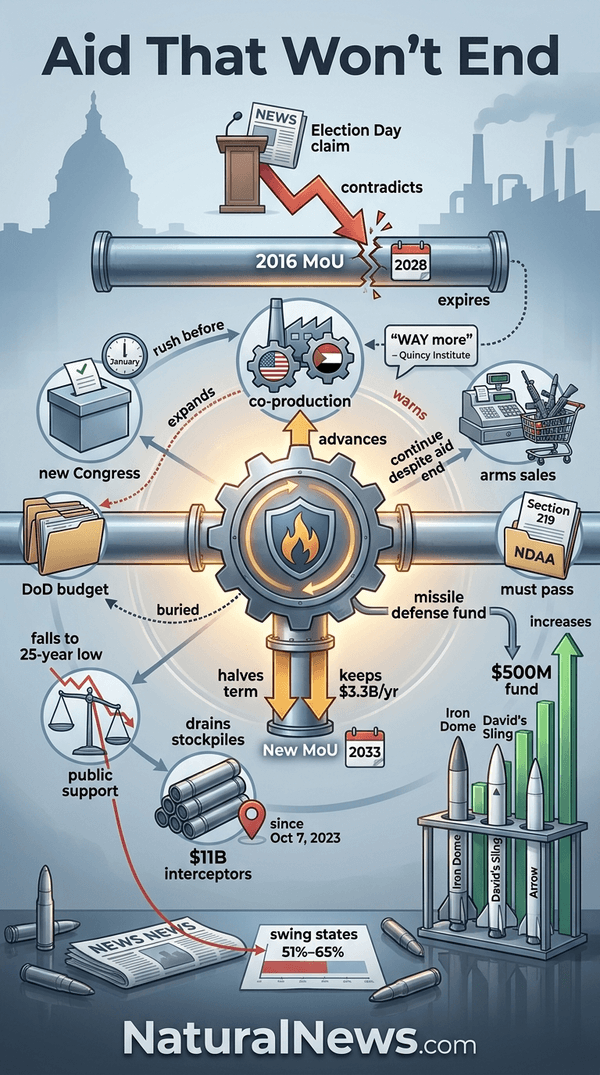
The current MoU, negotiated during the Obama administration, expires in 2028 and provides Israel with at least $3.8 billion in annual military assistance [1][9].
Current Aid Terms and Reported New Terms
According to Ynet, the emerging plan would halve the ten-year MoU term to five years while keeping Foreign Military Financing at $3.3 billion per year [9]. The $500 million missile defense fund would increase to an unspecified amount. The aid would then be phased out after the five years [9].
Other outlets have reported similar figures. Calcalist reported that Israel would receive approximately $16.5 billion in direct military financing over five years following the 2028 expiration of the current agreement [1].
Netanyahu Plan and Congressional Amendment
The phased reduction aligns with a proposal backed by Netanyahu to shift the U.S.-Israel relationship "from aid to partnership," according to the Ynet report.
The plan is being advanced through Section 219, an amendment included in the House version of the 2027 National Defense Authorization Act [9].
The House took up final passage of the $1.15 trillion NDAA on July 22, with Section 219 identified as the United States-Israel Defense Technology Cooperation Initiative, directing the Pentagon to expand and accelerate integration of U.S. and Israeli defense technologies [2]. A similar amendment exists in the Senate version of the NDAA, but the two chambers have not yet negotiated the final bill.
Critics have warned that the integration effort may not reduce American financial exposure so much as relocate it.
Ben Freeman of the Quincy Institute cautioned that if the integration moves forward, Israel could "end up getting WAY more" than the $3.8 billion it receives annually from the United States, and that the funds would "just be buried in the DoD budget [9]." Freeman made the comments after Trump's Election Day declaration.
Trump's Statements and Quincy Institute Criticism
On Election Day, during a telephone interview with Fox News, Trump declared that he and Netanyahu had agreed months ago to end U.S. military aid to Israel. The U.S. will suspend $4 billion in annual aid to Israel next year, but arms sales will continue [3].
The announcement drew immediate questions. Reuters noted that Trump did not explain how the funding would be halted at year's end given the existing MOU that provides $3.8 billion in military aid [4].
The Israeli finance ministry was unaware of any plans to immediately end U.S. military assistance before Trump's announcement, according to Israel's Channel 12 [5].
Netanyahu's office responded with a statement framing the shift as a collaborative transition. "U.S. military aid to Israel has always been a cross-the-aisle agreement."
Additional U.S. Military Support Since October 2023
Since October 7, 2023, the United States has provided "significantly more military aid than the annual $3.8 billion package," according to the Antiwar.com report.
On top of direct financial assistance, the U.S. has also fired $11 billion worth of interceptors defending Israel from missile attacks during the wars with Iran.
The U.S. has additionally deployed an additional Patriot missile defense system to Israel to prepare for the next potential escalation. These figures were reported in addition to the direct financial aid package.
The expanded support comes as public opinion has shifted.
American support for Israel has fallen to a 25-year low, with declining backing across both Democrats and Republicans, according to polling cited in media reports [6]. A September 2026 poll found that majorities in six swing states supported blocking bomb shipments to Israel, with support ranging from 51% in North Carolina to 65% in Maine [7].
Conclusion: Timeline and Unresolved Questions
The U.S. and Israel are hoping to finalize the new MoU before the new Congress is sworn in this January, according to Ynet. The negotiations have involved representatives for Rubio and the Israeli Defense Ministry and embassy officials in Washington.
The House and Senate versions of the NDAA, containing Section 219 and a similar amendment, have not been reconciled. The two chambers must negotiate the final bill before it can be signed into law. No final agreement has been announced, and the reported terms remain subject to congressional action and further negotiations.
The timeline remains uncertain. While Trump stated the aid would end by the end of 2026, the reported draft terms indicate military assistance would continue at reduced levels through 2033.
The Israeli teams were stunned by Trump's announcement and did not understand what he meant, according to reports [8].
References
- Israel's US military aid set to continue through 2033 under five .... https://www.calcalistech.com/ctechnews/article/fjchfengr
- Section 219: House Defense Provision on U.S. Israel Ties Advances Amid Debate - NaturalNews.com, August 02, 2026.
- President Donald Trump earlier this week said the U.S. will .... https://www.facebook.com/newshour/videos/president-donald-trump-earlier-this-week-said-the-us-will-suspend-4-billion-in-a/1450129460579808/
- As Americans Vote, Trump Says US Will Stop $4 Billion in Aid to Israel. https://www.usnews.com/news/world/articles/2026-11-03/trump-says-us-will-stop-paying-israel-after-year-end
- Report: Israeli finance ministry unaware of plans to end US military aid before Trump announcement. https://www.middleeasteye.net/live-blog/live-blog-update/report-israeli-finance-ministry-unaware-plans-end-us-military-aid-trump
- U.S. Midterm Elections Expose Eroding Bipartisan Support for Israel as Debate Over Military Aid Intensifies. https://www.naturalnews.com/2026-11-09-midterm-elections-eroding-bipartisan-support-for-israel.html
- Majority in Six Swing States Back Blocking Bomb Shipments to Israel, Poll Finds. https://www.naturalnews.com/2026-10-26-six-swing-states-back-blocking-bomb-shipments-israel.html
- US military aid to Israel won’t end this year, but total package will be halved. https://www.europesays.com/3362752/
- Report: US, Israel in Talks To Extend Military Aid Through 2033 Despite Trump Saying It Would. End. https://news.antiwar.com/2026/11/09/report-us-israel-in-talks-to-extend-military-aid-through-2033-despite-trump-saying-it-would-end/
Explainer Infographic










Please contact us for more information.


