


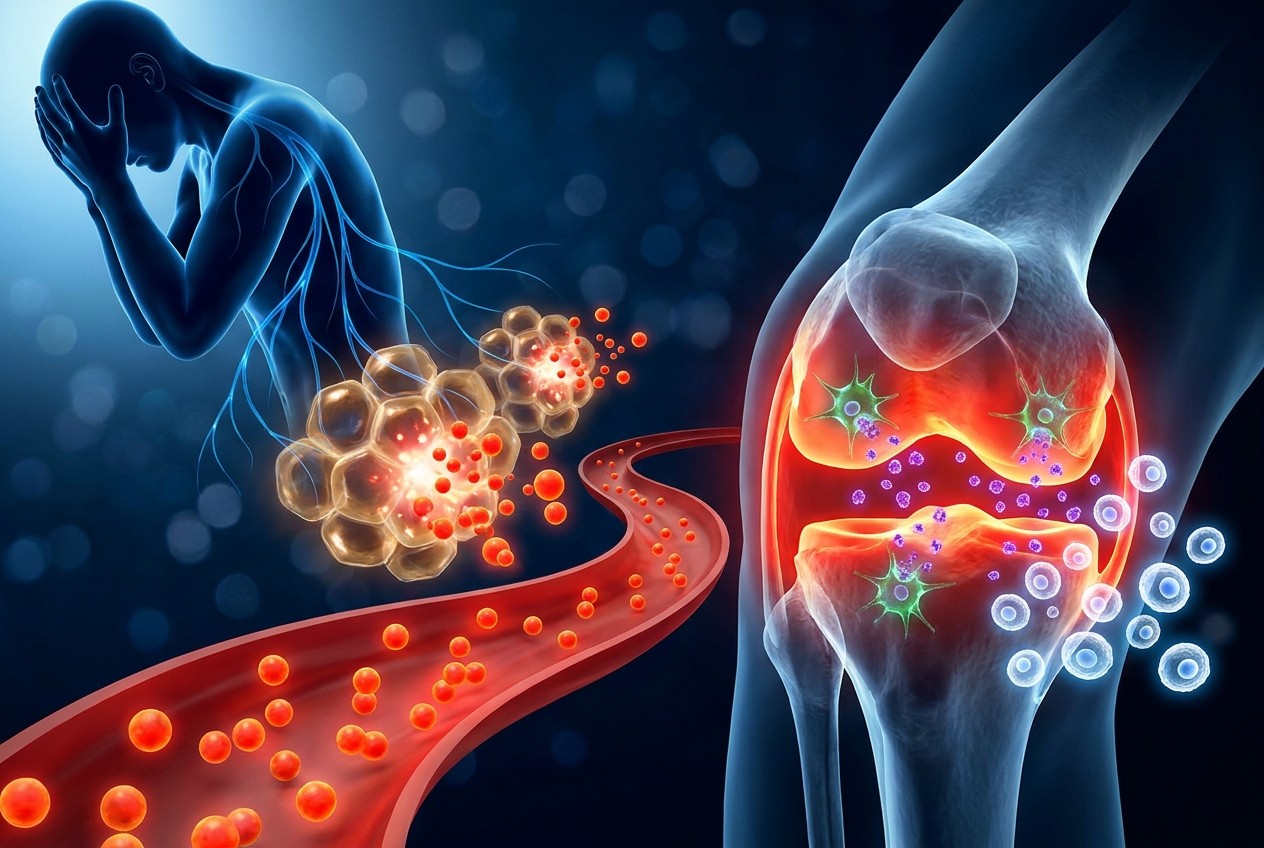
Scientists have long suspected a link between stress and arthritis flare-ups, but the biological mechanism connecting the two had remained unclear, according to an article published by mindbodygreen [3]. The experiments involved mice with arthritis that had gone into a remission-like state before being exposed to restraint stress, the study stated [1][2]. When researchers blocked part of the stress-response pathway, arthritis flares became significantly less severe, according to the findings [3][2].
Background: Rheumatoid Arthritis and Stress Flares
Rheumatoid arthritis is an autoimmune condition that causes inflammation in the joints, leading to pain, swelling and stiffness, according to the study and standard medical descriptions [3]. The condition is one of several major autoimmune diseases, a category that also includes multiple sclerosis and inflammatory bowel diseases such as Crohn's disease and ulcerative colitis, according to an article published by Mercola.com [4].
Researchers have long suspected that stress plays a role in flare-ups, even when the condition has been under control, according to the study published in Science Advances [3]. The relationship between high levels of psychological stress and increased disease activity in people with rheumatoid arthritis has been established in prior research, according to a prospective study cited by the National Library of Medicine [5]. A review published in Arthritis Care & Research suggested that emerging research points to a link between chronic stress and the development of arthritis, including rheumatoid arthritis [6].
A perspective noted that the relationship between stress and arthritis is complex, with stress potentially triggering the immune system's inflammatory response [7]. Separate research has found a higher incidence of autoimmune diseases among people who were previously diagnosed with stress-related disorders, according to Harvard Health [8].
Study Methods and Findings
The researchers examined stress-induced arthritis flares in mice, using a model in which arthritis was allowed to enter a remission-like state before the animals were exposed to restraint stress, according to Chiba University [1]. They used tissue analysis, immune-cell profiling and molecular measurements to trace the inflammatory signals activated by stress [1]. Following exposure to stress, they found that psychological stress reactivated inflammation in the joints [1][9].
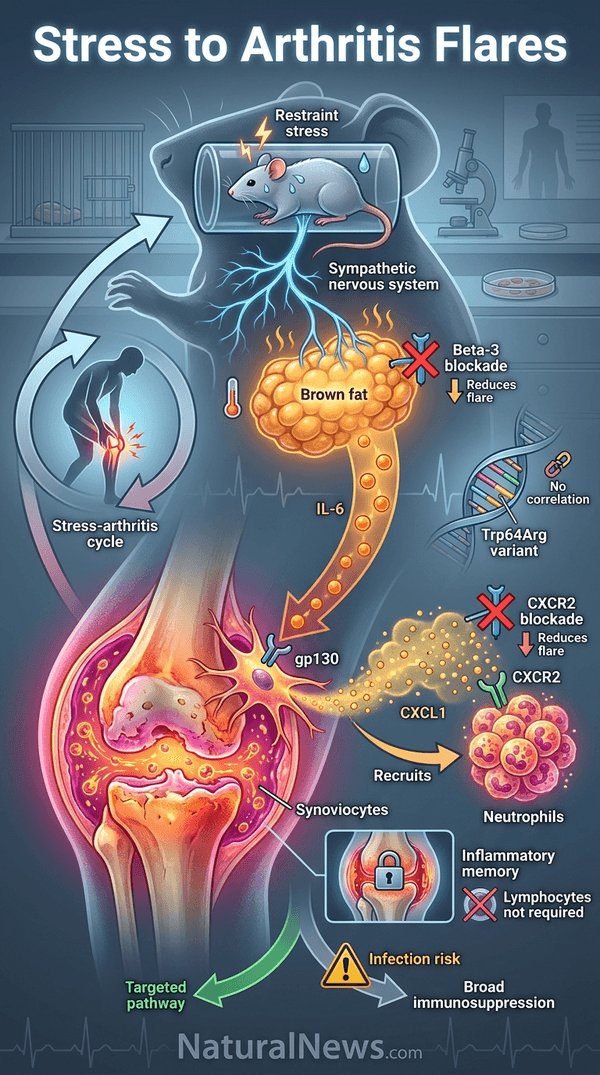
The experiments revealed a chain of events, researchers said. Stress activated the sympathetic nervous system and brown adipose tissue, a type of body fat involved in producing heat [1]. This activation caused the brown fat to release IL-6, an inflammatory signaling protein [1].
The researchers then identified which cells within the joint respond to the circulating IL-6 [1]. Their findings pointed to fibroblast-like synoviocytes, specialized cells found in the synovial tissue surrounding the joints [1].
IL-6 stimulated these cells to produce CXCL1, a chemokine that attracts neutrophils, a type of white blood cell involved in inflammation [1]. The resulting recruitment of neutrophils contributed to the reactivation of joint inflammation [1].
The study stated that fibroblast-like synoviocytes expressing the IL-6 receptor subunit gp130 were critical mediators, and that pharmacological blockade of the beta-3 adrenergic receptor significantly attenuated stress-induced arthritis flares [2]. Blocking the CXCR2 receptor, which responds to CXCL1, also significantly reduced stress-triggered inflammation, according to the university [1]. Findings suggested that arthritis may retain a form of tissue inflammatory memory that can be reactivated by stress independently of lymphocytes, according to Genetic Engineering & Biotechnology News [10].
The paper also reported that in patients with rheumatoid arthritis, carriers of the hypofunctional Trp64Arg variant of the ADRB3 gene showed no positive correlation between psychological stress and disease activity, whereas noncarriers did [2]. The authors described the human evidence as observational and noted that it does not by itself prove that the receptor is responsible for the difference [2][11].
Limitations and Implications
The experiments were conducted in mice, so researchers still need to confirm whether the same process occurs in humans, according to the study [3]. The study authors noted that experiments in animals do not necessarily mean that the same mechanism accounts for every episode of the disease [11]. Nearly one in three of the patients studied were carriers of the genetic variant, and the patient numbers sit in the paper's supplementary tables, according to a report on the findings [12].
The findings could eventually help scientists develop treatments that target stress-related inflammation more directly, researchers said [3]. The study suggested that targeting stress-responsive pathways may provide a complementary therapeutic strategy alongside current rheumatoid arthritis treatments without broadly suppressing systemic immunity [2]. A researcher from MedFitNetwork, Andrea W.M. Evers, PhD, examined the relationship between stress hormones and inflammatory cytokines and found that it played a main role in the amount of arthritis severity [13].
The study did not test whether stress-management techniques prevent arthritis flares, according to the report [3]. An article from Arthritis UK stated that long periods of stress can make inflammation and pain worse, which can worsen arthritis symptoms [14]. Research has also shown that increased tension in muscles can increase inflammation, which can worsen arthritis symptoms such as pain and joint damage, according to Arthritis Australia [15].
Takeaway
Further research is needed to confirm whether the pathway identified in mice applies to humans, according to the study authors [3].
The study's identification of a brown fat-IL-6-fibroblast axis that reactivates inflammatory memory in arthritis suggests a potential target for future therapies, according to the paper [2]. But the researchers cautioned that animal experiments do not necessarily translate to human disease, and that more work is needed to determine whether blocking this pathway could help patients [11].
References
- How Psychological Stress Triggers Arthritis Flares via an IL-6-Dependent Pathway | CHIBADAI NEXT. https://www.cn.chiba-u.jp/en/news/press-release_e261017/
- Fibroblast-like synoviocytes exacerbate autoimmune arthritis upon psychological stress in an IL-6–dependent manner | Science Advances. https://www.science.org/doi/10.1126/sciadv.aec9257
- Researchers Uncovered A New Connection Between Stress & Arthritis. https://www.mindbodygreen.com/articles/researchers-uncovered-surprising-reason-stress-may-worsen-arthritis
- New 6 Pronged Approach to Help Eliminate Auto - Mercola.com, August 27, 2022. Mercola.com
- Perceived stress and inflammatory arthritis: a prospective .... https://pmc.ncbi.nlm.nih.gov/articles/PMC7145743/
- Chronic stressors 'should be considered risk factors' for arthritis. https://www.healio.com/news/rheumatology/20201221/chronic-stressors-should-be-considered-risk-factors-for-arthritis
- Can Stress Cause Arthritis and Make It Worse? https://arthritiscare.com.au/can-stress-cause-arthritis/
- Autoimmune disease and stress: Is there a link? https://www.harvardhealth.org/blog/autoimmune-disease-and-stress-is-there-a-link-2018071114230
- How psychological stress triggers arthritis flares via an IL-6-dependent pathway. https://www.eurekalert.org/news-releases/1147153
- Psychological Stress Triggers Arthritis Flares in Mice via IL-6. https://www.genengnews.com/topics/translational-medicine/psychological-stress-triggers-arthritis-flares-in-mice-via-il-6-dependent-pathway/
- When Stress Triggers Inflammation: How Arthritis Can Flare Up Again. https://www.molecularmente.com/en/post/when-stress-triggers-inflammation-how-arthritis-can-flare-up-again
- Stress Wakes a Quiet Arthritic Joint Through Brown Fat. https://scholarpeer.com/stress-wakes-a-quiet-arthritic-joint-through-brown-fat/
- Stress and Arthritis – MedFitNetwork. https://medfitnetwork.org/public/all-mfn/stress-and-arthritis/
- Stress and arthritis: Managing stress levels. https://www.arthritis-uk.org/news/2024/january/stress-and-arthritis-why-it-s-important-to-manage-your-stress-levels/
- Stress and worry affect arthritis | Axial Spondyloarthritis (AS) support program | Arthritis Australia. https://myas.org.au/article/your-feelings-stress/stress-and-worry-affect-arthritis
Explainer Infographic











Please contact us for more information.


