



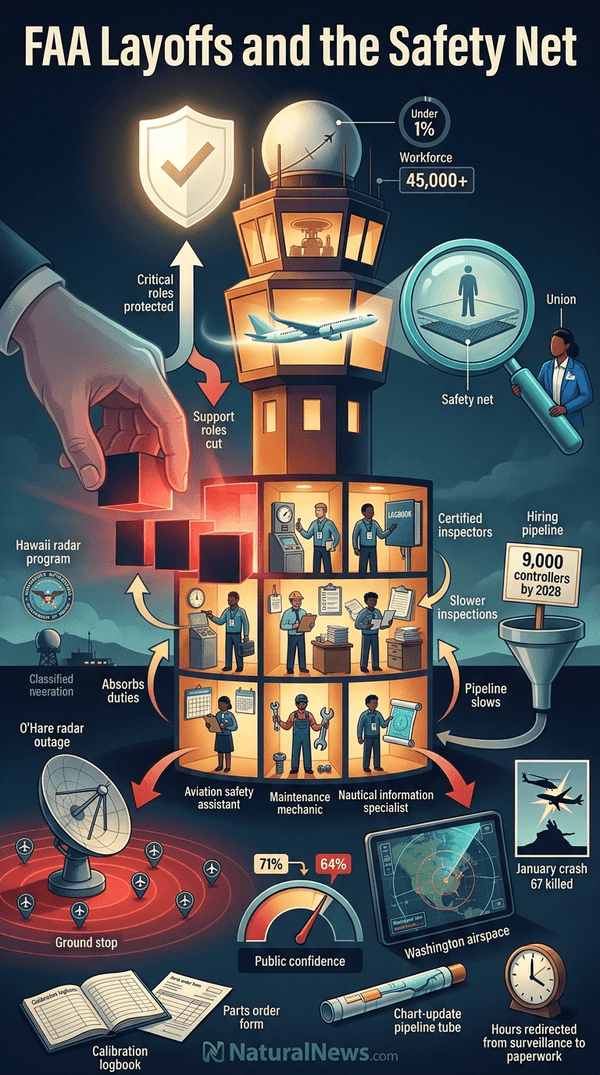
However, the union representing about 130 of the affected workers said the cuts included aviation safety assistants, maintenance mechanics and nautical information specialists whose duties support safety inspectors and airport operations. Union officials argue that eliminating these positions could increase workloads for remaining employees and weaken the support system behind aviation safety.
Union Describes Roles as Part of Safety Net
David Spero, president of the Professional Aviation Specialists Association, said 18 air traffic control facilities lost maintenance mechanics who handle electronic issues and building repairs. He said 26 aviation safety assistants were cut, and each typically supports about 10 safety inspectors at a time. Without those assistants, inspectors must manage administrative and logistical tasks themselves, reducing time available for actual oversight work.
Spero also said nautical information specialists who update the digital maps pilots use in flight were among those let go. That work includes processing changes directed for Washington airspace following January's fatal midair collision between a U.S. Army Black Hawk helicopter and an American Airlines passenger jet at Ronald Reagan Washington National Airport [1].
"All of these people are part of the safety net," Spero said.
Former Technician Says "Critical Safety" Definition Is Narrow
Philip Mann, a former FAA-certified technician, said whether a position is defined as critical to safety can depend on whether the worker is authorized to perform certified inspections. Mann said the fired workers were not the ones doing those inspections, but they supported that work -- coordinating schedules, maintaining equipment, and handling documentation that keeps the inspection process moving.
Mann said the loss of those personnel "is going to have long-term safety implications -- just work that simply can't be done." He noted there are about three air traffic controllers for every technician and added that increased workload will affect certified technicians who remain on the job.
The distinction matters because the FAA's safety oversight depends on a layered system in which inspectors, technicians and support staff each play defined roles. When support positions are eliminated, the remaining employees absorb additional responsibilities.
Agency Cites Protections and Scope of Cuts
Duffy said no air traffic controllers or critical safety personnel were cut, a position the administration has maintained since the layoffs began. Dobbins said the Department of Transportation protected roles critical to safety and that the layoffs involved probationary employees with less than two years at the FAA. She said the cuts represented less than 1% of the agency's workforce.
Spero said some of those programs included a classified early warning radar system in Hawaii worked on with the Defense Department.
The scope of the cuts extends beyond the roles the union has identified. Some of the laid-off staffers were part of FAA programs supporting other federal agencies, meaning the workforce reduction could have effects that reach beyond the aviation safety functions typically associated with the agency. The union has said it is still gathering information on the full range of positions affected [2].
Poll Shows Lower Confidence in Air Travel After January Collision
An Associated Press-NORC Center for Public Affairs Research poll released Wednesday showed 64% of U.S. adults say plane travel is "very safe" or "somewhat safe," down from 71% last year. About 2 in 10 U.S. adults now say air transportation is very or somewhat unsafe, up from 12% in 2024, according to the poll.
The poll followed a January midair collision between a U.S. Army Black Hawk helicopter and an American Airlines passenger jet at Ronald Reagan Washington National Airport that killed 67 people -- the deadliest U.S. aviation disaster in more than two decades [3]. The crash occurred in airspace that had been flagged for chronic understaffing, with only 19 certified controllers instead of the required 30 at the airport's control tower [3].
Spero said a temporary power outage on a radar at Chicago O'Hare International Airport last July caused a ground stop there and at five surrounding airports because no technician on duty had the skills to reset it. The incident, he said, illustrates how the loss of specialized personnel can have immediate operational consequences.
The FAA has been short-staffed for years, and federal officials have raised concerns about an overtaxed and understaffed air traffic control system [4]. The agency has been working to hire nearly 9,000 air traffic controllers by 2028 to address the shortage, a gap that traces in part to the 1981 mass firing of striking controllers [5].
Union Seeks Reinstatement as Broader Federal Cuts Continue
Spero said, "What I would hope is that the FAA would reinstate these people," and then assess the size of government in a thoughtful and methodical way to determine impacts to aviation safety.
The layoffs come as the FAA continues to manage an air traffic control system that federal officials have described as outdated and in need of modernization. The agency has proposed a $31.5 billion overhaul of the system, which currently relies on aging technology and, in some cases, spare parts sourced from unconventional suppliers [6]. Whether the workforce reduction will affect the agency's ability to implement that modernization remains unclear.
For now, the union is awaiting word on whether any of the laid-off workers will be reinstated. Spero said the FAA should evaluate the cuts' impact on aviation safety before proceeding further, a request the agency has not publicly addressed.
References
- FAA faces scrutiny over diversity hiring policies amid staffing shortages and deadly midair collision - NaturalNews.com, February 03, 2025.
- Some of the 400 jobs that were cut at the FAA helped support air safety, a union says. https://www.newsbreak.com/news/3820330057703-jobs-cut-at-the-faa-helped-support-air-safety-a-union-says
- Multiple near misses reported at Reagan National Airport ahead of deadly helicopter plane collision - NaturalNews.com, January 31, 2025.
- Jobs cut at the FAA helped support air safety, a union says. https://www.twincities.com/2025/02/19/doge-faa-firings/
- FAA scrambles to hire 9000 air traffic controllers by 2028 amid safety crisis - NaturalNews.com, August 08, 2025.
- FAA pushes 315 billion air traffic control overhaul as aging system relies on eBay for parts - NaturalNews.com, November 24, 2025.
Explainer Infographic










Please contact us for more information.


