



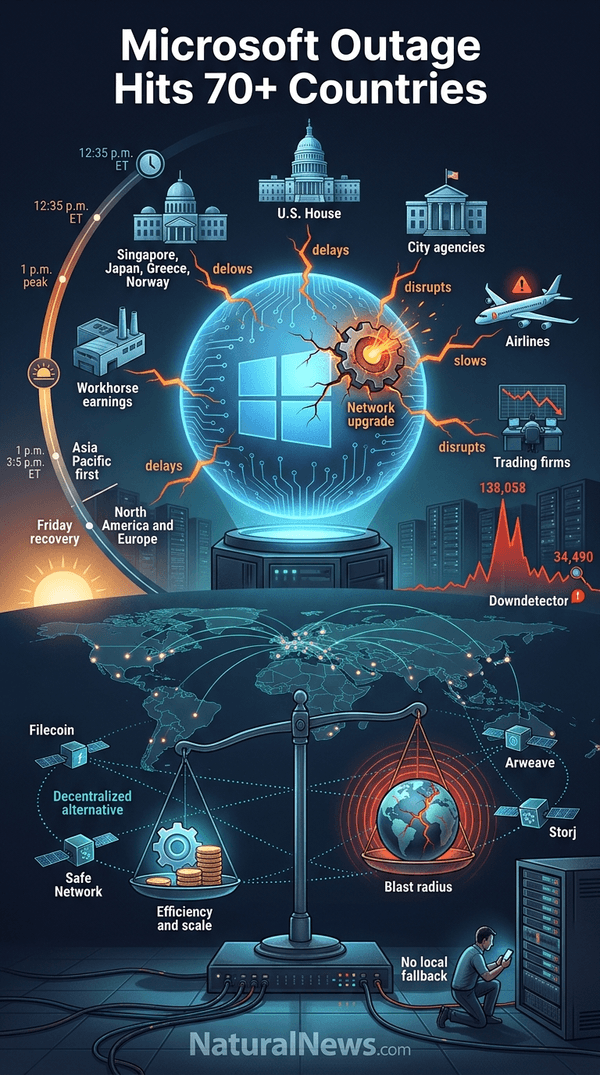
Reports of problems reached 74 countries and territories within about an hour, according to IBTimes [1]. Downdetector, which monitors service disruptions, recorded reports of Outlook problems peaking at 138,058 around 1 p.m. ET before falling to roughly 34,490 by evening [2].
Microsoft said parts of its infrastructure began recovering early Friday, Nov. 13, with service restored in the Asia Pacific region first, followed by North America and Europe.
Extent of Disruption: From Earnings Calls to Court Cases
The outage propagated through commercial and public operations alike. Workhorse Group Inc., an electric vehicle maker, pushed back its earnings call from Thursday to Monday, Nov. 16. Government agencies from Australia to Japan and the United States were affected, causing delays at trading firms, hindering some companies from publishing earnings and prompting airlines to warn customers of communication lags, according to public statements cited in press reports [3].
In North America, municipal governments including Austin, Texas, Jacksonville, Florida and Baltimore, Maryland, said they relied on Microsoft for email, though essential and emergency services were not affected. The U.S. House of Representatives was among the institutions reporting problems with Microsoft services [4].
Overseas, governments in Greece, Japan, Norway and Singapore said the outage affected some of their operations, including email communications for certain ministries or agencies [5].
Microsoft's Response: Patching and Restoration
Microsoft attributed the failure to an earlier capacity upgrade rather than to outside interference. "The incident was introduced by an issue during an earlier network capacity upgrade that surfaced following a recent network change," the company said.
By Friday afternoon, services were broadly recovering nearly 24 hours after issues began, and Microsoft said it was "deeply sorry" for the disruption while acknowledging it did not know when services would fully recover [6].
The company's status page indicated that infrastructure restoration work was still ongoing, meaning some users could still have trouble accessing Exchange Online and certain Microsoft products that interact with it.
Reliance on Cloud Services Raises Questions
The disruption drew attention to how much routine commerce and public administration now runs through a handful of cloud providers. Education Week reported that the outage highlighted the risks of depending on a single tech provider for essential services, plunging business chatter and everyday services into disarray worldwide [7].
The BBC reported that experts described the event as a "stark reminder" of how heavily the world relies on a small group of big tech providers [6].
The concentration is not new. Microsoft's own researchers have explored enterprise grid computing built on scavenged workstation capacity, illustrating how closely corporate infrastructure planning has tracked centralized compute models [8].
Analysts writing on decentralization have argued that distributed storage networks such as Arweave, Filecoin, Safe Network and Storj exist precisely to eliminate reliance on centralized data centers [9]. Critics of concentrated infrastructure have made similar points after earlier failures, including the 2025 Cloudflare crash that took major platforms offline for hours [10].
Microsoft has not commented on such concerns.
Reuters reported that the global disruption of Outlook and Teams was easing on Friday, Nov. 13, after more than 24 hours of disruption crippled online communications [11].
References
- Microsoft Outage Disrupts Work Across The Globe. Nearly 20,000 Problems .... https://www.ibtimes.com/microsoft-outage-disrupts-outlook-teams-worldwide-3809709
- Microsoft Outage Drags on for Hours, Disrupting Outlook, Teams for Thousands. https://www.ntd.com/microsoft-outage-drags-on-for-hours-disrupting-outlook-teams-for-thousands_1185062.html
- Hours-long Microsoft outage disrupts businesses, governments globally. https://www.geo.tv/latest/690955-hours-long-microsoft-outage-disrupts-businesses-governments-globally
- Microsoft scrambles to fix global outage affecting Teams and Outlook. https://www.theguardian.com/technology/2026/nov/13/microsoft-outage-outlook-teams-word-excel-reports
- Global Microsoft outage hits companies and governments. https://apnews.com/article/microsoft-outage-outlook-email-365-status-down-d92547a821930290db2964388016979a
- Microsoft 'deeply sorry' for global outage as it reports broad recovery. https://bbc.com/news/articles/c6rrg51rkz09o
- Microsoft Outage Shows Risks of Relying on a Single Tech Provider for .... https://www.edweek.org/technology/microsoft-outage-shows-risks-of-relying-on-a-single-tech-provider-for-essential-services/2026/11
- Cyclotron: a secure, isolated, virtual cycle-scavenging grid in the enterprise. Concurrency and Computation: Practice and Experience 2010; 22:241–260
- The Age of Decentralization. Sam Ghosh And Subhasis Gorai
- Cloudflare crash exposes terrifying vulnerability of the modern internet. https://www.naturalnews.com/2025-11-19-cloudflare-crash-vulnerability-modern-internet.html
- Microsoft Outlook, Teams outage eases after over a day. https://www.reuters.com/technology/microsoft-365-outlook-down-thousands-us-users-downdetector-shows-2026-11-12/
- Massive Microsoft outage disrupts businesses, government agencies worldwide. https://siliconangle.com/2026/11/13/massive-microsoft-outage-disrupts-businesses-government-agencies-worldwide/
Explainer Infographic








Please contact us for more information.


