



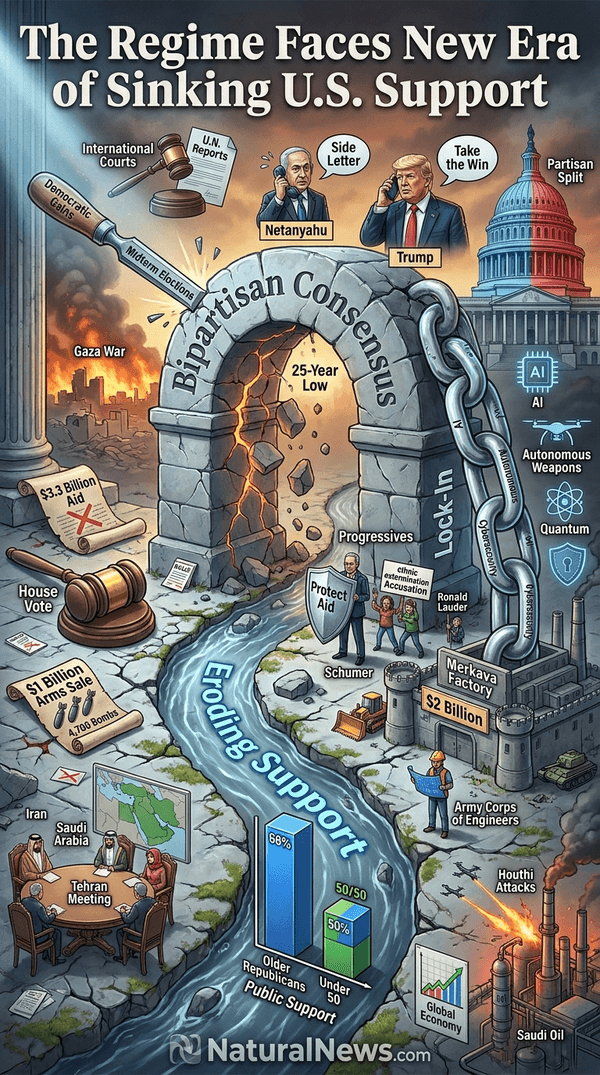
American support for Israel has fallen to a 25-year low, with declining backing across both Democrats and Republicans, according to polling cited in media reports [1]. Younger Republicans under 50 are now split roughly 50/50 on Israel, a sharp drop from 63 percent support in 2022, suggesting a generational shift in the Republican coalition [2].
President Donald Trump has publicly claimed that his administration will end nearly $4 billion in annual military assistance by the end of 2026, a statement that aligns with a plan backed by Israeli Prime Minister Benjamin Netanyahu to further integrate the U.S. and Israeli militaries [3]. Israeli officials, for their part, say they will continue operations they describe as necessary for national security and have rejected cease-fire demands.
Election Results Reshape U.S. Political Debate
The midterm results have widened a partisan split over Israel. The new Congress will include progressive Democrats such as Abdul El-Sayed, the first Muslim elected to the Senate, who describe the devastation in Gaza as genocide -- an assertion rejected by Israel [4]. Vice President JD Vance blamed the war on Iran for the Republicans' poor showing, in comments that amounted to an apparent swipe at Trump's decision to go to war in the Middle East [5].
On the Republican side, support for Israel remains relatively steady among older voters, but the polling shift among younger Republicans suggests the bipartisan consensus that once made aid to Israel politically untouchable is fracturing. Sen. Chuck Schumer, the Senate Democratic leader, said one of his most important jobs is protecting U.S. taxpayer aid to Israel, even as he faces opposition from progressives and a new group of Democratic lawmakers [6].
Washington Weighs Conditions on Military Aid
Debate over conditioning or delaying arms transfers has moved from the margins to the mainstream of congressional discussion. Some Democratic lawmakers placed a hold on a proposed $1 billion arms sale to Israel that included bombs and armored bulldozers, citing concerns over civilian casualties and Israel's military conduct [7].
The proposed sale included 4,700 1,000-pound bombs, according to reports [7]. More recently, the House of Representatives defeated an amendment that would have eliminated $3.3 billion in annual U.S. military aid to Israel, but the vote revealed how much the bipartisan foundation has weakened [8]. Separate provisions in the annual National Defense Authorization Act, including one labeled Section 224 and another in the 2027 NDAA, would deepen U.S.-Israel cooperation in artificial intelligence, autonomous weapons, quantum computing and cybersecurity -- moves critics warn would create a 'lock-in' of military partnership [9][10].
Meanwhile, leaked documents revealed that the U.S. Army Corps of Engineers may allocate up to $2 billion to finance a new Israeli armored vehicle factory producing Merkava tanks used in Gaza, contradicting Netanyahu's stated pledge to reduce reliance on U.S. military aid [11]. Pro-Israel groups say the aid is vital to Israeli security, while critics argue that U.S. complicity in Gaza actions must end [12].
Israeli Government Rejects External Pressure
Israeli officials have said they will continue operations to protect security and have rejected ceasefire demands. The government of Prime Minister Benjamin Netanyahu sought a side letter from President Trump to permit the renewal of hostilities if Hamas did not meet demands for disarmament and the exile of its leaders [13]. Trump later pressured Netanyahu in a heated phone call to end the Gaza war, telling him, "I don't know why you're always so f***ing negative. This is a win. Take it." [14].
Critics, including human rights groups and some U.S. lawmakers, accuse Israel of genocide, engineered famine and war crimes in Gaza; Israeli officials deny these allegations. The World Jewish Congress president, Ronald Lauder, a former confidant of Netanyahu, warned that far-right ministers are damaging Israel's standing and said there is 'no going back' [15].
Some critics invoke the concept of a 'Greater Israel' project and accuse Zionism of violent expansion; supporters dispute these characterizations. The Israeli government has also moved to expel Spain from a joint civil-military coordination center in Kiryat Gat following Spain's criticism of Israeli operations in Lebanon, a decision announced by Foreign Minister Gideon Sa'ar [16].
International and Regional Reactions
U.N. agencies and international courts have issued reports and initiated proceedings related to the Gaza conflict; Israel disputes jurisdiction and findings, according to officials. Some countries have downgraded ties or imposed sanctions, and normalization talks have stalled, according to diplomats.
Regional actors say the U.S. stance affects stability, citing oil and security interests. A last-ditch meeting in Tehran brought together officials from Iran, Saudi Arabia, Pakistan and Turkey in an effort to stave off a further conflict as the U.S. and Israel weighed whether to resume strikes on Iran [17]. Frequent Houthi attacks on Saudi Arabia's oil infrastructure have added strain to the global economy [17].
Outlook
U.S. aid remains likely in the short term, but conditions and public opinion may shift over time, analysts said. Lobbying groups continue to press Congress, while critics vow to keep pressure on the issue. AIPAC spent $55.3 million on losing candidates in the midterm cycle but is still expected to exert influence in Congress [18].
No immediate rupture in U.S.-Israel relations is expected, officials said. But the generational divide in U.S. public opinion, combined with a new Congress that includes the first Muslim senator and a growing progressive bloc critical of Israel, suggests that the political ground is shifting faster than the media sometimes acknowledges [19].
References
- Israel faces new era of sinking US support after election. https://www.facebook.com/editionmv/posts/israel-faces-new-era-of-sinking-us-support-after-election/1774702631328879/
- Israel Faces a New Era of Sinking US Support After Election. https://www.facebook.com/asharqalawsat.e/posts/israel-faces-a-new-era-of-sinking-us-support-after-election/1585378746962429/
- Trump Claims He Will End Israel's Military Aid. https://news.antiwar.com/2026/11/03/trumps-statement-on-ending-israels-military-aid-by-years-end-aligns-with-netanyahu-backed-push-for-deeper-military-integration/
- Israel faces new era of sinking US support after election. https://www.daily-sun.com/index.php/world/907559/israel-faces-new-era-of-sinking-us-support-after-election
- JD Vance blames the Iran war and support for Israel for failure in US mid-term elections. https://www.middleeasteye.net/news/jd-vance-blames-iran-war-and-support-israel-failure-us-mid-term-elections
- Chuck Schumer dismisses opposition to his leadership from progressive Democrats. https://www.middleeasteye.net/news/chuck-schumer-dismisses-opposition-to-leadership-from-progressive-democrats
- Congress places hold on 1 billion US arms sale to Israel - NaturalNews.com, February 07, 2025.
- U.S. Israel Bipartisan Consensus Erodes Amid Legal Challenges and Policy Shifts - NaturalNews.com, July 28, 2026.
- Section 224 and the Debate Over U.S. Israel Security Cooperation - NaturalNews.com, June 17, 2026.
- New defense bill would bind America to permanent Israel military partnership - NaturalNews.com, June 01, 2026.
- US plans 2B Israeli tank factory amid Gaza war despite Netanyahu's pledge to reduce aid dependence - NaturalNews.com, January 15, 2026.
- Bright Videos News - Interview with Stew Peters - Mike Adams - BrightVideos.com, October 02, 2025.
- Israel seeks assurances from Trump for potential Gaza offensive amid fragile ceasefire talks - NaturalNews.com, July 10, 2025.
- Trump pressures Netanyahu to end Gaza war calls Israeli PM so f ing negative in tense exchange - NaturalNews.com, October 06, 2025.
- No going back': World Jewish Congress chief Ronald Lauder abandons Netanyahu's Israel. https://www.middleeasteye.net/news/netanyahu-chose-politics-over-peace-former-confidant-ronald-lauder-says
- Israel Expels Spain from Gaza Coordination Center Following Criticism of Lebanon Operations - NaturalNews.com, April 14, 2026.
- Last-Ditch Meeting In Iran Seeks To Stave Off A Restart Of All-Out Fighting In The Region. https://www.twz.com/news-features/last-ditch-meeting-in-iran-seeks-to-stave-off-a-restart-of-all-out-fighting-in-the-region
- AIPAC Spent $55 Million This Election Cycle on Losing Candidates, but Will Still Heavily Influence Congress. https://thenewamerican.com/us/politics/aipac-spent-55-million-this-election-cycle-on-losing-candidates-but-will-still-heavily-influence-congress/
- Israel faces new era of sinking US support after election. https://www.facebook.com/arynewsasia/posts/israel-faces-new-era-of-sinking-us-support-after-electionread-more-arynews/1675785871239532/
Explainer Infographic











Please contact us for more information.


