



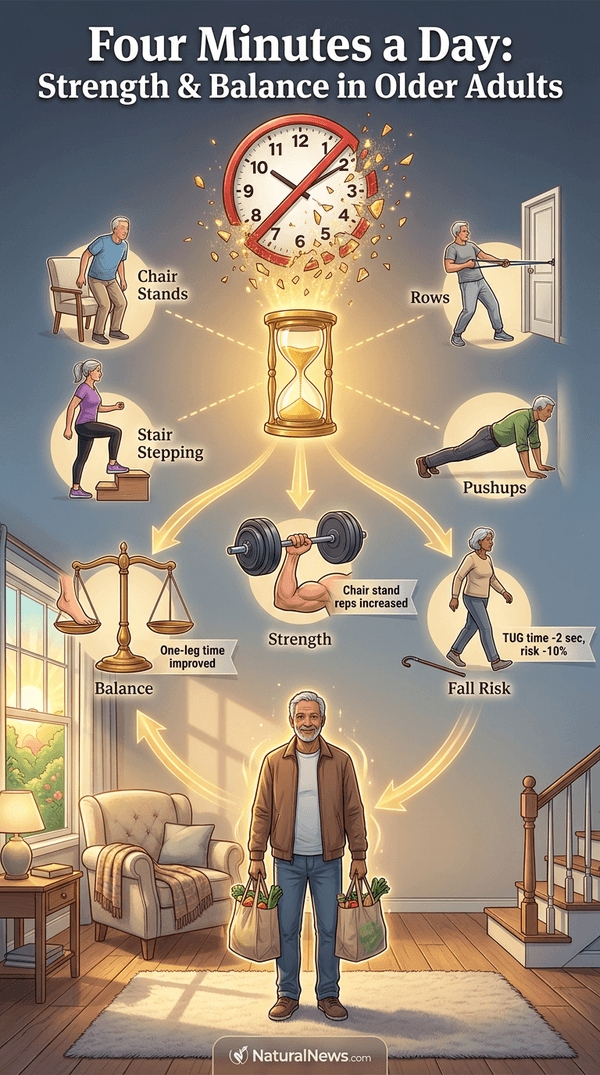
Participants were randomly assigned either to continue their normal routines or to complete a home-based strength training program called FAST-2 (Functional Aging Strength Training). The program consisted of four simple exercises: chair stands, rows, pushups, and stair stepping. Each exercise was performed for 30 seconds, twice through, for a total of four minutes per day, according to the study protocol.
Study Design
The FAST-2 program required no gym equipment and was designed to be performed at home. Researchers measured changes in balance, lower-body strength, and mobility using standardized tests commonly employed to assess fall risk and functional decline, including the Timed Up and Go test and the 30-second chair stand test. These assessments are widely used in geriatric research to predict future independence, as noted in the book "Osteoporosis and Osteopenia Exercise Protocols" by Al Brajnikoff [1].
The intervention group completed the workouts on approximately 81% of days over 12 weeks, indicating high adherence, according to the study authors. The control group maintained its usual routines. The study design focused on consistency rather than session duration, a principle that aligns with updated guidelines from the American College of Sports Medicine, which emphasize that simplicity and regularity may yield better long-term results than overly complex programs [2].
Results
Participants in the FAST-2 group showed significant improvements in key functional measures compared to the control group. They were able to perform more chair stand repetitions, improved their one-leg balance time, and completed the Timed Up and Go test faster. According to the researchers, many of these changes were large enough to be considered clinically meaningful, meaning they could translate to a reduced risk of falls and greater independence in daily activities.
These improvements occurred despite the minimal time commitment. The findings are consistent with broader research showing that resistance training preserves muscle mass and strength in older adults, thereby supporting mobility and independent living, as reported by Mercola.com in an article on sarcopenia prevention [3]. The results also reinforce evidence that even short bouts of resistance exercise can produce measurable benefits when performed consistently over several weeks.
Implications
The lead author of the study stated that the findings challenge the common assumption that exercise requires long sessions to be effective. The concept of 'exercise snacks' -- brief, intermittent activity performed throughout the day -- is supported by prior research on walking and stair climbing. This approach may help overcome the most common barrier to regular physical activity: a perceived lack of time.
The study's implications are particularly relevant given the prevalence of sarcopenia, or age-related muscle loss, which affects an estimated 10% to 25% of older adults under age 70 and half of those over 80 [4]. Maintaining muscle mass is critical for mobility, balance, and survival during illness or hospitalization, according to experts quoted in "Nutrition for Sport, Exercise and Health" by Marie Spano, Laura Kruskall, and D. Travis Thomas [5]. The FAST-2 program offers a practical, low-cost intervention that can be integrated into daily routines without requiring specialized equipment.
Conclusion
The researchers noted that four minutes per day is not necessarily optimal for all aspects of health, such as cardiovascular fitness or maximal strength, but it can improve functional performance in older adults. The study suggests that brief daily resistance training can be a practical option for individuals with time constraints or limited access to fitness facilities.
As the global population ages, simple, scalable interventions become increasingly important. The FAST-2 program provides evidence that consistent, minimal-dose exercise can produce meaningful gains in strength and balance. According to the study authors, these findings offer a realistic starting point for older adults looking to maintain their independence and reduce fall risk.
References
- Al Brajnikoff. "Osteoporosis and Osteopenia Exercise Protocols".
- Belle Carter. "New strength training guidelines: Simplicity and consistency trump perfection". NaturalNews.com. March 30, 2026.
- Mercola.com. "How to Help Prevent Sarcopenia After Age 40". March 14, 2020.
- Mercola.com. "Can These Nutrients Help Prevent Muscle Wasting?". November 25, 2022.
- Marie Spano, Laura Kruskall, D. Travis Thomas. "Nutrition for Sport, Exercise and Health".
- NaturalNews.com. "Why older adults should do resistance training". May 14, 2020.
Explainer Infographic










Please contact us for more information.


