



Cairncross submitted his resignation Thursday morning, according to the outlet [1]. He reportedly does not wish to serve another two years in the role [2].
He has served in the Trump administration since the beginning of the president's second term. He spent much of Trump's first term as a senior advisor to then-Chiefs of Staff Reince Priebus and John Kelly before leaving in 2018.
Outages Began With Microsoft Outlook and FAA Systems
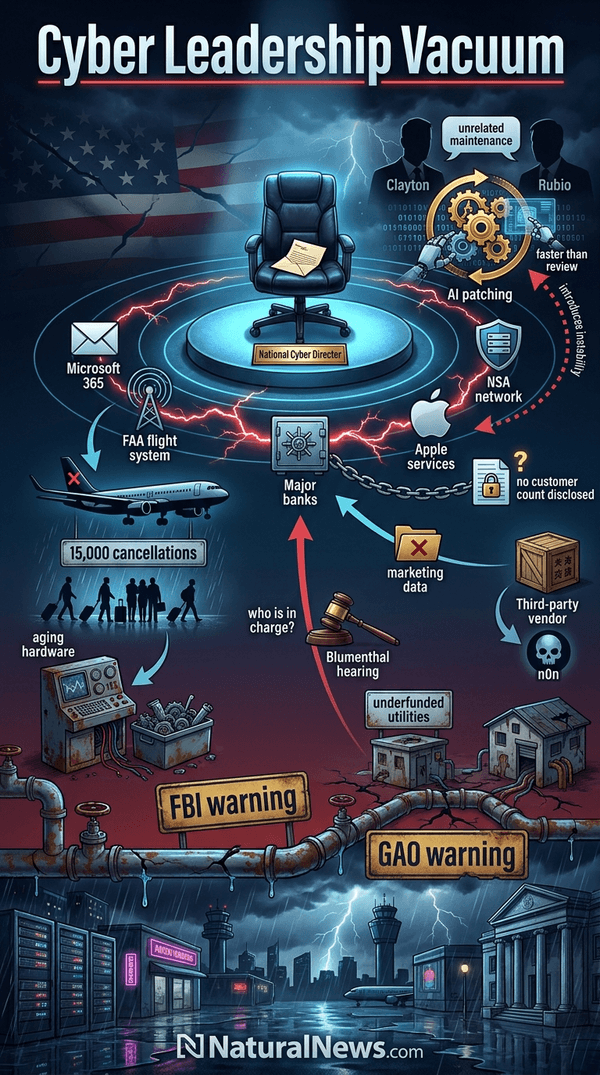
The massive ground stop led to more than 15,000 flight cancellations over two days, exposing vulnerabilities in the nation's critical infrastructure, The New American reported. Officials offered shifting explanations, blamed aging equipment, and sent mixed signals about the possibility of a cyberattack [3].
America's critical systems kept failing in rapid succession as officials repeated the same assurance that the incidents were not a coordinated cyberattack, according to Modernity News. Microsoft 365 went dark, the FAA ordered a rare nationwide ground stop, major banks locked out customers, Apple services glitched, and the NSA's classified internal network degraded. Director of National Intelligence Jay Clayton and Secretary of State Marco Rubio both said the incidents were unrelated maintenance and patching issues [4].
Chase, Visa and Mastercard Report Data Breach Tied to Third-Party Vendors
Visa said a third-party service provider in the Asia-Pacific region was impacted by the breach, but payment data and credit card numbers were not part of the information stolen. Cybersecurity firm SOCRadar stated that the attack was carried out by a group called n0n, which claimed responsibility for the breach on the dark web.
According to both Chase and JPMorgan, the hack targeted third-party vendors with access to the financial giant's marketing data. In a public statement, Chase claimed that the cyberattack was not tied to the ongoing global outages affecting banks, tech giants and federal agencies over the last week, and JPMorgan Chase added that there were no additional disruptions to the bank's services connected with this hack [5]. Bank officials did not provide details on how many customers may have been affected by the breach, the Daily Mail reported [5].
Officials and Experts Disagree on Cause of Widespread Failures
Officials in the Trump administration and some technology insiders have claimed that many of the outages stemmed from companies and federal agencies using artificial intelligence to quickly identify software issues and patch systems in real time.
The week's events also prompted renewed attention to longstanding warnings about infrastructure vulnerabilities; the FBI has warned of cyberattacks on water and wastewater utilities across multiple states, with some of that activity degrading water operations [6].
Resignation Adds to Leadership Turnover as Inquiries Continue
Senator Richard Blumenthal questioned a nominee on whether the country is safe from cyberattacks at a Senate confirmation hearing Thursday, The Independent reported [7]. The wave of outages has come as the federal government's cybersecurity posture faces scrutiny on multiple fronts, including a Government Accountability Office warning that foreign government-linked hackers and criminal groups are increasingly targeting American drinking water and wastewater systems, with many utilities remaining unprepared [8].
Conclusion
The resignation of Sean Cairncross as White House National Cyber Director marks the first departure linked to a week of technology failures that grounded flights, disrupted banking services and degraded government networks. The Office of the National Cyber Director thanked Cairncross for his service but did not specify why he was leaving, according to Firstpost [1].
The cause of the outages remains disputed.
As the administration prepares to name a replacement, the episode has drawn attention to longstanding questions about the security of critical infrastructure and the federal government's capacity to respond to cyber incidents [3][8].
References
- Sean Cairncross steps down as US National Cyber Director amid widespread tech outages. https://www.firstpost.com/world/united-states/sean-cairncross-steps-down-as-us-national-cyber-director-amid-tech-outages-report-14061366.html
- Trump's cyber chief Sean Cairncross to step down amid repeated tech outages. https://www.business-standard.com/amp/world-news/trump-s-cyber-chief-sean-cairncross-to-step-down-amid-repeated-tech-outages-126112000089_1.html
- FAA Ground Stop: Trump Administration Can’t Explain the Failure but Wants $50 Billion to Fix It. https://thenewamerican.com/us/faa-ground-stop-trump-administration-cant-explain-the-failure-but-wants-50-billion-to-fix-it/
- Do You Believe Them? https://modernity.news/2026/11/18/do-you-believe-them/
- Trump's national cyber director quits two years early after cyberattacks and outages wreaked havoc across America. https://www.dailymail.com/news/article-16307463/Trump-national-cyber-director-quits.html
- Officials: Hacks on U.S. Water Systems Follow Years of Warnings - NaturalNews.com, August 07, 2026.
- White House national cyber director Sean Cairncross fired after slew of tech outages, source says. https://www.the-independent.com/news/world/americas/cyber-director-sean-cairncross-quits-leaving-job-b3088339.html
- GAO Issues Warning: Hackers Are "Pre Positioning" in U.S. Water Networks - NaturalNews.com, June 03, 2026.
Explainer Infographic










Please contact us for more information.


