



Lawsuit Seeks Class Certification and Unspecified Damages
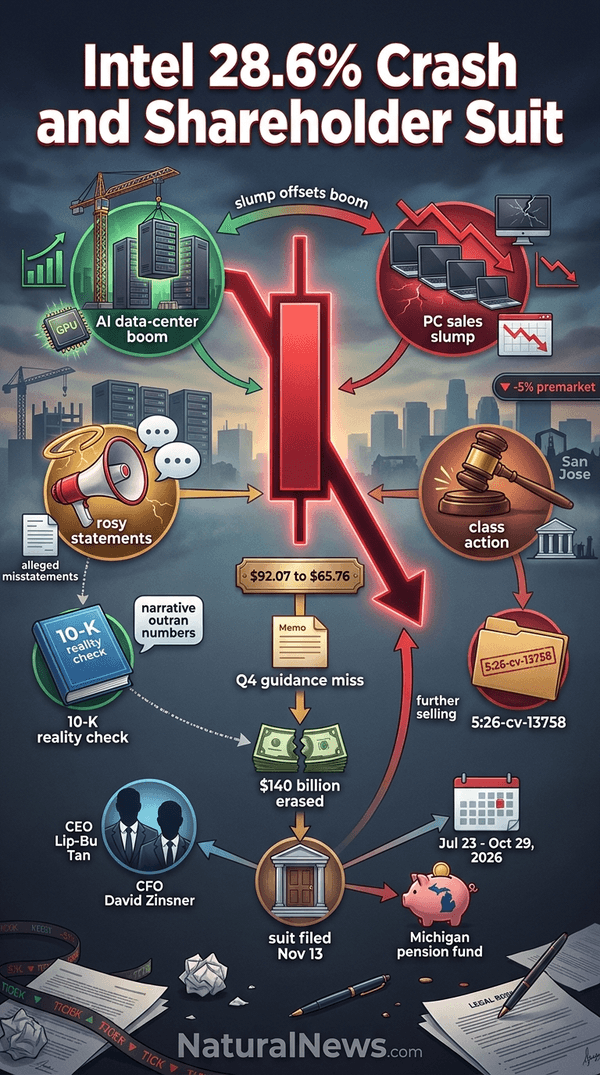
The complaint was filed in the U.S. District Court for the Northern District of California in San Jose, according to court records cited in the lawsuit. The case, identified as 5:26-cv-13758, seeks to represent those who purchased Intel common stock between July 23 and October 29, 2026, inclusive [2]. Reuters reported that a Michigan pension fund filed the proposed class action against Intel, CEO Lip-Bu Tan and CFO David Zinsner on November 13 in federal court in San Jose [3].
The defendants have not admitted wrongdoing.
Plaintiffs Allege Omissions on PC Slump, Component Prices and Substrate Constraints
The complaint alleges that positive impacts to Intel's business and financial results resulting from data center construction and other aspects of the AI boom were more than offset by the PC sales slump [4].
Investment advisors caution that when the media are full of stories about how well things are going for a company, people tend to assume that it is a guaranteed success, and typically that is when investors get hurt [5]. A fast, cost-effective way to find out what a company does and whether an investor would like to invest in it is to review the annual report (10-K), which discloses whether the company is making money, how it has done over the past five years, and whether sales are growing [6].
Earnings Report Preceded Record Single-Day Stock Decline
Intel issued weak fourth-quarter guidance on the 29th, and the stock plummeted 28.6% the following day, erasing roughly $140 billion in market value [7]. The next day, Intel shares fell 28.6%, closing at $65.76 after ending the previous session at $92.07 [8].
The complaint describes the move as the largest single-day decline in Intel common stock in more than 50 years [8]. Intel shares declined approximately 5% in premarket trading following the shareholder class-action lawsuit [9]. The market reaction reflected the impact of a deepening PC slump exposed by a weaker-than-expected sales forecast [10].
Case Seeks Damages as Intel Has Not Publicly Responded
The lawsuit seeks class-action status for shareholders who purchased Intel common stock between July 23 and October 29, 2026 [2].
Some legal observers note that many stock investments can become instruments for filing lawsuits, with some plaintiffs buying stocks knowing that a law firm may eventually sue the companies [11]. A veteran investment advisor has written that after a long period of bad news, when more bad news no longer lowers the price, that could be an opportunity for buyers, while warning that coming down from very high to high feels like a big drop but may not be enough to constitute a bargain [12].
Conclusion: Class Action Highlights Disclosure Risks in a Volatile Semiconductor Market
The Intel lawsuit is part of a broader pattern of shareholder litigation against major technology companies following significant stock price declines. Shareholders of other companies have also sued their boards over various issues, with lawsuits led by pension funds accusing management of putting profits ahead of compliance and safety [13].
References
- Intel sued by shareholders following 29% stock plunge. https://www.reuters.com/business/intel-sued-by-shareholders-following-29-stock-plunge-2026-11-15/
- Intel lost USD 140 billion in one day and its shareholders sued the company for alleged deception | La Derecha Diario en Inglés. https://derechadiario.com.ar/us/argentina/shareholders-demand-intel-after-plunge-28-6-papers-for-crisis-pc
- Intel is sued by shareholders after a 29% stock plunge | MLQ.ai. https://mlq.ai/news/intel-is-sued-by-shareholders-after-a-29-stock-plunge/
- Shareholders sue Intel, its CEO, and CFO after stock drops 28.6 percent in one day - Ars Technica. https://arstechnica.com/tech-policy/2026/11/shareholders-sue-intel-its-ceo-and-cfo-after-stock-drops-28-6-percent-in-one-day/
- Saving, Spending, Investing, Giving: A Veteran Investment Advisor Reflects on Money. macOS Version 10.14.6 (Build 18G1012) Quartz PDFContext
- 101 investment lessons from the wizards of Wall Street. Michael Sincere
- Intel Hit With Shareholder Class Action Over Alleged Concealment of PC Slump; Market Cap Wipes Out approximately $140 Billion in a Single Day — BigGo Finance. 2026-11-16T11:28:59Z. https://finance.biggo.com/news/c2081bcb-00ba-4375-8235-dedf10f13ae7
- Shareholders Sue Intel, CEO And CFO After 28.6 Percent Stock Plunge. https://vinnews.com/2026/11/16/shareholders-sue-intel-ceo-and-cfo-after-28-6-percent-stock-plunge/
- Intel Drops Over 5% Pre-Market as Company, CEO and .... https://www.tradingkey.com/analysis/stocks/us-stocks/262307101-intel-drops-over-5-premarket-company-ceo-cfo-shareholder-class-action-lawsuit-tradingkey
- Shareholders sue Intel after its shares plunge nearly 29%. https://www.euronews.com/2026/11/16/shareholders-sue-intel-after-its-shares-plunge-nearly-29
- Circle of Greed. by Patrick Dillon
- Saving Spending Investing Giving. macOS Version 10146 Build 18G1012 Quartz PDFContext
- Shareholders sue Uber’s board over sexual assaults, other incidents. https://techcrunch.com/2026/06/22/shareholders-sue-ubers-board-over-sexual-assaults-other-incidents/
Explainer Infographic










Please contact us for more information.


