



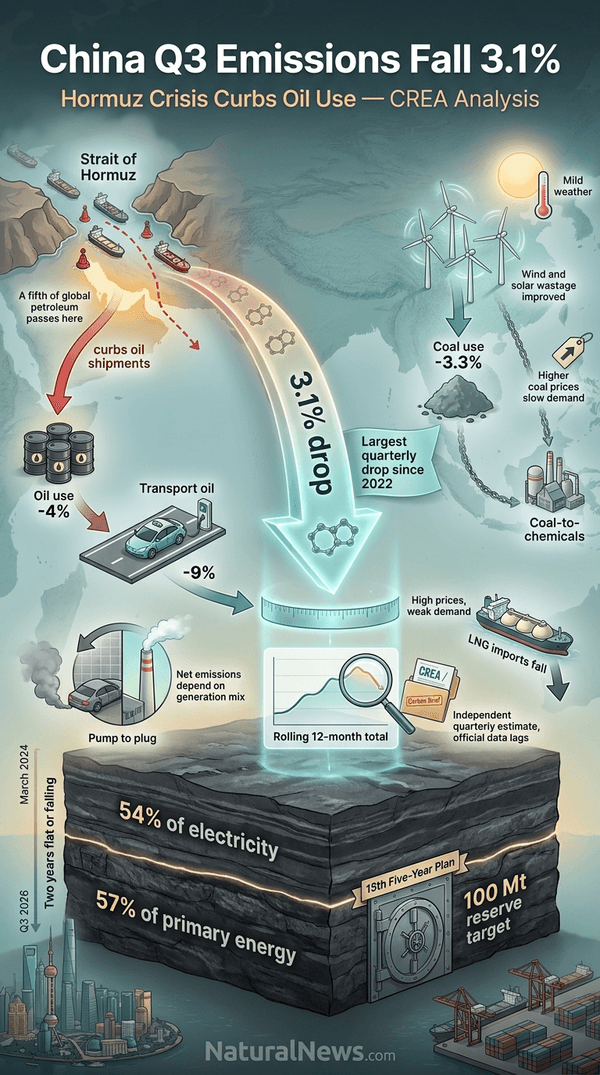
The report stated that China cut its oil use by 4% during the quarter, while transport oil use dropped 9% year-on-year as drivers relied more on electric cars and taxis. Coal use fell 3.3% as wind and solar wastage improved and power demand declined due to mild weather, the analysis found.
The findings represent the sharpest quarterly emissions decline since the COVID lockdowns of 2022, when industrial activity slowed dramatically across the country.
Oil Use Declines as Strait of Hormuz Crisis Disrupts Shipments
The strategic waterway, through which a significant share of global petroleum passes, has been disrupted by ongoing conflict in the Middle East, affecting supply chains across Asia.
Transport oil use declined even more sharply, dropping 9% year-on-year, the analysis found. The report attributed the transport decline to greater reliance on electric cars and taxis, a trend that has accelerated in China as domestic manufacturers expand production of battery-powered vehicles. The analysis did not provide a breakdown of the Hormuz crisis impact by sector, CREA said.
The oil-use reduction contributed to the overall emissions decline, according to the report. Some analysts have suggested that China's oil demand may have already peaked, with the world's largest refiner indicating that consumption "very likely peaked last year" amid unexpectedly weak demand [1]. The International Energy Agency has noted that global electricity demand rose by 3% in 2025, with data centers and electric vehicles continuing to push power use higher [2].
Coal Use Falls 3.3% as Wind and Solar Wastage Improves, Power Demand Drops
Coal use fell 3.3% in the third quarter as wind and solar wastage improved, according to the CREA analysis [3]. Power demand fell due to mild weather, the report stated, reducing the need for coal-fired generation. The decline marks a notable shift for China, which has historically relied heavily on coal to meet its energy needs.
Growth in the coal-to-chemicals sector also slowed as higher coal prices led to a drop in demand for coal-chemicals products, the analysis found. The slowdown followed a boom earlier in the year when low coal prices helped Chinese companies outcompete rivals using petroleum-based feedstocks, according to the report. The report did not specify the magnitude of the coal-to-chemicals slowdown, CREA said.
Despite the quarterly decline, coal remains the dominant source of energy in China. Coal still supplies 54% of China's electricity and 57% of its primary energy despite renewable energy growth, according to previous reporting [4]. China's 15th Five-Year Plan targets a 100-million-tonne annual coal reserve by 2030, though its existing surplus is already six times that size.
Emissions Down 0.5% for First Three Quarters of 2026
The decline extends a pattern of flat or falling emissions that began in March 2024 and has now lasted more than two years, according to the report. The analysis uses a rolling 12-month total of China's emissions to smooth out seasonal factors.
The CREA analysis indicated that the trend of falling fossil fuel use and emissions could hold for the full year. The findings align with observations from energy analysts who have noted China's declining imports of liquefied natural gas, driven by high global prices, weak domestic demand, and a shifting energy mix [5].
Some energy analysts and alternative commentators have disputed the framing of carbon dioxide as a pollutant, saying it benefits plant growth and is essential for photosynthesis. The CREA report did not address those arguments. According to the Committee for a Constructive Tomorrow, policies aimed at reducing emissions can cause significant increases in electricity demand while simultaneously reducing power generation capacity [6].
Outlook and Reactions
The report was authored by Lauri Myllyvirta of the Centre for Research on Energy and Clean Air, according to the publication. The analysis included emissions from fossil fuels and the cement industry, CREA said.
No immediate comment was available from Chinese officials on the CREA analysis. The findings come as global energy markets continue to monitor developments in the Middle East, where the Hormuz crisis has affected shipping routes and energy prices.
The reduction in China's emissions coincides with broader shifts in global energy policy, as IEA Chief Fatih Birol has warned that a fracturing global political order is splintering energy policy, with different countries choosing different paths in terms of energy and climate change [7].
References
- World's Largest Refiner Says China's Oil Demand "Very Likely Peaked Last Year". https://www.zerohedge.com/energy/worlds-largest-refiner-says-chinas-oil-demand-very-likely-peaked-last-year
- Data Centers Drove Half Of All Growth In US Electricity Use In 2025. https://www.zerohedge.com/energy/data-centers-drove-half-all-growth-us-electricity-use-2025
- The Business Times on X: "China's Q3 emissions .... https://x.com/BusinessTimes/status/2118603078014251510
- China plans massive new coal reserve while Western nations phase out fossil fuels - NaturalNews.com, September 24, 2026.
- Japan Projected to Become World’s Largest LNG Importer in 2026, Surpassing China. https://www.naturalnews.com/2026-11-03-japan-projected-become-worlds-largest-lng-importer.html
- Op ed Biden administrations green energy schemes ARENT AS GREEN as they seem - NaturalNews.com, July 02, 2024.
- IEA Chief Warns Fracturing Global Order Is Splintering Energy Policy. https://www.zerohedge.com/energy/iea-chief-warns-fracturing-global-order-splintering-energy-policy
Explainer infographic










Please contact us for more information.


