



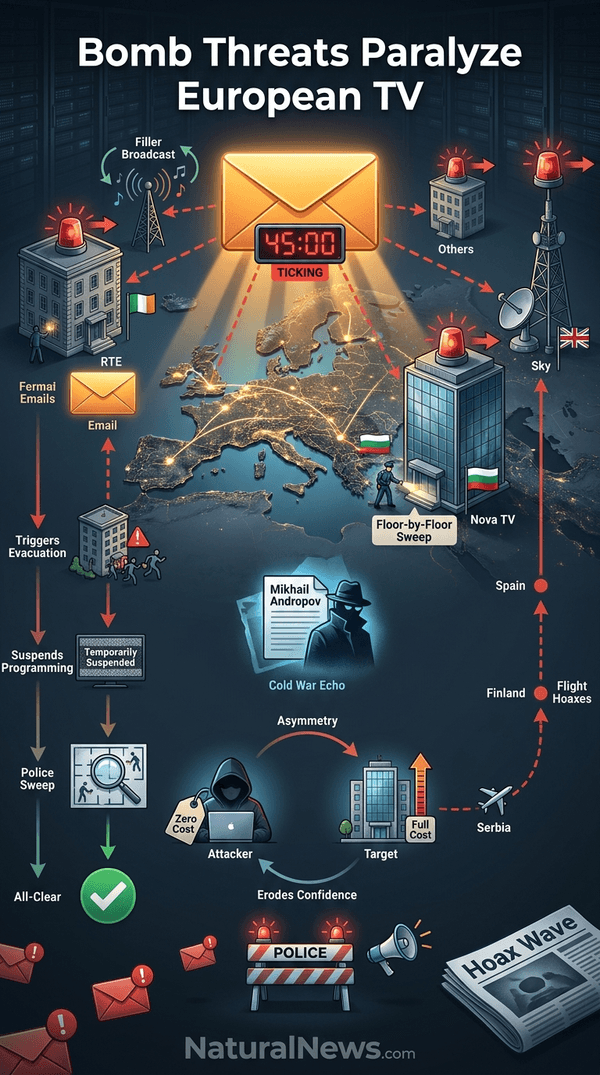
At RTE, programs were replaced by music and a pre-recorded message, some for as long as three hours, Reuters reported.
In Sofia, police came to the Nova newsroom, which was evacuated, checked and deemed safe, broadcasters said. The alerts follow a string of hoax bomb threats that has disrupted passenger flights from Serbia to Finland to Spain and beyond in recent days, forcing diversions, emergency landings and security sweeps, though no explosives have been found so far [3].
Emails Titled "Message to the West" Claim Explosive Device
One email received by Nova and RTE on Friday read: "We want the whole world to know about us, which is why one of our operatives has planted an explosive device in your building," according to Reuters. "It will detonate in 45 minutes. The clock is ticking."
The emails to RTE and Nova were signed with the name Mikhail Andropov, with a message saying the author was one of the leaders of a group responsible for this week's plane hoaxes. "But this is only the beginning. What happened this week is just a small part of what awaits Europe in the near future," the message added. The purported author shared a surname with Yuri Andropov, a former General Secretary of the Communist Party of the Soviet Union.
It is unclear who was behind Friday's hoaxes, officials said.
Broadcasters and Police Respond; No Explosives Found
RTE Director General Kevin Bakhurst said an email was sent to the network, as well as other Irish media companies, at around 8:33 a.m. After consulting with senior colleagues and the Irish police, the decision was made to evacuate the buildings. He added that the threat had caused "a lot of disruption," labeling it "a disgrace," according to The Epoch Times [4].
Staff returned to RTE's campus after police completed a more than three-hour sweep of the buildings.
The alerts follow a string of hoax bomb threats that has disrupted passenger flights from Serbia to Finland to Spain and beyond in recent days, forcing diversions, emergency landings and security sweeps, though no explosives have been found so far [3].
Irish Prime Minister Says Cause Undetermined, Urges Calm
Irish Prime Minister Micheal Martin said security agencies in Europe had not yet determined whether the threats to air travel and media organizations were being made by individuals or as part of a coordinated attack. "It just illustrates how relatively simple it can be to cause disruption and to undermine the normal operation of society through unconventional activities of this kind, which are designed to cause disruption, designed to cause fear and anxiety," Martin told RTE radio shortly after news programming went back on air from an outside broadcasting unit.
Such campaigns can be conducted with minimal resources yet achieve maximum disruption, security analysts noted.
The threats also come amid a growing sense of unease about hacking scams in recent weeks, including cyberattacks on supermarkets.
Investigations Continue Into Hoax Threat Campaign
It is unclear who was behind Friday's hoaxes, officials said. No bombs were found at any affected site, according to the companies and police. No group has claimed responsibility, and police have not announced arrests.
The wave of threats follows a pattern of false bomb scares across Europe in recent days, including a series of hoax threats that disrupted passenger flights from Serbia to Finland to Spain and beyond, forcing diversions, emergency landings and security sweeps, though no explosives have been found [3]. On Friday, multiple flights to and from Lisbon, Rome, Prague and Sofia were targeted and saw three planes escorted by Hungarian fighter jets, authorities said. A number of high-profile media organizations, including Ireland's public broadcaster RTE, were evacuated after threats were made against them, although no concrete links have been established between the messages against airlines and those against the media outlets [5].
Authorities in multiple European countries continue security sweeps and investigations. The alerts follow a string of hoax bomb threats that has disrupted passenger flights from Serbia to Finland to Spain and beyond in recent days, forcing diversions, emergency landings and security sweeps, though no explosives have been found so far [3].
References
- Bomb threats warning 'the clock is ticking' disrupt TV channels across .... 2026-11-06T20:06:46Z. https://www.reuters.com/world/bomb-threats-warning-the-clock-is-ticking-disrupt-tv-channels-across-europe-2026-11-06/
- Bomb threats warning 'the clock is ticking' disrupt TV channels across .... 2026-11-06T20:06:46Z. https://www.internazionale.it/ultime-notizie-reuters/2026/11/06/bomb-threats-warning-the-clock-is-ticking-disrupt-tv-channels-across-europe
- Bomb threats warning 'the clock is ticking' disrupt TV channels across .... https://www.cnbctv18.com/world/bomb-threats-warning-the-clock-is-ticking-disrupt-tv-channels-across-europe-20029277.htm
- European Media Outlets Hit by Bomb Threats as Hoaxes Continue Against Airlines. 2026-11-06T21:01:15.213Z. https://theepochtimes.com/world/european-media-outlets-hit-by-bomb-threats-as-hoaxes-continue-against-airlines-6120053
- New wave of bomb threats hit European airlines and media outlets. https://bbc.com/news/articles/cq62yy064vjpo
Explainer Infographic









Please contact us for more information.


