



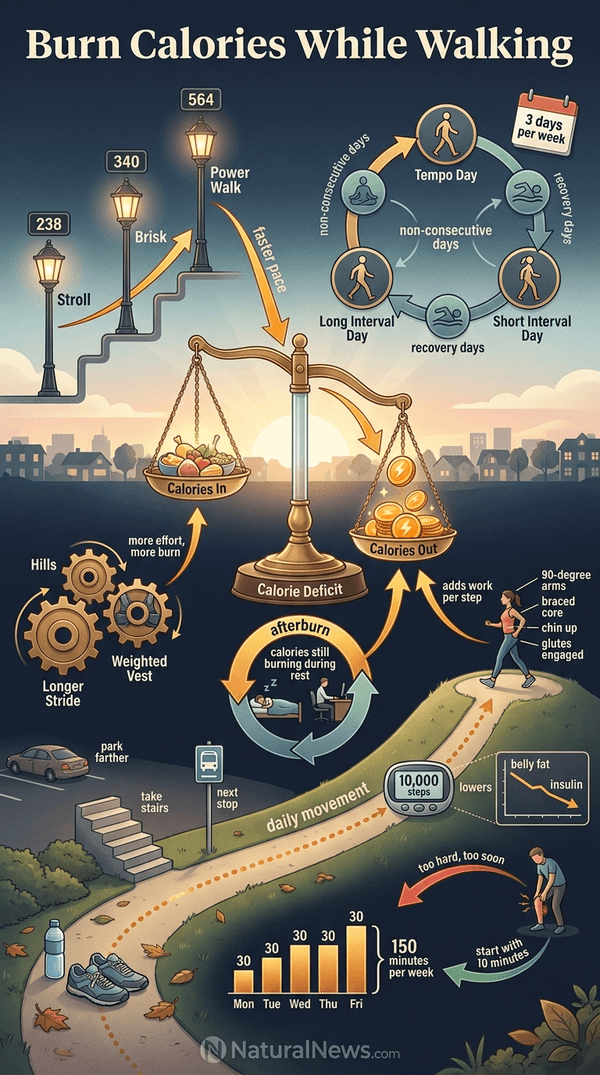
Tom Holland, an exercise physiologist and author of "Beat the Gym," provided pace guidelines in the report. A stroll burns about 238 calories per hour, a brisk walk up to 340 calories per hour and a power walk about 564 calories per hour, according to the report. The differences are driven by speed, body weight and effort, and the report cited the calorie figures as estimates rather than fixed targets.
The report recommended building toward 30-minute power walks on three days per week, with slower strides between spurts if needed. Weight loss occurs when the body burns more calories than it consumes, a principle that holds regardless of the activity chosen, and walking increases daily energy expenditure in a way that can move a person closer to that deficit, according to the report.
Three-Day Power-Walking Plan Uses Tempo and Interval Workouts
Holland designed a program in the report that mixes regular walking with interval routines to reach 30 minutes of power walking three times per week. The report advised walking on three non-consecutive days and resting or cross-training with power yoga or swimming on the other days.
The tempo day in the plan consists of a five-minute stroll warm-up, 30 minutes at power-walk intensity, and a three- to four-minute cool-down, according to the report. The long interval day consists of a five-minute warm-up, six intervals of five minutes of hard power walking and one minute of brisk recovery and a three- to five-minute cool-down. The short interval day consists of a five-minute warm-up, 15 intervals of two minutes of hard power walking and one minute of brisk recovery, and a three- to five-minute cool-down.
The interval structure draws on a broader principle that interval training can improve fitness and calorie expenditure while reducing total exercise time. Interval training can improve fitness and the body's ability to use oxygen, increase post-exercise fat burning and calorie expenditure even during rest or sleep, and allow a person to exercise for less time while achieving greater fitness and weight loss benefits, according to Mark Hyman in "Ultrametabolism." [4] The same source stated that interval training can naturally increase growth hormone levels, which promote fat burning and muscle building.
Increasing Intensity and Improving Form
Adding hills on a treadmill or in a neighborhood, going off-road for uneven terrain, and increasing stride length were among the intensity options described in the report. The report also described form cues: swinging arms with elbows bent at 90 degrees and hands in loose fists, keeping elbows tight to drive forward and build upper-body strength; activating the abs by pulling the belly button toward the spine; keeping the chin up and gaze about 10 feet ahead; and squeezing the glutes for propulsion.
Other sources describe comparable adjustments. Wearing a weighted vest and walking uphill can help increase the amount of calories a person burns, and walking at a brisk pace burns more calories than walking more slowly, according to Medical News Today [2].
Consistency is a recurring theme in the guidance. In Walking the Weight Off for Dummies, Erin Palinski-Wade wrote that the consistency that walking allows is what makes it such a powerful weight-loss tool, and that a daily calorie deficit is required to lose weight and keep it off [3]. She noted that on days when a person cannot talk themselves into a brisk power walk, they can still increase their daily activity.
For people who have been sedentary, starting slowly and building over time is the recommended approach. Hyman advised starting with no more than ten minutes of low-impact aerobic conditioning daily, which can be as simple as walking around the block, and increasing to fifteen or twenty minutes a day the following week [4].
Transitioning to Running and Adding Daily Walking
Running newbies can do a modified short-interval day three times weekly, running one to two minutes and walking one minute for 15 intervals, according to the report. After several weeks, the report stated, they can move to the long-interval day with five-minute runs and one-minute walks for six intervals. Experienced runners can substitute running for power walks in the long-interval day, and regular gym-goers can cross-train on an elliptical, rowing machine or stationary bike, the report stated.
The report also listed ways to increase daily walking: parking farther away, planning activity breaks, walking to the next bus stop, taking stairs instead of an elevator, and walking to work or on errands. Tracking can support these habits. Kellyann Petrucci wrote in The 10-Day Belly Slimdown that tracking steps with a pedometer or step-tracking app can help a person reach at least ten thousand steps per day, that walking in place while watching shows is one way to multitask, and that every mile racked up burns calories and lowers insulin levels, taking off belly fat [5].
The case for cumulative movement is supported by the broader literature. The report's daily-activity recommendations are consistent with walking guidance that emphasizes frequency and total volume rather than single sessions.
Reported Benefits of Regular Walking
Walking can reduce abdominal fat, a risk factor for type 2 diabetes and heart disease, according to the report. Power walking is easier on the joints than running, and other benefits listed in the report include boosting bone strength, reducing osteoporosis risk, helping thinking, improving sleep, preventing weight gain, supporting emotional well-being, and reducing depression risk.
That source also stated that walking at least five times per week for 30 minutes per session reaches the recommended guideline of 150 minutes of moderate-intensity physical activity per week.
Walking also fits into a gradual, low-impact approach that some practitioners recommend over high-intensity extremes. In Ten Years Younger, Dr. Steven Masley wrote that the program is designed to help even the most deconditioned participants start rebuilding lean muscle mass gradually enough not to cause injury, and that gentle consistency does the trick, while weekend warriors who push themselves to complete exhaustion once or twice a week deplete their antioxidant defense systems and consequently get sick more often [6]. The report focused on walking pace, frequency, form and daily activity rather than pharmaceutical interventions.
Conclusion
The report's five tips center on measurable variables: pace, frequency, form, intensity, and daily movement. Holland's calorie estimates – about 238 calories per hour for a stroll, up to 340 for a brisk walk, and about 564 for a power walk – give walkers a way to compare effort levels, and the three-day power-walking plan provides a structure that mixes tempo work with long and short intervals.
The guidance repeatedly returns to fundamentals that require no prescription: walk on non-consecutive days, add hills or uneven terrain, improve arm and core mechanics, and accumulate steps through routine choices such as parking farther away or taking stairs.
References
- Walking for Weight Loss: 5 Tips To Burn Calories. Health.com. https://www.health.com/weight-loss/how-to-walk-off-10-pounds
- Walking for weight loss: 8 tips to burn fat - Medical News Today. https://www.medicalnewstoday.com/articles/325809
- Walking the weight off for dummies by Palinski-Wade Erin author
- Ultrametabolism the simple plan for automatic weight loss awakening the fat-burning DNA hidden in your body by Hyman Mark 1959
- The 10-day belly slimdown lose your belly heal your gut enjoy a lighter younger you by Petrucci Kellyann author
- Ten Years Younger The Amazing Ten Week Plan to Look Better Feel Better and Turn Back the Clock by Dr Steven Masley
Explainer Infographic











Please contact us for more information.


