


Study Reports Widespread Molecular Changes During Seven-Day Fast
Researchers from Queen Mary University of London and the Norwegian School of Sports Sciences found that a seven-day water-only fast produced significant, systematic changes across multiple organs in the human body, with many of the most notable effects appearing only after about three days without calories.
About one third of all the proteins measured changed significantly during the fasting period, with effects linked to all major organs, the study stated. The pattern suggested a coordinated whole-body response rather than simply a change in how the body obtained energy, researchers said.
The findings offer an unusually detailed look at how the human body responds during an extended fast and suggest that fasting may influence health in ways that go beyond weight loss, the authors reported [1].
How the Fasting Study Was Conducted
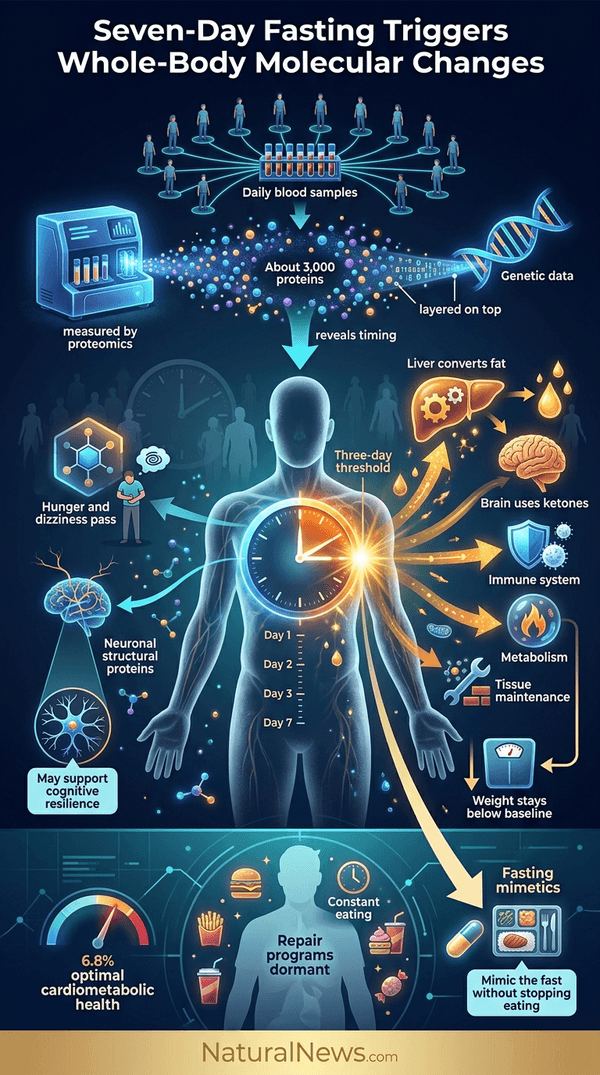
For the study, researchers followed 12 healthy volunteers who completed a seven-day water-only fast. Participants were closely monitored each day, and blood samples were collected before the fast, throughout the fasting period, and after they began eating again, according to the researchers [1].
The scientists measured changes in about 3,000 proteins in the blood using proteomics, then combined those protein measurements with genetic information from large population studies. This allowed them to investigate which biological pathways were changing during fasting and to predict some of the possible health consequences associated with those changes, the study said [1].
The research was conducted by scientists from Queen Mary University of London's Precision Healthcare University Research Institute (PHURI) and the Norwegian School of Sports Sciences. The findings were published in Nature Metabolism in 2024 [2][1].
Metabolic Shift and Weight Loss Recorded
During the first two or three days without food, the body shifted away from glucose and toward stored fat as a major energy source, according to the study.
Lean mass includes tissues that are not body fat, such as muscle and other water-rich tissues. Three days after participants resumed eating, their overall weight remained below where it had started.
The metabolic shift observed in the study mirrors what other researchers have described as the body's transition to burning stored fat for fuel when incoming calories are absent. Valter Longo, director of the Longevity Institute at the University of Southern California, has documented his own experiences with extended fasting, noting that hunger and dizziness would pass during the first days without food [3].
Protein Changes Across Major Organs After Day Three
After approximately three days of fasting, researchers began detecting distinct changes in protein levels throughout the body, the study stated. The pattern suggested a coordinated whole-body response rather than simply a change in how the body obtained energy, according to researchers [4].
Changes were linked to all major organs, and many appeared consistently among the participants, the report said. Researchers also detected biological signatures that could not be explained by weight loss alone, including changes in proteins associated with the structural support of neurons in the brain.
Timing, Limitations, and Potential Treatment Research
The study examined complete calorie restriction lasting several days, and researchers said the results do not mean shorter intermittent fasting schedules necessarily produce the same effects.
Researchers said understanding which molecular pathways are responsible for potentially beneficial effects could eventually lead to treatments that mimic fasting without requiring patients to stop eating for several days.
The broader context of metabolic health in the United States remains a concern. A landmark study released in July 2022 revealed that only 6.8% of U.S. adults had optimal cardiometabolic health as of 2018, with more than 93% of U.S. adults metabolically unfit, according to Mercola.com [5]. That figure indicates that the actual percentage of metabolically unfit adults may exceed 95%, given the lack of 2022 data.
Conclusion
The study provides a detailed molecular map of how the human body adapts during prolonged fasting, according to its authors. Researchers identified a threshold of about three days, after which many broader biological changes became detectable beyond the initial shift toward burning stored fat [4].
Further research is needed to determine whether those pathways can be reproduced without prolonged periods without food, the report stated. Research published in 2024 found that prolonged fasting produces widespread and coordinated biological changes across multiple organs, with some of the most notable effects appearing only after about three days without calories [4].
References
- Study identifies multi-organ response to seven days without food. https://www.qmul.ac.uk/news/latest-news/2024/fmd/study-identifies-multi-organ-response-to-seven-days-without-food.html
- Study identifies multi-organ response to seven days .... https://www.bihealth.org/en/notices/study-identifies-multi-organ-response-to-seven-days-without-food
- The Longevity Diet. by Valter Longo
- Scientists reveal what seven days of fasting does to the .... https://www.sciencedaily.com/releases/2026/10/261005012444.htm
- US Health in Crisis - Mercola.com, October 09, 2022
Explainer Infographic











Please contact us for more information.


