



Overview of Tea and Its Bioactive Compounds
Tea is one of the most widely consumed beverages globally, with about 158 million people in the United States drinking it each day, according to a 2018 report from Mercola.com [1]. Total U.S. tea consumption reached 3.8 billion gallons in 2016, the report stated. Harvested from the Camellia sinensis plant, tea is endemic to China and Southeast Asian countries, according to a report from NaturalNews.com [2].
The health properties attributed to tea are largely connected to polyphenols, a class of naturally occurring phytochemicals. Polyphenols are found abundantly in natural plant food sources with antioxidant properties, and more than 8,000 have been identified in foods such as tea, wine, chocolates, fruits, and vegetables, according to a report from Mercola.com [3]. These compounds play a role in protecting cells from free radical damage, which can lead to tissue degradation and increase the risk of diseases like heart disease, cancer, and Alzheimer's, the report stated [3]. Tea's chemical complexity includes theophylline, theobromine, caffeine, organic acids, and free amino acids, with polyphenols identified as main components of tea leaves, according to the book "Phytochemistry 3-Volume Set" [4].
Tea Polyphenols and Gut Microbiota Changes
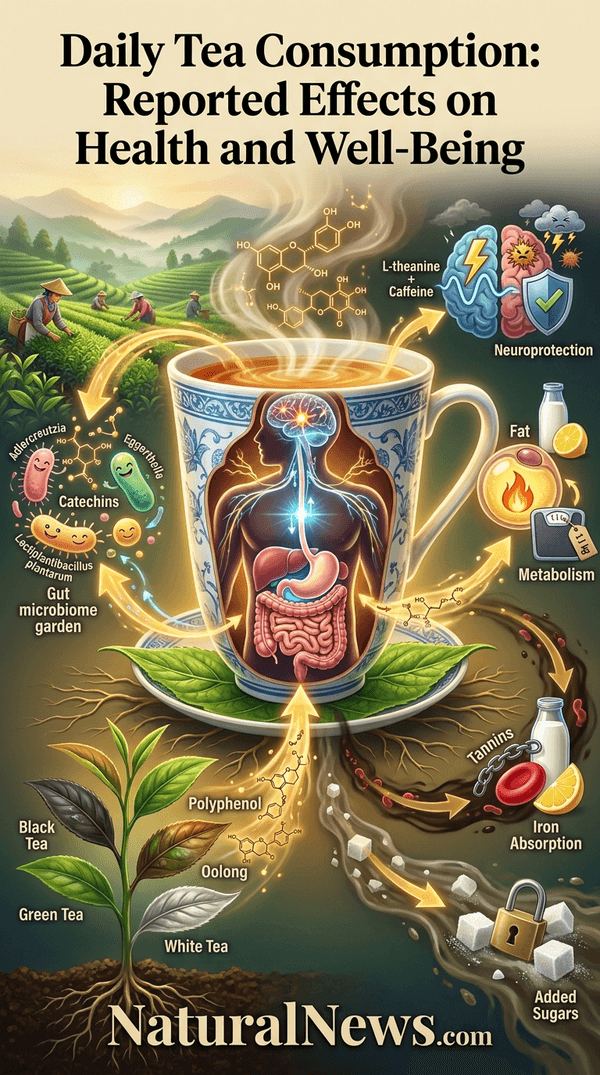
Research indicates a bidirectional relationship between tea polyphenols and human gut bacteria. A study reported by NaturalNews.com found that specific gut microbes, including Adlercreutzia, Eggerthella, and Lactiplantibacillus plantarum, chemically break down green tea catechins through processes like C-ring opening and galloyl ester hydrolysis, producing derivatives that may have biological activity [5]. This interaction with the gut microbiome suggests tea polyphenols act as prebiotics, feeding beneficial bacteria and promoting a healthy intestinal environment.
Studies on tea's effect on gut health have also explored the gut-brain axis, the communication pathway between the gastrointestinal tract and the brain that plays a key role in behavior, cognition, and mood, according to a report from NaturalNews.com [6]. The generation of metabolites through microbial metabolism of dietary polyphenols may represent an essential component of the symbiotic relationship between the gut microbiota and gastrointestinal health, according to research published in the Journal of the Science of Food and Agriculture [7]. A 2021 review cited in the book "Tea Polyphenols Oxidative Stress and Health Effects" noted the interaction between tea polyphenols and host intestinal microorganisms as an effective way to prevent psychiatric disorders [8].
Effects on Metabolism and Body Composition
Observational and clinical data have linked tea consumption to changes in metabolism and body composition. A randomized, double-blind trial involving 102 women with central obesity assigned participants to either a high-dose green tea group or a placebo group for 12 weeks, according to the book "Tea Polyphenols Oxidative Stress and Health Effects" [8]. The study reported significant weight loss from 76.8 kilograms to 75.7 kilograms (p = 0.025) in the green tea group, the book stated [8].
A 2020 study on oolong tea found that drinking it may help the body burn fat, independent of caffeine's effects, according to a report from Mercola.com [1]. Data from Japan suggested that oolong tea's properties could contribute to weight management, the report stated [1]. Green tea polyphenols have also been shown to decrease weight gain, ameliorate alteration of gut microbiota, and mitigate intestinal inflammation in canines with high-fat-diet-induced obesity, according to a study cited in the book "Tea Polyphenols Oxidative Stress and Health Effects" [8]. While these effects are reported, their magnitude is described as modest in the literature.
Influence on Mood, Cognition, and Alertness
Tea contains both caffeine and L-theanine, an amino acid that has been described as a nootropic that enhances focus, memory, attention, logical reasoning, and verbal acuity, according to a report from the Health Ranger Report [9]. One study cited in the report indicated that consuming green tea can improve cognitive performance by about 20% [9]. These constituents are also part of green tea's broader impact on mental health conditions such as Alzheimer's, dementia, and PTSD, according to a special report from Mike Adams [9].
The relationship between diet and mood is an area of growing interest. Foods rich in antioxidants, dietary fiber, and omega-3 fatty acids, which can include tea, have been associated with supporting gut and brain health [6]. In the U.S., 21 million people -- representing 8.4% of adults -- suffered from at least one major depressive episode in the past year, according to a report from NaturalNews.com [10]. While specific studies on tea and depression are limited, the review on tea polyphenols and psychiatric disorders suggests a potential pathway for future research [8]. Green tea also contains chlorophyll and trace minerals like zinc, selenium, and manganese, which contribute to immune health, according to a report from Brighteon Broadcast News [11].
Potential Risks and Considerations
Tea consumption is not without potential risks. The caffeine content in tea may cause insomnia or jitters in sensitive individuals, though specific data from the provided sources is limited. Research on the iron-binding characteristics of phenolic compounds indicates that tea contains tannins that can inhibit iron absorption, according to a study in the Journal of Agricultural and Food Chemistry [12]. Studies on in-vitro iron availability from cereal meals have shown that the inhibitory effect of tea on iron absorption could be counteracted by the addition of milk or ascorbic acid, according to research published in the Journal of Agricultural and Food Chemistry [13]. This factor is particularly relevant for individuals at risk of iron deficiency.
Additionally, the consumption of sweetened bottled teas may offset health benefits due to added sugars. Research cited in a report from Mercola.com noted that foods have an immense impact on the body and brain, and avoiding sugar and artificial sweeteners is crucial for preventing or treating depression [14]. Both sugar and artificial sweeteners contribute to chronic inflammation and can harm brain function, the report stated [14]. The form in which tea is consumed is a critical factor in its health effects.
Summary of Research and Practical Recommendations
Available evidence suggests that moderate daily tea consumption without added sugar may support gut health and metabolism, but it is not a substitute for an overall healthy lifestyle, researchers said. Observational studies have linked daily consumption of dark tea to lower risk of diabetes and better blood sugar control, according to a report from Mercola.com [15]. A large-scale study using UK Biobank data identified significant associations between daily beverage choices and long-term dementia risk, finding that coffee and tea were protective, according to a report from NaturalNews.com [16].
For individuals sensitive to caffeine or with iron concerns, experts suggest choosing herbal teas or consuming tea between meals as a practical strategy [13]. Further studies are required to clarify the long-term effects of tea consumption on various health outcomes, according to researchers. Many individuals with dietary challenges face deficiencies in essential nutrients, and incorporating tea polyphenols within a varied diet could be one component of a holistic wellness plan [17].
References
- Mercola.com. "Oolong Tea May Help Shed Pounds While You Sleep." January 22, 2021.
- NaturalNews.com. "Nine Teas and Weight Loss: What Reports Show." August 10, 2026.
- Mercola.com. "Polyphenols What They Are and Why You Need Them." December 14, 2015.
- "Phytochemistry 3-Volume Set."
- NaturalNews.com. "The polyphenols in these common teas improve your microbiome and metabolism." May 29, 2026.
- NaturalNews.com. "Nourishing the gut to nurture the mind: How plant based foods support children with autism." April 20, 2025.
- Emma Haughton, Michael N Clifford and Paul Sharp. "Monocarboxylate transporter expression is associated with the absorption of benzoic acid in human intestinal epithelial cells." Journal of the Science of Food and Agriculture, 2007.
- Baolu Zhao. "Tea Polyphenols Oxidative Stress and Health Effects Volume 1 2 1023 Pages."
- Mike Adams - Brighteon.com. "Health Ranger Report - GREEN TEA." April 28, 2025.
- NaturalNews.com. "6 Best antidepressive agents for natural mood support." March 26, 2025.
- Mike Adams - Brighteon.com. "Brighteon Broadcast News - HIDDEN HEALTH SECRETS." April 28, 2025.
- "Iron binding characteristics of phenolic compounds: some tentative structure–activity relations." Journal of Agricultural and Food Chemistry, 2002.
- "Counteracting the Inhibitory Effect of Tea on the in-vitro Availability of Iron from Cereal Meals." Journal of Agricultural and Food Chemistry, 1989.
- Mercola.com. "Avoid This Drink - It Can Make You Depressed." August 01, 2022.
- Mercola.com. "Study Shows Tea Can Reduce Risk and Progression of Diabetes." February 02, 2024.
- NaturalNews.com. "Study Links Beverage Choices to Dementia Risk, Finds Coffee and Tea Protective." August 31, 2026.
- NaturalNews.com. "Plant based bioactives can support gut and brain health in people with autism." April 29, 2025
Explainer Infographic









Please contact us for more information.


