


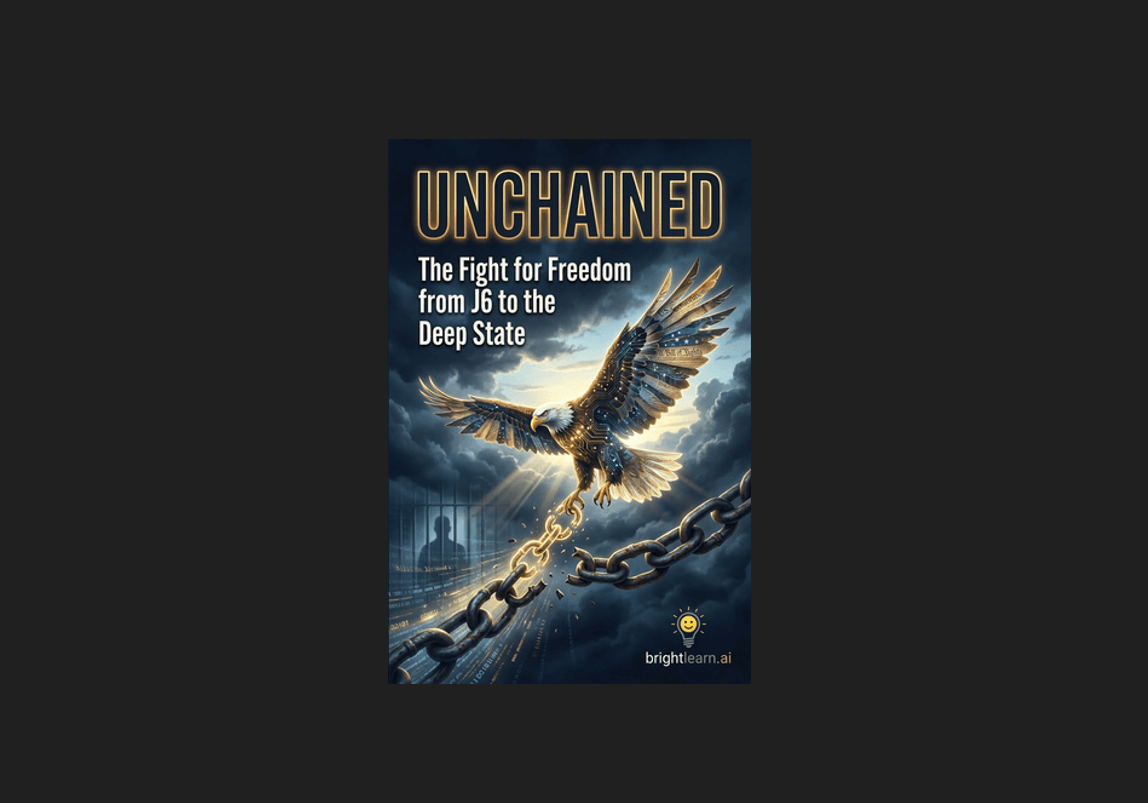
- "Unchained" reveals that the Department of Justice itself filed a motion to vacate the convictions of Oath Keepers and Proud Boys leaders, effectively admitting the prosecution was flawed and relied on coerced testimony, as seen with Jeremy Bertino's affidavit.
- The text highlights the accusation that defendants were prosecuted for who they are (e.g., Oath Keepers, Proud Boys) rather than for their actions, drawing a direct parallel to Soviet-era tactics where the state targets a person's political identity.
- The book explains how laws created for specific threats (like the Patriot Act for terrorism) are permanently retained and expanded for use against any political opponent, with the ratchet of state control only turning toward less freedom.
- The text argues that presidential commutations (reducing sentences) are inferior to pardons, as they leave individuals as convicted felons, stripping them of rights like voting, firearm ownership and veteran benefits, creating a "softer form of captivity."
- Despite its grim analysis, the book offers a plan for action, including demanding full pardons for J6 defendants, advocating for a Sunset Amendment to expire emergency powers and urging citizens to build encrypted patriot networks for self-sufficiency.
"Unchained: The Fight for Freedom from J6 to the Deep State" is a book written for those who suspect—no, who know—that something has gone terribly wrong with the machinery of American justice, and who want to understand not just how we got here, but where we're going and what we can do about it.
Reading "Unchained" is like sitting across the table from a grizzled intelligence veteran who has seen too much to be polite anymore. The prose is direct, unflinching and occasionally profane. It pulls no punches and asks no forgiveness. This is both its greatest strength and, for some readers, its most challenging feature. But if you can handle the heat, you will find a kitchen full of truth.
The architecture of political prosecution
The book opens with what can only be described as a bombshell: the Department of Justice itself—the same DOJ that spent years building cases against the leaders of the Oath Keepers and Proud Boys—filed a motion to vacate their convictions. This is not a pardon from the White House. This is the prosecutors themselves admitting, in legal language that is as close to a confession as government agencies ever get, that they got it wrong.
The author walks us through this stunning about-face with the precision of a surgeon and the passion of a preacher. We learn that the DOJ's motion came just days before the defendants' appellate briefs were due—a timing that, in the world of legal strategy, speaks volumes. The government clearly wanted to avoid having those briefs filed, briefs that would have aired all the misconduct, false testimony and constitutional overreach that marked these trials.
One of the most damning revelations concerns Jeremy Bertino, a Proud Boy who testified against the group's leaders. Bertino later signed an affidavit admitting he was coerced into lying. The book handles this with appropriate gravity: "When the state relies on coerced testimony, the justice system becomes a tool of oppression. It does not seek truth. It seeks convictions."
This is not hyperbole. It is a cold, hard fact that Unchained documents with meticulous detail.
Identity crime: The Soviet playbook in America
Perhaps the most chilling chapter deals with what the author calls "identity crime"—the practice of prosecuting people not for what they did, but for who they are. Stewart Rhodes, founder of the Oath Keepers, puts it bluntly: "We were targeted for it; it was really identity crime, just like in the Soviet Union."
The book draws a direct line from the KGB's motto—"Show me the man, I'll show you the crime"—to the DOJ's treatment of Jan. 6 defendants. Out of more than 1,500 people who entered the Capitol, only Oath Keepers and Proud Boys were charged with seditious conspiracy. Why? Because the government needed to spin a narrative about a coordinated attack, and these groups fit the villain role the media had already prepared for them.
The author is careful to distinguish between national security and state overreach. The comparison to the Soviet Union is not made lightly, but it is made convincingly. When prosecutors rely on informants who admit to lying, when charges are stretched beyond their original intent and when the target is chosen based on political affiliation rather than criminal behavior, we have entered dangerous territory.
The ratchet effect: How every police state power endures
One of the book's most powerful concepts is what it calls "the ratchet effect." This is the observation that laws and precedents created to target one group never go away. They become permanent tools of state control, ready to be turned against anyone the government deems a threat.
The Patriot Act was supposed to be about terrorism. Now it's used against protesters. The obstruction statute was meant for corporate criminals like those at Enron. Now it's used against people who walked through open doors at the Capitol. The book makes an uncomfortable but necessary point: "It does not matter if you agree with the initial target. What matters is that the lever of state control is now in place, and it can be pulled against you tomorrow."
This is not a partisan observation. The author notes that right-leaning administrations have often expanded surveillance powers, believing they would only be used against their enemies. The George W. Bush administration pushed through the Patriot Act. The Trump administration defended expansive surveillance powers under FISA. Now those same tools are being used against conservatives.
The ratchet only turns one way: toward less freedom.
The commutation trap: Freedom without rights
One of the most frustrating sections deals with what the book calls "the commutation trap." When President Trump commuted the sentences of many Jan. 6 defendants, including Stewart Rhodes, the public cheered. But a commutation is not a pardon. A commutation reduces your sentence; a pardon wipes the conviction away entirely.
The difference is enormous, and "Unchained" explains why with devastating clarity. A commutation unlocks the cell door but leaves the prison record on your back. You walk out of prison, but you walk out as a convicted felon. You lose the right to vote. You lose the right to own a firearm. You can lose federal benefits, including veterans' disability payments. For someone like Rhodes, a disabled veteran, this meant watching his benefits disappear even as he regained his physical freedom.
The book argues that this is not an accident. It is a feature of the system. The Deep State loves commutations because they create a permanent underclass of political prisoners—people free enough to stop making headlines, but still bound by invisible chains. "Freedom without rights," the author writes, "is not real justice. It is just a softer form of captivity."
The Deep State's survival playbook
The second half of the book shifts from diagnosis to analysis, examining how the Deep State maintains its grip on power. The chapters on Todd Blanche, the lawyer who reportedly held up pardons while angling to become Attorney General, are particularly revealing. The author argues that Blanche's ambition served as a leash, allowing the Deep State to control the pardon process from within.
We also learn about Ed Martin, a Trump appointee who was supposed to investigate FBI misconduct but was blocked at every turn. Career officials inside the DOJ put up walls. Senate resistance stalled his confirmation. Internal sabotage chipped away at every move he made. The message is clear: the Deep State doesn't need to resist with open force; it simply co-opts rising stars with the promise of bigger titles.
The chapter on "dual loyalty" and the Zionist lobby is likely to be controversial, but it raises important questions about the influence of foreign interests on American policy. The author argues that when a leader's closest advisors have a primary loyalty to another country, that leader becomes a puppet. Whether you agree with the specific examples or not, the underlying principle—that we must be vigilant about divided loyalties in positions of power—is hard to dispute.
A practical roadmap
Despite its grim subject matter, "Unchained: is not a book of despair. The final chapters offer a practical roadmap for resistance. The author calls for demanding full pardons for all J6 defendants, not just commutations that leave them as second-class citizens. He advocates for a Sunset Amendment that would automatically expire emergency powers after one year. He urges readers to build patriot networks using encrypted communication tools, to achieve food and energy independence and to hold assets in forms that cannot be frozen or seized.
The book's closing message is one of urgent action. "The window for human-based resistance is closing fast," the author warns. "Once these machines are fully operational, traditional protests, marches and even armed standoffs will become as futile as throwing stones at a tank. We must act now, before our freedom is automated away."
Grab a copy of "Unchained: The Fight for Freedom from J6 to the Deep State" via this link. Read, share and download thousands of books for free at Books.BrightLearn.AI. You can also create your own books for free at BrightLearn.AI.
Watch the "Health Ranger Report" episode below, where Mike Adams interviews Stewart Rhodes on DOJ vacating J6 convictions, Deep State power and local resistance.
This video is from the Health Ranger Report channel on Brighteon.com.
Sources include:









Please contact us for more information.


