



The AI Mania Feels Like 1999 All Over Again
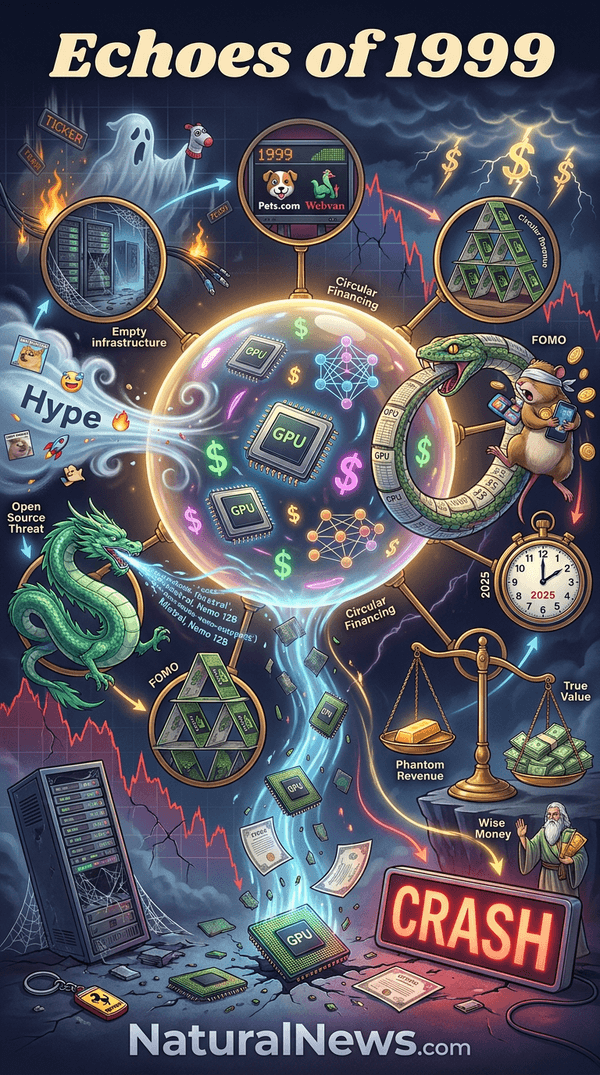
I see unmistakable parallels between today’s AI infrastructure frenzy and the dot-com bubble of the late 1990s. Billions of dollars are pouring into data centers, GPU purchases, and speculative startups with no clear path to revenue, let alone profit. As Chris Martenson noted in his piece “Déjà Vu All Over Again,” what was sold as a “new era” of limitless growth is starting to look like every other speculative mania. Companies are spending tens of billions on data centers and chips, but many of those facilities sit empty, waiting for power that may never come [1]. Last week, renewed skepticism in the AI narrative pushed markets lower, yet investors keep buying the dip [2].
Meanwhile, China’s free open-source AI models are undercutting U.S. companies at every turn. In my interview with Seth Holehouse, we discussed how the most advanced AI is emerging from China, and that OpenAI is scrambling to reverse-engineer Chinese technology [3]. This is not innovation; it is speculative overinvestment destined to collapse. The same pattern played out in 1999 when companies with no earnings commanded sky-high valuations before the crash erased trillions. History is repeating itself, and the smart money is already rotating out of tech [4].
The Financial House of Cards: No Revenue, No Hope
The financial engineering behind this bubble is even more transparent than the dot-com era. AI companies report revenue from circular deals, leasing GPUs to each other to inflate stock prices. Former BlackRock portfolio manager Ed Dowd explained on PeakProsperity that most of the seven stocks propping up the market are engaged in “circular financing,” a practice that echoes the dot-com bubble’s vendor financing [5]. In other words, companies pay customers to buy their products, then book the transaction as revenue. It is a house of cards.
Consider OpenAI: it is hemorrhaging cash, projecting $44 billion in losses over five years with no profits expected until 2028 at the earliest [6]. Real demand for AI services is weak; most applications lack sustainable business models. As I wrote in my own article, this is a speculative mania fueled by cheap debt and fairy-tale projections [7]. The idea that this spending will generate returns is wishful thinking. History will repeat itself, and the only question is when the music stops.
The Cultural Echo: Young Investors Fooled Again
I keep hearing young investors brag that buying any AI or semiconductor stock makes them a genius. This is exactly the same talk I heard in 1999, when everyone thought they’d never have to work again. The hubris is breathtaking. A recent analysis of semiconductor returns shows that during the dot-com bubble, semi stocks soared 234% over 14 months before crashing [4]. Today we see the same euphoria: Samsung’s AI bonus boom is fueling Ferrari purchases among chip employees [8]. In reality, they are riding a bubble, not displaying skill, and the crash will wipe them out.
The Trends Journal warned that “talk of bubbles in tech or AI, or in investment strategies focused on growth and momentum, obscures the mother of all bubbles in U.S. markets” [9]. That warning applies directly to the young traders who think they have found a sure thing. They haven’t. They are victims of the same FOMO that trapped a generation in 2000. The crash will be especially devastating for those in their 20s and 30s who risk losing years of savings and retirement security.
The Inevitable Crash and Its Human Toll
When the AI investment bubble bursts, it will not be a gentle correction. It will be a wealth destroyer. Chris Martenson’s analysis in “Creak! Pop! More Signs That the Everything Bubble Is Getting Ready to Burst” reminds us that we are in the late stages of the largest set of financial asset bubbles ever blown in human history [10]. The “this time is different” narrative is always a trap. Fundamentals still matter. Older investors near retirement will suffer the most, with little chance to recover because they no longer have many productive "work years" remaining.
The caution from the Trends Journal is clear: “There’s a huge boom in AI… Some people are scrambling to get exposure at any cost while others are sounding the alarm that this will end in tears” [11]. I believe the alarmists are right. The narrative that AI will justify infinite spending is a fantasy. When the crash comes, it will expose the circular financing, the empty data centers, and the unrealistic revenue projections. Capital preservation must be the priority, not chasing the latest FOMO-driven rally.
A Smarter Path: Protect Your Wealth with Honest Money
Given the systemic risk in stocks and fiat currency, I continue to believe that gold and silver are the safest havens. They have no counter-party risk and cannot be devalued by central bank printing. With silver currently at $60+ per ounce and gold at $4,100+, the recent pullback in metals is a buying opportunity, not a reason to sell. Owning physical metals is the kind of self-reliance that will protect you when the financial system cracks.
Investing in a world in turmoil requires thinking beyond Wall Street’s narrative. As James Rickards noted, the war in Iran, soaring energy prices, and debt at an all-time high create an environment where only tangible assets offer security [12]. In these uncertain times, self-reliance and preservation of capital are the only sane strategies.
I have been stacking precious metals for years, and I urge you to consider the same strategy. Do not let the AI bubble pull you away from a rational assessment of where this is all headed. Greed and FOMO will cost the intellectually lazy a fortune when the market sharply corrects, while those who hold honest money (i.e. gold and silver or other hard assets) will be the true winners in the long run.
References
- Déjà Vu All Over Again: AI’s Many Similarities to the Dot-Com Bubble. Chris Martenson. PeakProsperity.com. November 13, 2025.
- These Are The Biggest Pain Trades. zerohedge.com. July 2, 2026.
- Mike Adams interview with Seth Holehouse. January 31, 2025.
- 5 Charts to Navigate This Chaotic Market. dailyreckoning.com. July 2, 2026.
- Ed Dowd: It Has Begun — Housing, Credit and FCF Have Cracked; Stocks Are Next. Chris Martenson. PeakProsperity.com. November 11, 2025.
- The AI Bubble: A Financial House of Cards That’s About to Collapse. naturalnews.com. June 3, 2026.
- Why I Can’t Wait for the AI Bubble to Crash. naturalnews.com. June 8, 2026.
- Samsung Inks Labor Deal, Averts Chip Strikes As AI Bonus Boom Fuels Ferrari Purchases. zerohedge.com. May 27, 2026.
- Trends-Journal-2024-12-10.
- Creak! Pop! More Signs That the Everything Bubble Is Getting Ready to Burst. Chris Martenson. PeakProsperity.com. November 20, 2025.
- Trends-Journal-2023-08-33.
- Rickards: Investing In A World In Turmoil. zerohedge.com. May 21, 2026.
- 2025 10 15 BBN Interview with Cordon . Mike Adams.
- Stockman Warns This Is Not Your Grandfather’s Stagflation. zerohedge.com. April 6, 2026.
Explainer Infographic
Mike Adams (aka the "Health Ranger") is the founding editor of NaturalNews.com, a best selling author (#1 best selling science book on Amazon.com called "Food Forensics"), an environmental scientist, a patent holder for a cesium radioactive isotope elimination invention, a multiple award winner for outstanding journalism, a science news publisher and influential commentator on topics ranging from science and medicine to culture and politics.
Mike Adams also serves as the lab science director of an internationally accredited (ISO 17025) analytical laboratory known as CWC Labs. There, he was awarded a Certificate of Excellence for achieving extremely high accuracy in the analysis of toxic elements in unknown water samples using ICP-MS instrumentation.
In his laboratory research, Adams has made numerous food safety breakthroughs such as revealing rice protein products imported from Asia to be contaminated with toxic heavy metals like lead, cadmium and tungsten. Adams was the first food science researcher to document high levels of tungsten in superfoods. He also discovered over 11 ppm lead in imported mangosteen powder, and led an industry-wide voluntary agreement to limit heavy metals in rice protein products.
Adams has also helped defend the rights of home gardeners and protect the medical freedom rights of parents. Adams is widely recognized to have made a remarkable global impact on issues like GMOs, vaccines, nutrition therapies, human consciousness.







Please contact us for more information.


