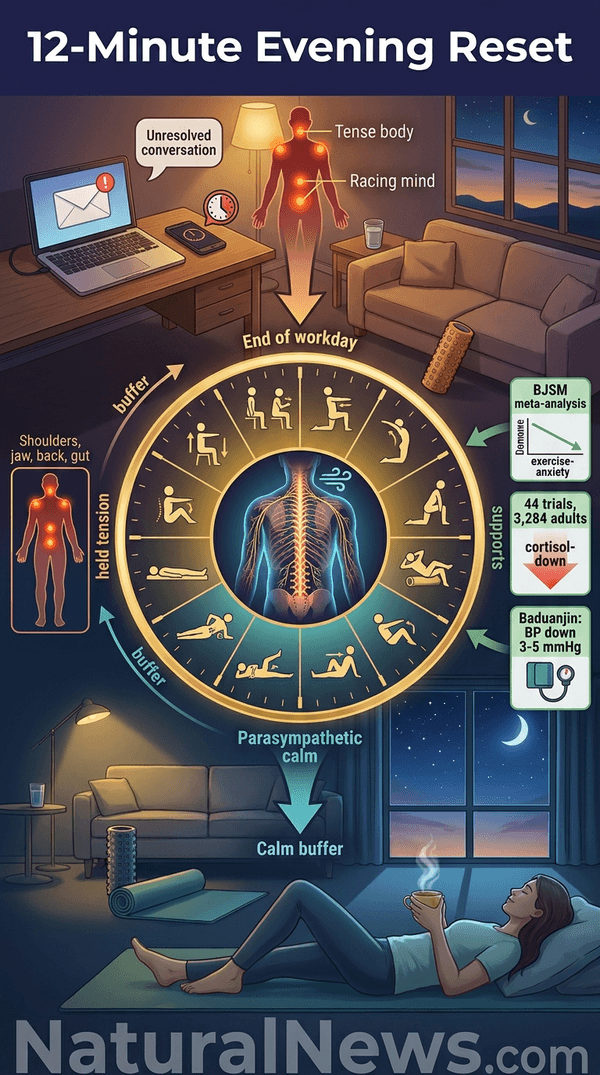
The routine consists of 10 gentle stretch-and-relax exercises that pair slow, mindful breathing with controlled movements, the report stated. Amber Yang, identified in the report as a certified personal trainer, wrote that the sequence is designed for people whose minds are still racing and whose bodies remain tense after returning home.
The article’s summary line describes the approach as pairing slow, mindful breathing with gentle stretches to release tension, relax the body, and calm the mind, according to the report [1].
Study Links Short, Low-Intensity Exercise to Anxiety Reduction
A meta-analysis published in the British Journal of Sports Medicine found that exercise helps reduce anxiety, according to the report.
Separate research has examined the relationship between gentle movement and stress hormones. An analysis of 44 randomized controlled trials encompassing 3,284 adults with elevated stress, anxiety, or low mood found that yoga produced a moderate, consistent drop in cortisol, and that qigong, described as an ancient practice of slow movement, was also among the modalities compared, according to a report on that analysis [2].
Yang wrote that moving slowly and rhythmically gently brings attention back to the breath and body, creating a calm buffer after a hectic day, according to the article.
Routine Incorporates Classical Chinese Dance Movement
The sequence incorporates “ti-chen,” a lifting-and-sinking movement from classical Chinese dance, pairing breath with spinal motion, the report stated. According to the article, the spine is richly lined with nerves, and mild, rhythmic movements help ease torso tightness from long hours of sitting or everyday stress.
The report said deep breathing activates the parasympathetic nervous system and gently quiets the mind. Similar principles appear in other traditional movement systems: an 800-year-old Chinese exercise routine called baduanjin reduced systolic blood pressure by 3 to 5 mmHg in a yearlong clinical trial, an effect comparable to that of some first-line blood pressure medications, according to a report on the study published in JACC [3].
Yang described the routine as a way to release tension in both body and mind, according to the report. Instructional material on body-scan and relaxation practices likewise describes using the breath to release held tension in the shoulders, jaw, and gut long after a stressor has passed [4].
Ten Exercises Include Seated, Kneeling, and Side-Lying Movements
The first two exercises are seated lifting and sinking movements, with the second adding arm raises, according to step-by-step instructions in the report.
The report lists kneeling chest, back, and leg stretches for the left and right sides, a foam roller side crunch, a kneeling sit-up, and a kneeling variation of the chest, back, and leg stretch for both sides. The kneeling movements begin on hands and knees with toes tucked under, with instructions to extend one leg and reach the opposite arm upward while rotating the torso, according to the article.
The sequence concludes with side-lying spinal stretches for the left and right sides, the report stated. Other reporting on short routines has noted that brief, targeted movement can address specific complaints: a 10-minute stretching routine was described as designed for sedentary workers dealing with neck and shoulder stiffness, according to a report citing health reporter Amber Yang [5].
Author Describes Routine as Calm Buffer After Hectic Day
Yang wrote that by moving slowly and rhythmically, practitioners gently bring attention back to the breath and body, creating a calm buffer after a hectic day, according to the report.
The report stated that stress does not just affect mood and can show up as tight muscles, restless sleep, or an upset stomach. Research on stress and digestion has similarly linked chronic stress to worsened symptoms of gut disorders, with a study presented at Digestive Disease Week 2026 examining data from more than 15,000 participants, according to a report on that research [6].
The article did not include independent verification of the routine’s specific effects beyond the cited meta-analysis and the author’s description.
Conclusion
The report presents the 12-minute sequence as a low-cost, equipment-light option for people seeking to wind down after work, with the author’s rationale resting on the pairing of slow breathing and gentle spinal movement, according to the article.
The article does not quantify the routine’s effects, and it does not describe a controlled trial of the full 10-exercise sequence. Readers evaluating the routine are left with the author’s description and the broader research context she cites, according to the report.
References
- 12-Minute Exercises to Unwind From a Long, Tense Day. https://m.theepochtimes.com/health/still-tense-after-a-long-day-try-these-10-exercises-to-unwind-6106399
- Study finds gentle yoga, not intense exercise, best for lowering stress hormones. https://www.naturalnews.com/2026-10-12-gentle-yoga-best-for-lowering-stress-hormones.html
- Baduanjin Exercise Lowers Blood Pressure in Clinical Trial - NaturalNews.com, May 30, 2026.
- Meditation for stress: 12-minute softening session, after a long day | SoftlyStill. https://softlystill.com/meditations/meditation-for-stress-12-minute-softening-session-after-a-long-day
- Study Suggests 10 Minute Stretches to Ease Shoulder and Neck Stiffness for Sedentary Workers - NaturalNews.com, June 01, 2026.
- Late-night eating, chronic stress deliver “double hit” to gut health, new research finds. https://www.naturalnews.com/2026-06-27-late-night-eating-chronic-stress-gut-health.html
Explainer Infographic









Please contact us for more information.