



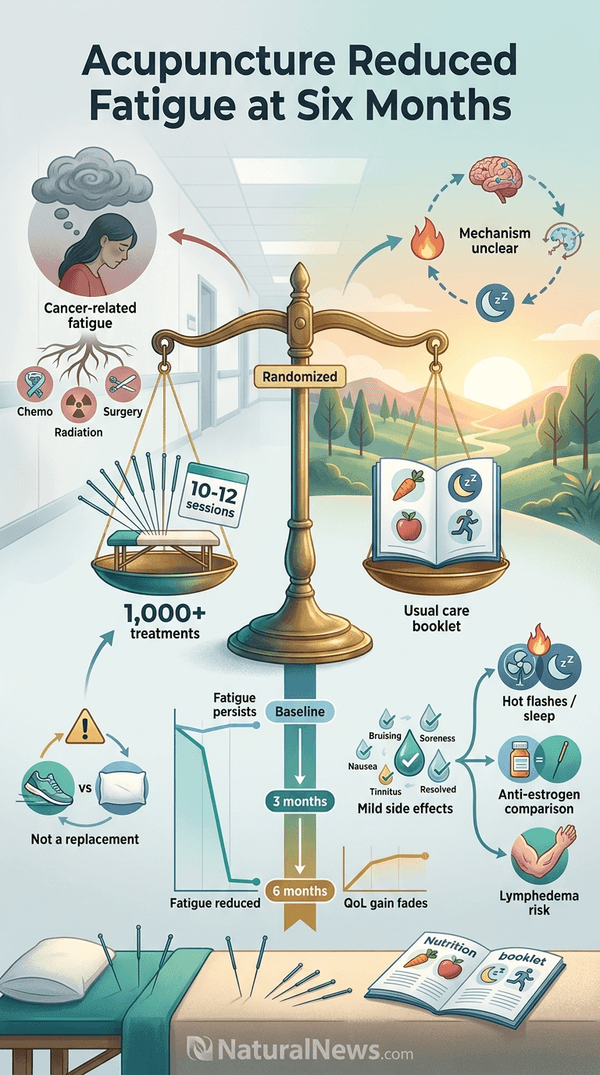
All participants had no active disease but had experienced fatigue for at least six months, according to the study. Assessments were conducted at baseline, three months and six months. The acupuncture group received 10 to 12 sessions over eight to 12 weeks in addition to usual care, while the control group received usual care including an educational booklet.
The findings were published in a peer-reviewed journal, according to the source. The trial adds to a body of research examining whether Traditional Chinese Medicine practices can address persistent symptoms that conventional treatment often leaves unresolved.
Trial Design and Participants
The randomized controlled trial enrolled 221 women after curative breast cancer treatment. All had fatigue lasting six months or longer and no active disease, according to the study.
The acupuncture group received 10 to 12 sessions over eight to 12 weeks alongside usual care, the researchers said. The usual-care group received a booklet with guidance on nutrition, sleep and physical activity. Researchers delivered more than 1,000 acupuncture treatments during the trial.
Fatigue and quality of life were measured at the start, three months and six months. According to the report, the trial used two fatigue measures and quality-of-life assessments.
Cancer-related fatigue is one of the most common side effects of cancer treatment, affecting up to 90% of patients during therapy [1]. The condition may last for weeks, months or longer after treatment has finished [2]. Research has shown that 20% to 30% of patients experience persistent severe fatigue for many years after breast cancer treatment [3].
Fatigue and Quality-of-Life Results
Women in the acupuncture group reported less fatigue than the usual-care group, according to the researchers. The improvement was evident at three months and remained at the six-month check-in. A second fatigue measure showed a similar pattern, according to the study.
The acupuncture group also reported greater quality-of-life improvements during the first three months, but the difference had disappeared by six months. The report stated that the findings suggest acupuncture may offer additional support, not a replacement, for established fatigue-management strategies.
Research has found that fatigue management often requires addressing multiple factors. Other research has found that psychological factors such as depressive symptoms and stress provide a greater link to fatigue experienced by breast cancer survivors than changes in heart function [4].
Safety, Side Effects and Clinical Guidance
Side effects were generally mild, including temporary bruising, post-treatment soreness, and less commonly nausea or ringing in the ears, according to the researchers. All resolved without lasting problems.
The trial involved 10 to 12 appointments over two to three months, not a one-time treatment. Patients were advised to discuss potential causes and complementary care with their healthcare team.
The source recommends choosing a qualified acupuncturist familiar with cancer care because treatment history may affect needle placement. Cancer-related fatigue may involve inflammation, disrupted sleep, physical deconditioning and emotional stress, and acupuncture's mechanism is not fully understood, researchers said.
Previous research has examined acupuncture for other breast cancer-related symptoms. A study published in The International Journal of Radiation Oncology examined the effectiveness of acupuncture in treating women coping with the side effects of conventional breast cancer treatment, led by Dr. Eleanor Walker at Henry Ford Hospital [5]. Acupressure, a related technique involving applying pressure to specific points, has been recommended by researchers at the University of Michigan Rogel Cancer Center for reducing anxiety, pain and symptoms associated with conventional breast cancer treatments [6]. The NIH issued a consensus statement on acupuncture in 1997 [7]. Books on integrative oncology have documented research on acupuncture for cancer-related fatigue [8].
Conclusion
The trial found acupuncture was associated with reduced fatigue for up to six months among breast cancer survivors who had completed treatment. Quality-of-life improvement faded by six months.
Fatigue remains an issue for some survivors after chemotherapy, radiation or surgery. Researchers said acupuncture may complement, not replace, physical activity and healthy sleep habits, and further research is needed on how it works. According to the report, patients should consult their healthcare team before pursuing acupuncture.
References
- Why does fatigue linger after breast cancer? New study now recruiting. https://blogs.brighton.ac.uk/healthandsport/2026/03/12/why-does-fatigue-linger-after-breast-cancer-new-study-now-recruiting/
- Extreme tiredness (cancer-related fatigue). https://breastcancernow.org/about-breast-cancer/treatment/extreme-tiredness-cancer-related-fatigue
- Long-Term Longitudinal Patterns of Patient-Reported Fatigue After .... https://ascopubs.org/doi/10.1200/JCO.21.01958
- Depression and stress drive long-term fatigue for breast cancer survivors | VCU Massey Comprehensive Cancer Center. https://www.masseycancercenter.org/news/2026/depression-and-stress-drive-long-term-fatigue-for-breast-cancer-survivors/
- Acupuncture Offers Benefits in Alleviating Br - NaturalNews.com, November 10, 2008.
- Acupressure can treat side effects caused by conventional breast cancer treatments - NaturalNews.com, April 28, 2019.
- Integrative Medicine. reply
- Oncology nutrition for clinical practice Second edition. Coble Voss Anne editor Williams Valaree editor
Explainer Infographic










Please contact us for more information.


