


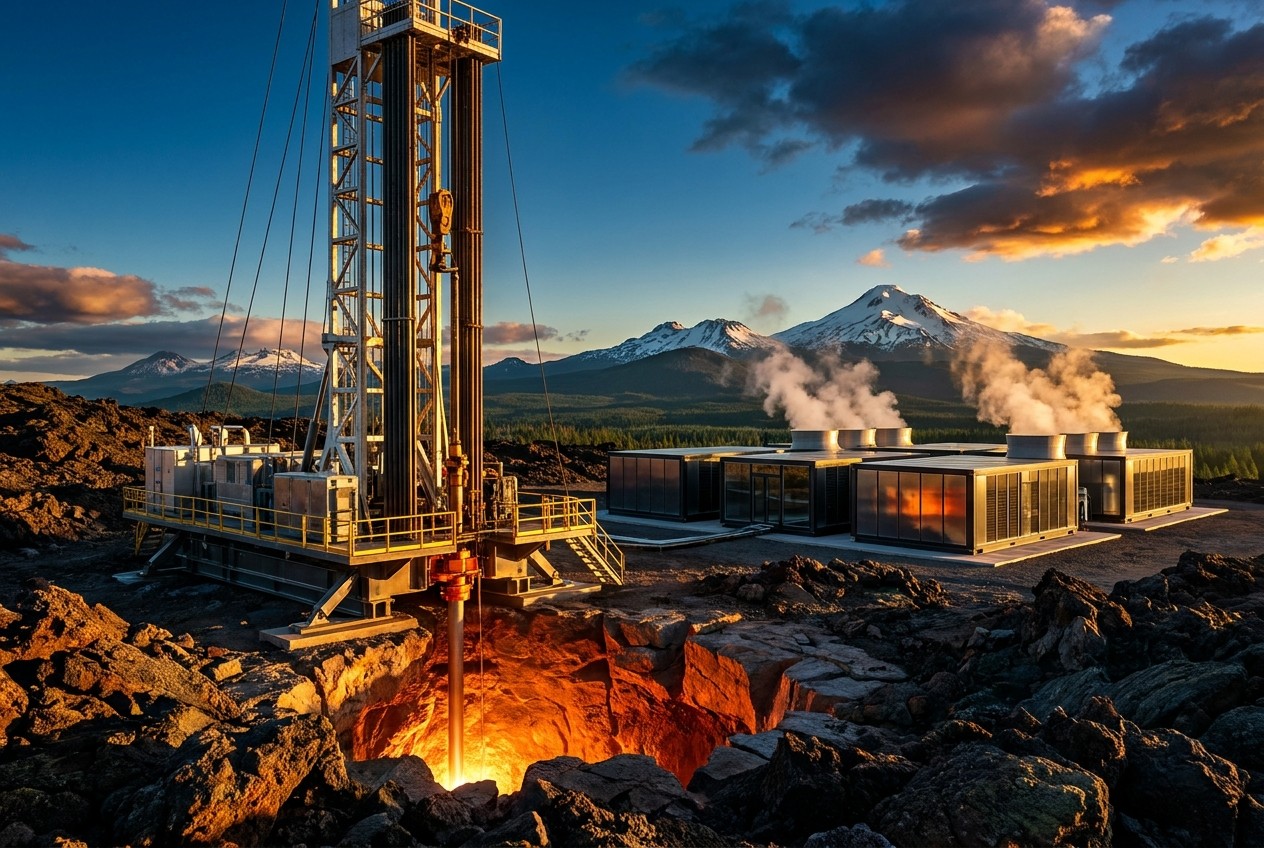
The electricity is expected to power Google's data center operations in The Dalles, with deliveries slated to begin as early as 2030 [2][3]. Company officials said the project would support the company's growing data center load in the Beaver State.
Background
The company has also turned to geothermal, nuclear and battery storage as it seeks firm power for its data centers [4]. Electricity demand from data centers has climbed alongside artificial intelligence and cloud services, industry reports stated [5].
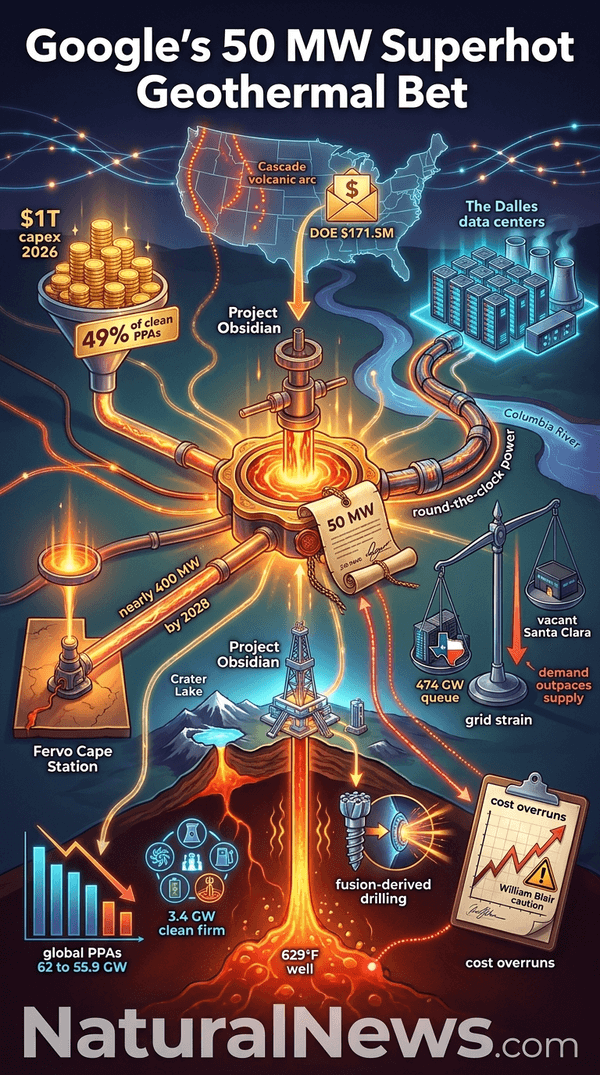
The five largest hyperscalers – Google, Meta, Amazon, Oracle and Microsoft – are expected to cross $1 trillion in capital expenditures in 2026 and $8 trillion total between 2025 and 2031, according to venture capital firm Bessemer Venture Partners [6]. Those five companies also accounted for 49% of all corporate clean energy power purchase agreements, the same report found [6].
Central Oregon's volcanic geology has drawn geothermal developers for years. Mazama Energy, a separate company backed by Khosla Ventures, said it drilled a well in Oregon that reached 629 F at the bottom of the borehole [7].
The project is also advancing against a policy backdrop shaped by federal incentives and grid strain. The Department of Energy (DOE) released a notice of funding opportunity offering up to $171.5 million for next-generation geothermal field tests and resource exploration [8]. At the same time, corporate clean power procurement worldwide fell in 2025 to 55.9 gigawatts (GW) from a record 62 GW in 2024, according to BloombergNEF [4].
How Superhot Geothermal Works
Geothermal energy originates in the inner mantle of the earth, where hot molten magma circulates upward while surface groundwater seeps downward, according to Rik DeGunther's book "Alternative Energy For Dummies" [9]. The magma heats the water and forces it back up through cracks and faults [9].
Enhanced geothermal systems, the category into which Project Obsidian falls, extend that principle by drilling several miles down, sending water through cracks in hot rock, and returning the heated fluid to the surface to generate power [10]. Quaise said the initial phase of Project Obsidian's development will use conventional drilling methods before later phases deploy the company's advanced technology [11].
The strategy mirrors approaches used by other enhanced geothermal developers. Fervo Energy, which signed a separate agreement to supply Google with nearly 400 megawatts from its Cape Station project in Utah, has said its plan is to "deploy repeatable GeoBlocks – standardized 50 MW units of geothermal energy" to form larger "GeoClusters" [12].
Energy Market and Data Center Implications
Supporters said firm geothermal resources can reduce reliance on natural gas and coal for round-the-clock power. The Clean Energy Buyers Association defines "clean firm" resources as those that can provide consistent power on demand, including hydroelectric, geothermal, nuclear, long-duration energy storage and thermal with carbon capture and storage [13].
Corporate buyers contracted for about 20.4 GW of clean power from January to September 2025, including 3.4 GW from clean firm technologies [13]. William Blair analysts noted concerns about Fervo's stock performance and the cost trajectory of enhanced geothermal projects [12].
The Google-Quaise deal comes as grid operators warn of rising electricity demand from data centers and electrification. Texas' grid operator reported 474 GW of large new customers in its interconnection queue by June 2026, up from 63 GW at the end of 2024, with about 90% of the load attributed to data centers [14].
Some data centers in Santa Clara, California remain vacant because the city-owned utility cannot supply enough electricity to meet their demands, according to Bloomberg [15]. It would take an enormous amount of energy to power all of this, and no amount of money printing can conjure terawatt hours into existence, a point emphasized in independent energy commentary [16].
Regulatory and Community Response
Project Obsidian is expected to create 200 to 400 construction jobs and more than 50 permanent roles, according to ESG News [17]. The practice of artificial recharge – deliberately introducing water into the subsurface – dates back many decades and is used to improve water quality and manage aquifer pressure.
Some energy policy observers said government incentives and corporate goals are driving geothermal investment. The DOE's funding opportunity targets field-scale demonstrations of enhanced geothermal systems for electricity generation [8].
The search engine giant's deal with Quaise follows the separate Google deal for 396 megawatts of enhanced geothermal power from Fervo's Cape Station project in Utah. The Fervo project is expected to go online in 2028 [12][18].
References
- Google locks in 50 megawatts of superhot geothermal energy in Central Oregon. https://interestingengineering.com/energy/google-geothermal-energy-deal
- Google announces world’s first deal to buy commercial superhot rock geothermal energy from Central Oregon. https://www.opb.org/article/2026/11/17/google-oregon-bend-la-pine-superhot-rocks-technology-energy-power/
- Google signs a 50 MW deal for superhot geothermal power from Quaise for its Oregon data centers. https://mlq.ai/news/google-signs-a-50-mw-deal-for-superhot-geothermal-power-from-quaise-for-its-oregon-data-centers/
- Corporate clean energy buying fell globally in 2025, reversing trend: BNEF. https://www.utilitydive.com/news/corporate-clean-energy-procurement-ppa-meta-amazon-google/812591/
- The AI boom needs power. Tariffs can make it fair. https://www.utilitydive.com/news/ai-data-center-large-load-tariff/806691/
- Large-load customers can help commercialize new clean energy technology: CEBA. https://www.utilitydive.com/news/innovative-customer-utility-agreements-derisk-new-technology-ceba/821402/
- Khosla-backed Mazama taps super-hot rocks in race to deliver 24/7 power. https://techcrunch.com/2025/10/28/khosla-backed-mazama-taps-super-hot-rocks-in-race-to-deliver-24-7-power/
- DOE Announces $171 Million For Geothermal Expansion. https://www.zerohedge.com/energy/doe-announces-171-million-geothermal
- Alternative Energy For Dummies. Rik DeGunther
- Geothermal Project in Utah Tests Shale Techniques for AI Power Grids. https://www.naturalnews.com/2026-08-31-geothermal-project-utah-test-ai-power-grids.html
- Google Signs PPA for 50 MW of Superhot Geothermal Power from. https://www.publicpower.org/periodical/article/google-signs-ppa-50-mw-superhot-geothermal-power-oregon-project
- Analysts say Fervo-Google geothermal deal underscores baseload power scarcity. https://www.utilitydive.com/news/analysts-say-fervo-google-geothermal-deal-underscores-baseload-power-scarci/829419/
- Corporate buyers contracted for 20.4 GW of ‘clean’ energy so far this year: CEBA. https://www.utilitydive.com/news/ceba-clean-energy-corporate-procurement/807392/
- Why Texas Is Making Data Centers Wait. https://www.zerohedge.com/ai/why-texas-making-data-centers-wait
- California data centers lie dormant as american power supply shot to hell. https://wattsupwiththat.com/2025/11/12/california-data-centers-lie-dormant-as-american-power-supply-shot-to-hell/
- Health Ranger Report - Cant print terawatt hours - Mike Adams - BrightVideos.com, July 24, 2025.
- Google to Buy 50 MW of Superhot Geothermal Power From Quaise’s Oregon Project. https://esgnews.com/quaise-google-superhot-geothermal-oregon/
- Enhanced geothermal notches another win as Google buys 400 MW from Fervo. https://techcrunch.com/2026/09/02/enhanced-geothermal-notches-another-win-as-google-buys-400-mw-from-fervo/
Explainer Infographic










Please contact us for more information.


