


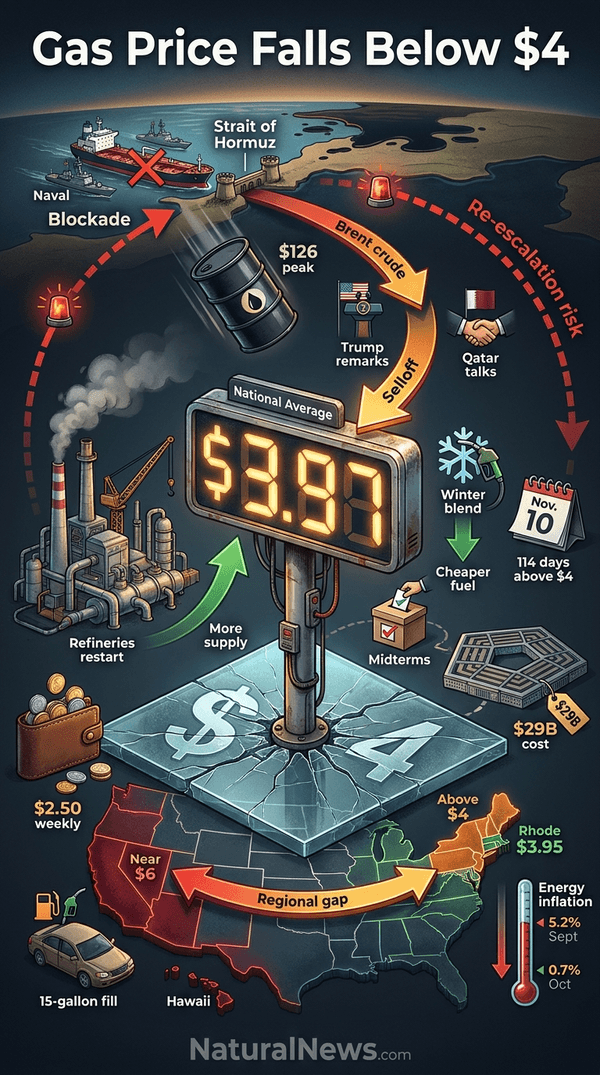
The move below the $4 threshold ends a 114-day stretch at or above that level, according to industry tracking [3]. AAA's Oregon/Idaho division said the average was last below $4 on July 19, when it stood at $3.99, and remained at or above $4 through Tuesday.
Prices remain uneven across regions, however. Most of the Northeast – except the state of Rhode Island – and much of the Western U.S. still have gas prices above the $4 mark. Nevada, California and Hawaii have average prices of almost $6 per gallon [4].
Oil Futures Post Sharp Decline
The pump-price decline followed a sharp selloff in crude oil markets. The nationwide average regular gas price stood at $4.14 on Election Day and had fallen to $3.97 by Tuesday, NBC News reported [5].
Seasonal factors also contributed. AAA cited less expensive winter-blend fuel, the typical decline in gasoline demand at this time of year and refineries increasing output as maintenance concludes [6]. CNBC noted that the Bureau of Labor Statistics reported energy prices rose 0.7% in October, down sharply from a 5.2% increase in September [4].
Strait of Hormuz Closure and Iran War Drove Earlier Price Surge
The run above $4 a gallon followed the outbreak of the U.S.-Israel war with Iran. Brent crude topped $126 a barrel at the wartime peak, and the national average gasoline price reached $4.30 a gallon, the highest since July 2022, according to AAA data [7].
Prices climbed through the spring and summer. The national average hit $4.16 in April, an almost 20% increase from a month earlier, driven by the conflict and the Strait of Hormuz blockade [8]. Brent surged past $126 in May as California drivers faced a state average of $6 a gallon [7].
The conflict has been widely unpopular. A New York Times/Siena College survey of 1,507 registered voters conducted in early May found that 64% opposed the U.S. military campaign and only 30% supported it, and a separate Washington Post poll found that roughly two-thirds of Americans wanted a deal to end the war quickly [9]. Multiple polls indicated that voters ranked the war and the cost of living among their top concerns ahead of the midterms [10].
Officials Respond as Conflict Enters New Phase
President Donald Trump on Monday, Nov. 9, downplayed the likelihood of renewed strikes on Iran. The president told reporters at the White House that Iran militarily is effectively over and that U.S. naval and land blockades amount to a status quo. The remarks came after he met with Qatari Prime Minister Sheikh Mohammed bin Abdulrahman Al Thani.
Trump had earlier said the U.S. would not launch new strikes before the Nov. 3 midterms. The president wrote on Truth Social that Washington was "having productive discussions with the Islamic Republic of Iran" and that the U.S. blockade of Iranian ports remained in effect while oil continued to flow through the Strait of Hormuz [11]. In a separate exchange at the Lincoln Memorial Reflecting Pool, the president answered "No" when asked about resuming strikes after the election [12].
Iranian officials have maintained their position on the waterway. Iranian Deputy Foreign Minister Kazem Gharibabadi said the Strait of Hormuz "will be opened and closed only under Iran's command" and that Tehran would keep enforcing its blockade until Washington accepts "the reality of defeat," according to his post on X [13]. Analysts have warned that traders betting on a quick end to the conflict may be making a dangerous assumption [14].
Regional Prices Remain Elevated as Market Watches Talks
Most Southern states were below $3.70 [15]. Oregon's average fell 15 cents to $4.62 a gallon for the week [6]. Market participants said prices could change with further developments in the Iran conflict and diplomatic talks.
Patrick De Haan, head of petroleum analysis at GasBuddy, said in a post on X that GasBuddy's national average was just under $3.97 [2]. De Haan said in a separate interview that the decline "didn't just happen because of an election, it's been ongoing" and that Americans drive less as temperatures cool off [16]. The 113-day stretch at or above $4 was the second longest on record, behind a 158-day run from March to August 2022 after Russia invaded Ukraine [6].
References
- Average cost of gas drops to less than $4 per gallon for first time since July. https://thehill.com/policy/energy-environment/6210134-average-gas-price-drops-post-election-inflation-iran-war/
- National Average Gas Price Falls Under $4 per Gallon. https://theepochtimes.com/us/national-average-gas-price-falls-under-4-per-gallon-6123137
- Gas prices dip below $4 for first time since July. https://www.wtnh.com/news/national/average-cost-of-gas-drops-below-4-per-gallon-for-first-time-since-july/
- U.S. gas prices fall below $4 for first time since July. https://www.cnbc.com/2026/11/10/us-gas-prices-below-four-dollars.html
- Gas prices fall below $4 per gallon for the first time since July. https://www.nbcnews.com/business/energy/gas-prices-fall-4-gallon-oil-markets-trump-iran-war-russia-ukraine-rcna608498
- National Average Price for Regular Gas Falls below $4 for First Time since July | AAA Oregon/Idaho. https://info.oregon.aaa.com/national-average-price-for-regular-gas-falls-below-4-for-first-time-since-july/
- Oil Prices Hit Wartime High as Iran Conflict Escalates Brent Crude Surges Past 126 Gas Prices Soar to 6 in Calif - NaturalNews.com, May 02, 2026. by NaturalNews.com
- Gas prices hit 416 as Iran war chokes global oil supply - NaturalNews.com, April 10, 2026. by NaturalNews.com
- Poll: 68% of Americans Want Quick End to Iran War - NaturalNews.com, June 07, 2026. by NaturalNews.com
- Voters Weigh In on Top Issues Ahead of Midterms. https://theepochtimes.com/us/voters-weigh-in-on-top-issues-ahead-of-midterms-6111716
- No US attack on Iran before midterm elections, Trump says. https://www.middleeasteye.net/live-blog/live-blog-update/no-us-attack-iran-midterm-elections-trump-says
- Trump Says “No” To Resuming Iran Strikes After Midterms. https://www.naturalnews.com/2026-11-03-trump-no-resuming-iran-strikes-after-midterms.html
- Iran Stands Firm on Strait of Hormuz as Trump Warns Americans of Higher Gas Prices - NaturalNews.com, August 18, 2026. by NaturalNews.com
- Jim Rickards Warns Oil's 'Peace Trade' Is A Trap. https://www.zerohedge.com/geopolitical/jim-rickards-warns-oils-peace-trade-trap
- Average gas price drops below $4 per gallon for first time. https://foxreno.com/news/nation-world/average-gas-price-drops-below-4-per-gallon-for-first-time-since-july-aaa-iran-war-oil-president-trump-strait-of-hormuz-jd-vance-midterm-elections-rrt
- National gas average falls below $4 per gallon for first time since August. https://www.kxii.com/2026/11/11/national-gas-average-falls-below-4-per-gallon-first-time-since-august/
Explainer Infographic






Please contact us for more information.


