
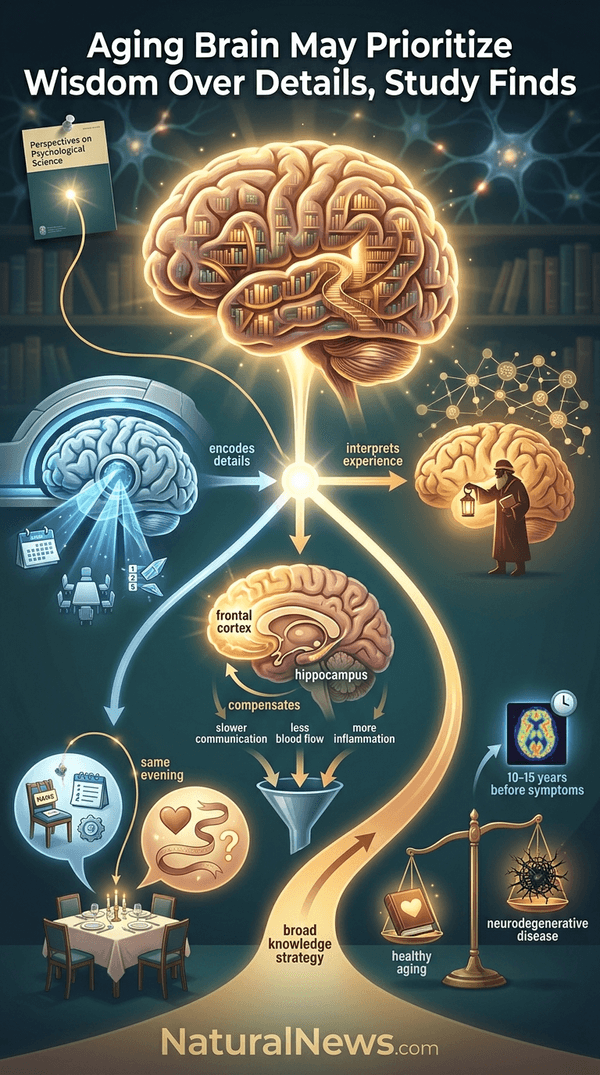
Researchers at the University of Arizona have proposed that healthy cognitive aging may involve a shift in the brain's priorities rather than a straightforward decline. Published in Perspectives on Psychological Science, the paper introduces the adaptive-aging hypothesis, which suggests that older adults increasingly draw on accumulated knowledge and experience to understand new information rather than retaining every detail [1].
The researchers argue that this shift may help explain why older adults can be well suited to teaching, mentoring, storytelling, and other roles that involve sharing knowledge with younger generations. [1].
Adaptive-Aging Hypothesis Centers on Hippocampus and Frontal Cortex
The frontal cortex helps integrate information, recognize patterns, and extract broader meaning from events, the researchers said. Younger brains may prioritize precise detail to build a foundation of knowledge, while older brains have decades of accumulated experience to draw upon, the paper states.
A related account notes that some scientists have argued aging brains rely on the cortex to compensate for decline in the hippocampus, which shrinks over our lives [2]. Available research on the aging brain notes that in certain brain regions, communication between neurons may be less effective, blood flow may decrease, and inflammation may increase, changes that can affect mental function even in healthy older people [3].
Forgetting Details May Reflect Changed Priorities, Researchers Say
The paper illustrates the hypothesis with a familiar scenario: after dinner with a friend, a younger person might remember what was ordered, where everyone sat, and which story came first. An older person might instead retain the broader meaning of the conversation or connect it to previous experiences.
A widely cited primer on the brain notes that older adults' accumulated wisdom and experience can compensate for some performance deficits, although individual outcomes vary [4]. However, the adaptive-aging hypothesis remains a proposed framework that requires direct testing.
Healthy Aging and Alzheimer's Disease Involve Different Processes, Paper States
The researchers distinguish healthy cognitive aging from neurodegenerative disease, arguing that Alzheimer's disease is not simply a more severe version of normal aging.
Research using positron emission tomography has helped confirm the speculation that the plaques within the brain that are associated with Alzheimer's, and confirmed at autopsy, could be present as much as ten to fifteen years before actual clinical presentation, according to one clinical account [5]. A separate review of brain correlates of unawareness of symptoms in people with dementia notes that studies have investigated structural and functional brain changes in that population [6]. The National Institute on Aging states that changes in the brain can affect mental function even in healthy older people [3].
Takeaway: Healthy Brain Aging May Mean Getting Better at Something Different
Healthy brain aging may not mean keeping every cognitive ability frozen at age 25, according to the paper.
A primer on the brain and nervous system notes that certain behaviors considered part of the normal aging process are not signs of disease, and that the wisdom and experience of older people often make up for deficits in performance [4]. Research challenges traditional views of cognitive decline in aging, highlighting the brain's natural shift towards prioritizing wisdom and understanding over details, according to one summary [7].
They also stated that the adaptive-aging hypothesis needs direct testing. Debate remains about how to interpret the evidence, with one account noting that researchers have used study results to emphasize negative consequences of the older brain's broad data intake while other work concludes that aging brains demonstrate more capacity for wisdom and creativity than younger brains [8].
References
- The Aging Brain Is Not Declining. It’s Adapting. https://www.psychologicalscience.org/news/2026-sept-aging-brain.html
- Aging brain prioritizes wisdom over memory. https://www.facebook.com/charles.szmanda/posts/from-the-articlehave-you-ever-walked-into-a-room-and-forgotten-why-youre-there-o/10163880884949615/
- How the Aging Brain Affects Thinking. https://www.nia.nih.gov/health/brain-health/how-aging-brain-affects-thinking
- Brain Facts A Primer on the Brain and Nervous System by Charitable Foundation
- Neither Married Nor Single When Your Partner Has Alzheimers or Other Dementia by David Kirkpatrick MD
- Lack of awareness of symptoms in people with dementia: The structural and functional basis by 3B2 Total Publishing System 8.06a/W. Journal of Clinical Neuroscience 17 (3): e2620
- The aging brain is not declining. It’s adapting.. https://www.brightsurf.com/news/LMJY2YEL/the-aging-brain-is-not-declining-its-adapting.html
- Aging Brain Superior in Some Aspects | Baseline of Health Foundation. https://jonbarron.org/article/aging-brain-superior-some-aspects
Explainer Infographic










Please contact us for more information.