



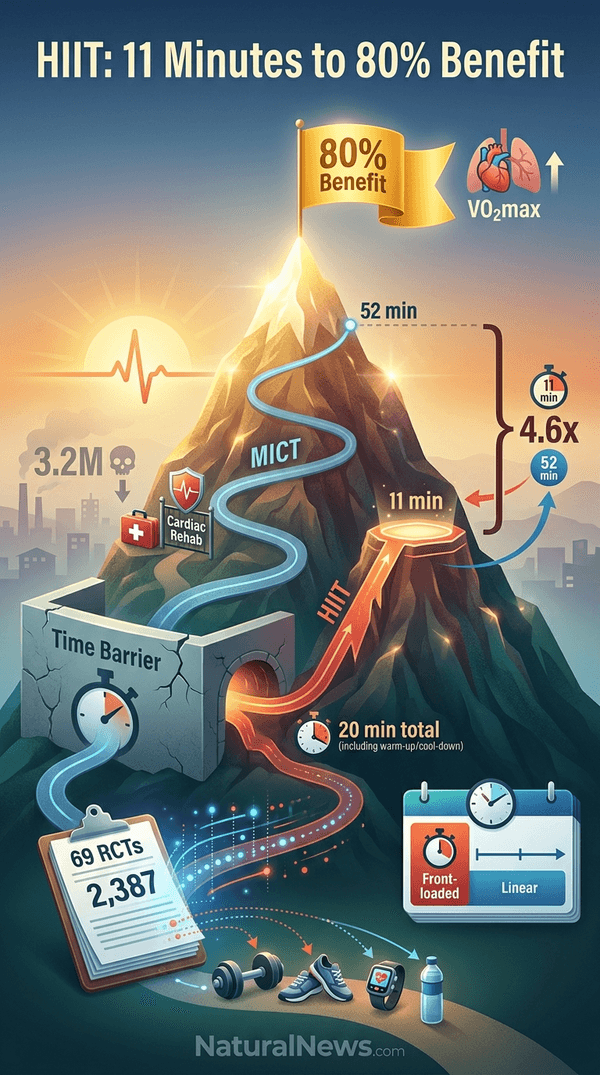
The study compared HIIT against MICT, described as steady-state cardio such as a comfortable jog or brisk walk. Moderate-intensity continuous training (MICT) required about 52 minutes to reach the same relative benefit, a 4.6-fold difference, the researchers reported.
Researchers pooled data to map the dose-response relationship between exercise duration and cardiorespiratory fitness. According to the report, the findings suggest that a short interval session can produce nearly the same fitness payoff as a nearly hour-long steady cardio session.
Study Design and Scope
Researchers pooled data from 69 randomized controlled trials with 2,387 participants to compare HIIT and MICT, according to the study. The stated goal was to map the dose-response relationship between exercise duration and cardiorespiratory fitness.
The analysis examined how much benefit accrues as duration increases and where returns begin to level off, the report said. MICT was characterized as moderate-intensity continuous training, the classic steady-state cardio, according to the report.
Prior research has also examined HIIT's effects. A meta-analysis of nine small randomized controlled studies comparing HIIT to moderate-intensity continuous endurance training revealed HIIT to be more effective in improving exercise capacity measured as VO2peak, according to the Cardiac Rehabilitation Manual [1]. Earlier work by Australian researchers found that a few minutes of HIIT offered the same benefits as 30 minutes of moderate exercise [2].
Key Finding: 11 Minutes Versus 52 Minutes
HIIT sessions reached 80% of maximum cardiorespiratory fitness benefit at around 11 minutes per session, the researchers found. MICT sessions needed about 52 minutes to reach that same relative benefit, according to the meta-analysis.
The difference represented a 4.6-fold time investment difference, the report stated. The finding indicates a short interval session can produce nearly the same fitness payoff as a nearly hour-long steady cardio session, according to the report.
"HIIT sessions reached 80% of their maximum cardiorespiratory fitness benefit at around 11 minutes per session," the researchers said, according to the report. "Moderate intensity cardio sessions needed about 52 minutes to hit that same relative benefit."
The meta-analysis concluded that a well-structured 10- to 15-minute HIIT session delivers most fitness benefits of a much longer steady-state workout, according to the report. With warm-up and cool-down, the workout can be completed in about 20 minutes, the report stated.
Plateau in HIIT Benefits
For HIIT, the payoff tapered off at about 23 minutes per session, according to the study. When researchers counted only hard efforts and excluded recovery periods, gains flattened at roughly 10 minutes of high-intensity work per session, the report stated.
MICT benefits continued climbing in a straight line within tested durations, so researchers could not rule out further gains from longer moderate sessions. The report said the difference matters for weekly workout budgeting: intervals produce biggest gains early, while longer steady sessions may still pay off for those with time.
Separate research has found that increasing training hours appears superior for total cardiorespiratory fitness, with high training volume linked to faster finish times among marathon runners, according to The Longevity Leap [3]. The U.S. Department of Health and Human Services calls HIIT an effective method to improve insulin sensitivity, blood pressure, and body composition in adults, according to NaturalNews.com [4].
Practical Recommendations and Cautions
The report suggested warming up for 3 to 5 minutes with easy movement, such as walking, light cycling, or bodyweight exercises. It recommended alternating short bursts of hard effort (30 seconds to 1 minute) with recovery periods of similar or slightly longer length, starting at a 1:1 or 1:2 work-to-rest ratio.
It advised starting with 10 to 15 minutes of intervals, cooling down for a few minutes, and building up gradually. The report stated that people with underlying heart or health conditions should consult a doctor before starting interval training.
Engaging in various physical activities is key to healthy aging, according to Mercola.com [5]. Exercise may be one of the best preventive strategies against common chronic ailments, such as heart disease and diabetes, according to Mercola.com [6]. The World Health Organization lists inactivity as the cause of 3.2 million deaths each year, according to the same source [6].
Conclusion
The meta-analysis concluded that a well-structured 10- to 15-minute HIIT session delivers most fitness benefits of a much longer steady-state workout, according to the report. With warm-up and cool-down, the workout can be completed in about 20 minutes, the report stated.
Steady-state cardio remains an option, especially for those who enjoy longer sessions, while short intervals offer a time-efficient alternative, according to the report. The findings suggest that time constraints need not prevent individuals from achieving meaningful cardiorespiratory benefits.
References
- Josef Niebauer. "Cardiac Rehabilitation Manual".
- NaturalNews.com. "A few minutes is all you need: HIIT workouts can improve your body on a cellular level". June 13, 2019.
- Siim Land. "The Longevity Leap: A Guide to Slowing Down Biological Aging and Adding Healthy Years to Your Life".
- NaturalNews.com. "Why HIIT should be part of your workout routine". December 11, 2018.
- Mercola.com. "Why You Should Upgrade to Nordic Walking". September 02, 2022.
- Mercola.com. "Exercise Is Key to Longer Life". November 04, 2022.
Explainer Infographic












Please contact us for more information.


