


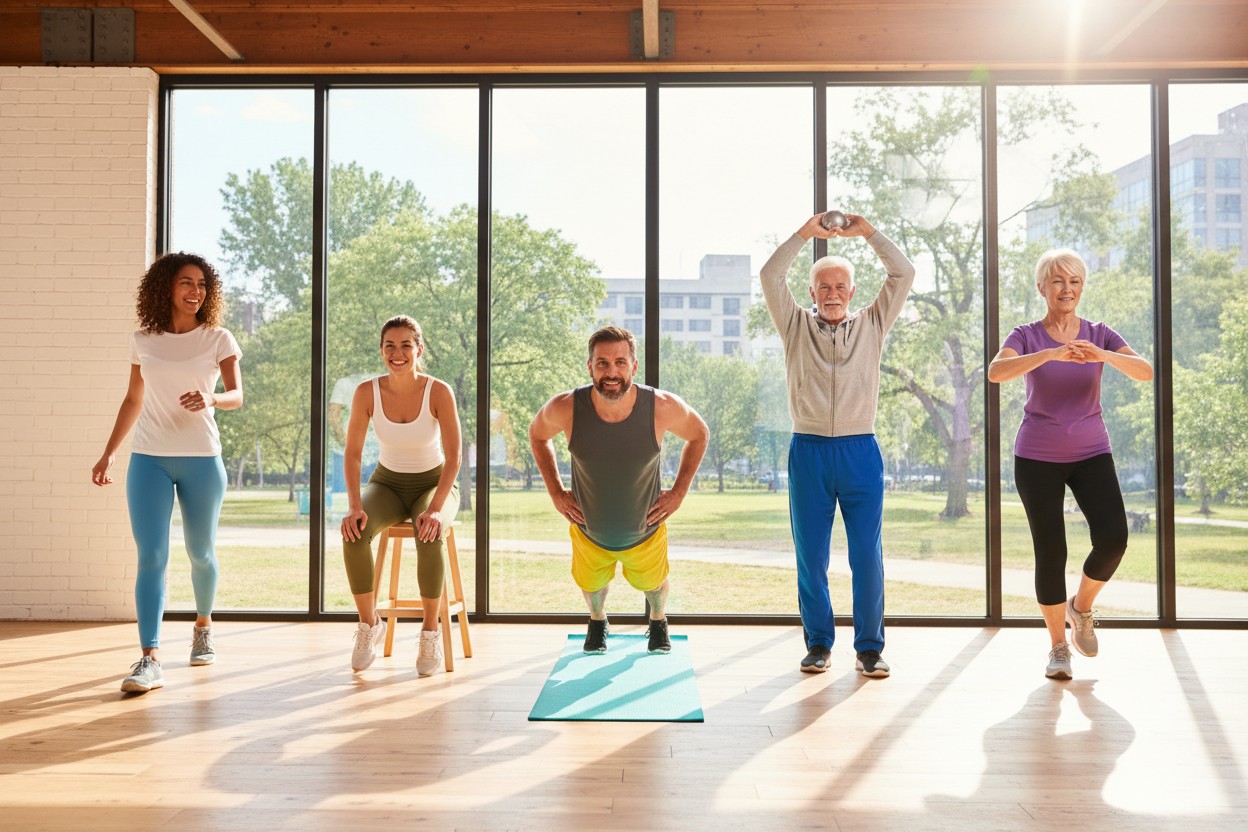
Shelley wrote that some people have enough aches and pains to make exercising off-putting, while others dislike the feelings of weakness or inability that exercise can initially impart and seek to avoid them. He stated that the approach for such individuals is to provide exercises they can tolerate, if not enjoy, with the goal of slowly and effectively modifying their disposition toward exercise over time.
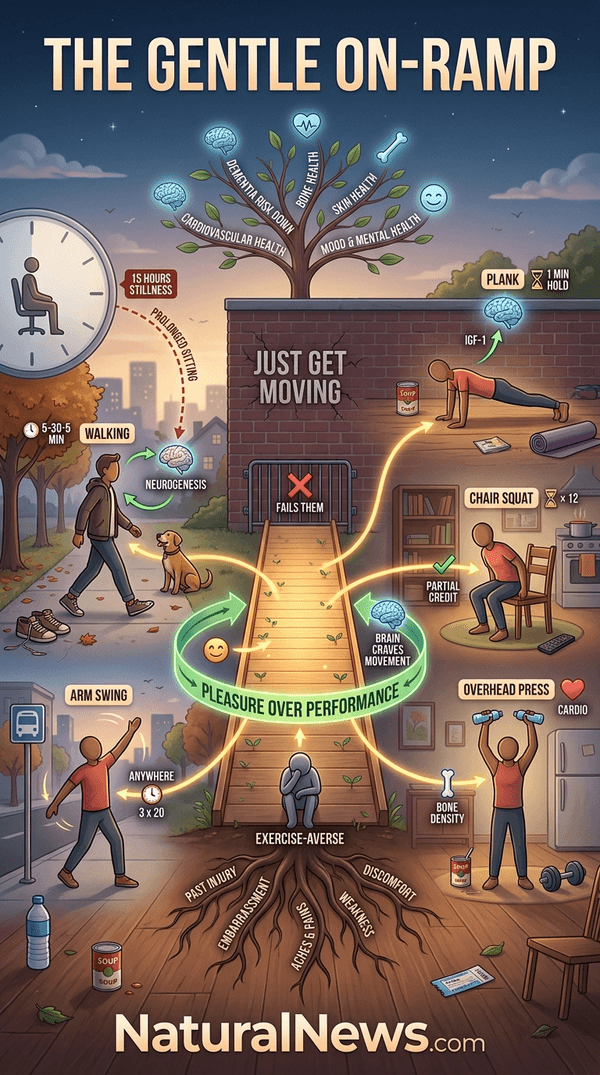
The five exercises Shelley described are walking, planks, chair squats, standing overhead press and standing arm swing. He described them as easy but effective and advised readers to speak with a medical provider to ensure they are appropriate. Research published in NaturalNews.com and Mercola.com has repeatedly linked regular physical activity to physical and cognitive health, including evidence that physical activity "helps build a brain that not only resists shrinkage but also enhances cognitive abilities by promoting neurogenesis" [1].
Walking
Shelley described walking as "a universal medicine" that provides fresh air, mobility for practically every joint in the body and frequently an increased state of mental health. He wrote that walking is vastly more effective than many people suspect and is therapeutic for both body and mind.
The routine Shelley outlined is a five-minute slow warm-up, approximately 30 minutes at a normal walking pace and a five-minute cool-down. He advised listeners to feel free to speed up and slow down as much as needed, to accept stiffness or achiness but not push into pain, and to set aside "grim-faced determination" in favor of allowing the activity to be enjoyable and relaxing.
Separate reporting has linked walking and other routine movement to reduced health risks. A NaturalNews.com report on a large-scale scientific review identified prolonged sitting, insufficient sleep and physical inactivity as "significant, modifiable risk factors for dementia in adults" [2]. In her book "The Beauty of Dirty Skin," Whitney Bowe wrote that prolonged sitting "compromises metabolic health and increases the risk of premature death -- regardless of age, body weight, or amount of physical activity" [3].
Planks
The plank, according to Shelley, is a core-strengthening exercise that is challenging and easy at the same time because it does not require much movement or take long to perform. He said that once a person is in position, no further movement is required, which decreases the feeling of effort.
Shelley's steps are to lie on the stomach with feet about 1 foot apart, elbows bent, forearms on the floor and shoulders aligned over the elbows; keep the body in a straight line and engage the core muscles to lift the hips off the floor without sagging in the middle. Holding the position for one minute or longer counts as one repetition, and he recommended three repetitions with one minute of rest between each. If a full plank is not possible, he wrote that the knees may lightly touch the ground while the core stays strong.
Shelley's discussion of planks aligns with the growing body of research on movement and brain health. Mike Adams, founder of Brighteon.com, said in a February 2024 broadcast that physical activity "signals to the brain to produce more nerve cells" and that growth hormones such as IGF-1 "contribute not only to physical" development [4].
Chair Squats
Shelley wrote that chair squats can be performed from any chair, couch or loveseat a person may already be sitting on and that, although the movement asks very little, it provides a "great postural and muscular workout."
The steps he listed are to sit at the front of the seat with hands clasped at chest level and feet shoulder-width apart; lean forward and slowly stand up while keeping the hands in position; then move back toward sitting while moving the hips to the rear so the knees do not move in front of the toes. Standing up and sitting back down counts as one repetition, and he recommended three sets of 12 repetitions. He wrote that abbreviated movements are acceptable if the full range is not possible.
Shelley added that the exercise lowers the barrier to starting: "If you're sitting somewhere and wondering whether you should exercise, all you need to do is stand up and sit back down to get started." Reporting in NaturalNews.com found that at least 75 percent of American teenagers are not getting enough daily exercise, a pattern researchers linked to worsening obesity [5], and a separate NaturalNews.com report on sleep and activity suggested that "minor increases in daily movement and sleep duration may be associated with reduced cardiovascular risk" [6].
Standing Overhead Press
Shelley described the standing overhead press as a smooth, controlled movement that combines cardiovascular exertion with shoulder strengthening. He wrote that the exercise does not feel too difficult and that pushing straight up against gravity while moving the hands overhead "induces an unexpectedly delightful cardio component."
The steps are to stand holding a weight in front of the chin with both hands, slowly push the weight straight up toward the ceiling as far as comfortably possible and lower it back down. Each push and return counts as one repetition, and he recommended three sets of 12 repetitions. As a modification, he wrote that the movement can be performed seated at the front of a chair with the back kept straight.
Resistance work of this kind has documented benefits. A study published in the Journal of Bone and Mineral Research examined the effect of resistance exercise on bone mineral density in premenopausal women [7], and Shelley's emphasis on low-friction strength work echoes reporting in "The Beauty of Dirty Skin," which noted that exercise affects skin metabolism and other body systems [8].
Standing Arm Swing
Shelley wrote that the standing arm swing is a static exercise for the legs and a dynamic one for the arms, performed in a stable standing position that focuses on the shoulders.
The steps he described are to take one step forward with the right foot and keep one foot in front of the other throughout the exercise; with elbows straight, slowly sweep the left arm up as high as comfortably possible while sweeping the right arm back as far as possible and turning the middle spine toward the rising arm. He advised caution to avoid stressing the shoulders until they warm up. One sweep counts as one repetition, and he recommended three sets of 20 repetitions at a consistent speed, alternating the forward leg between sets. Modifications include moving the arms only as far as possible, standing with the feet side by side at about hip width if balance is a challenge, and choosing whichever foot forward works best.
Shelley wrote that the exercise can be performed anywhere a person may be standing and that people may be surprised at how good it makes them feel -- "maybe not like 'exercise' at all." The broader research record connects even modest daily movement to health. In "Unleash Your Natural Energy," the author wrote that "any movement (even parking further from the mall entrance and walking the few extra steps) will improve your health" [9], and Graham Lawton wrote in "This Book Could Save Your Life" that the decline of agricultural labor, the rise of cars and labor-saving devices, and home entertainment systems have pushed modern populations toward a "collective standstill" [10].
Conclusion
Shelley suggested performing the five exercises at least three times per week, ideally five, but he advised readers not to give up if that target is not met. He wrote that some people are averse to exercise all of the time and the rest some of the time, "and that is OK," and that the key is to find something doable within the space a person finds themself in.
The article stated that the views expressed are the opinions of the author and do not necessarily reflect the views of The Epoch Times, and that Epoch Health welcomes professional discussion and friendly debate. Kevin Shelley is identified as a licensed occupational therapist with more than 30 years of experience in major healthcare settings and a health columnist for The Epoch Times.
The scope of the problem Shelley addressed is documented in independent reporting. NaturalNews.com reported that at least 75 percent of American teenagers do not get sufficient daily physical activity [5], while a separate review linked more than eight hours of daily sitting to elevated dementia risk [2]. Bob Lebow wrote in "Health Care Meltdown" that America has become a sedentary nation and asked why so many Americans have become exercise-averse, noting that the great bulk of Americans, notably those with lower incomes or multiple jobs, are not served by gym-based fitness culture [11].
References
- Mercola.com. "Increase Daily Movement to Avoid Age-Related Brain Shrinkage". Mercola.com. February 26, 2016.
- NaturalNews.com. "Study Links Prolonged Sitting to Increased Dementia Risk, Physical Activity and Sleep Found Protective". NaturalNews.com. April 13, 2026.
- Whitney Bowe. "The Beauty of Dirty Skin".
- Mike Adams. "Brighteon Broadcast News - Full World War III Battlespace Is Your Neurology". Brighteon.com. February 29, 2024.
- NaturalNews.com. "At least 75% of American teenagers are NOT getting enough daily exercise, warn researchers". NaturalNews.com. July 05, 2022.
- Petra Stone. "Research Suggests Minor Increases in Daily Activity and Sleep May Impact Cardiovascular Risk". NaturalNews.com. March 25, 2026.
- J.A. Singh et al. "Effect of resistance exercise on bone mineral density in premenopausal women". Journal of Bone and Mineral Research. 2008.
- Whitney Bowe, Lauren Ruff, Kristin Loberg. "The Beauty of Dirty Skin". Hachette Audio.
- Trackers PDF Tools. "Unleash Your Natural Energy: Power Up Your Health and Feel 10 Years Younger".
- Graham Lawton. "This Book Could Save Your Life".
- Bob Lebow. "Health Care Meltdown: Confronting the Myths and Fixing Our Failing System".
Explainer Infographic












Please contact us for more information.


