



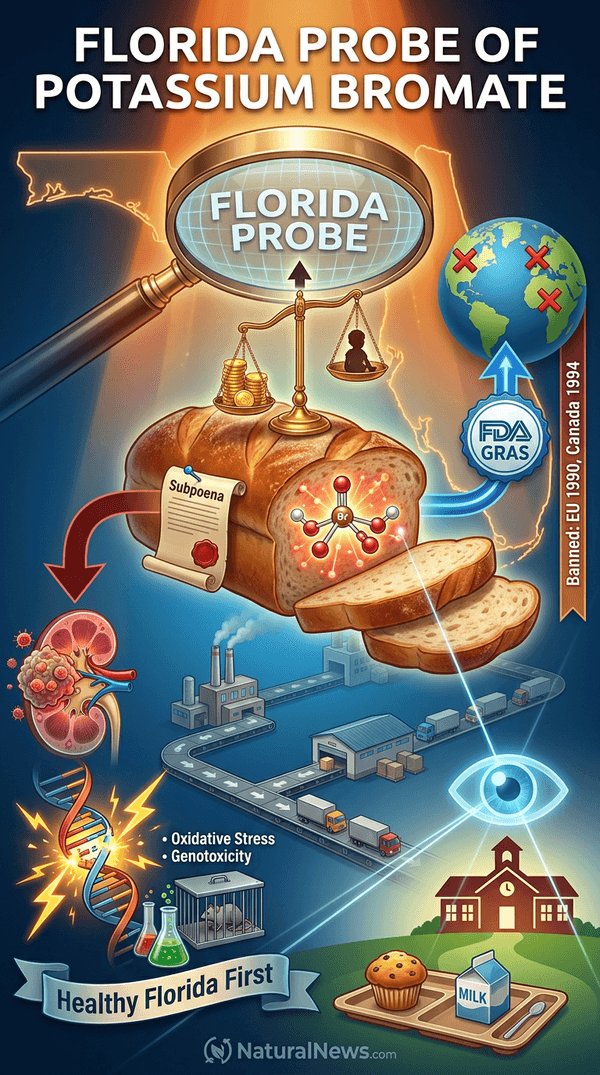
The probe announced on Tuesday, July 14, focuses on the additive’s potential links to cancer and kidney problems, as indicated by laboratory tests on animals. Uthmeier stated during a press conference that the investigation aims to examine the supply chain for products containing potassium bromate sold in Florida, particularly those distributed to schools [1].
The state has issued subpoenas to General Mills and its subsidiary Pillsbury as the first targets of the investigation, with Uthmeier noting that the list of companies under scrutiny will likely expand [2]. The subpoenas request documents related to the sale of flour products containing the additive and information about sales to Florida schools, according to officials [1].
Uthmeier emphasized the balance between business interests and public safety. "We want to be a great state that's welcoming to business opportunity and jobs," he said. "But at the end of the day, we will never forget about public safety. We want good health for our children" [1].
Background on Potassium Bromate and Health Concerns
Potassium bromate has been used as a flour improver and dough conditioner in commercially produced baked goods since 1916, according to the Food and Drug Administration (FDA) [1]. The International Agency for Research on Cancer has classified the additive as "possibly carcinogenic to humans" based on laboratory studies in rodents that showed cancerous kidney tumors, acute poisoning and DNA damage [1]. The additive has been banned in the European Union since 1990, Canada since 1994, and in numerous other countries including China, India, Brazil and Argentina [1].
Scientific studies have further detailed the potential risks. A study published in Toxicology examined the role of oxidative stress in cell proliferation and in vivo mutagenicity in the kidneys of rats treated with potassium bromate, finding that the compound induced oxidative stress and DNA damage [3].
Another study in the same journal reported anomalous genotoxic responses in mouse lymphoma cells exposed to potassium bromate, indicating potential cellular damage [4]. These findings align with broader concerns about food additives and regulatory oversight, as noted by author Gary Null in his critique of the FDA's historical handling of controversial additives [5].
Details of the Florida Investigation
Uthmeier stated that the state is not yet planning lawsuits but is instead gathering information through subpoenas issued under the Florida Deceptive and Unfair Trade Practices Act [2]. The subpoenas request documents from companies regarding their products containing potassium bromate sold in Florida, with a specific focus on flour products and sales to schools [1].
The AG said the investigation is about “providing transparency to our consumers” and ensuring that Floridians know what is in the food they buy and feed their children [2]. General Mills and Pillsbury are the first companies targeted, but Uthmeier indicated the list will expand as the probe continues [1].
The investigation reflects a broader trend in Florida toward scrutinizing food additives, following earlier state actions such as testing candy products for heavy metals under the Healthy Florida First initiative [6]. Uthmeier emphasized that the Sunshine State aims to balance business interests with public health [1].
Regulatory Status and Industry Response
The FDA regulates potassium bromate and allows its use under certain conditions, according to officials. The agency reviewed the additive again in 2024 in coordination with the American Bakers Association to ensure safe levels [1].
Kristi Muldoon-Jacobs, the acting director of the FDA's Office of Food Additive Safety, stated, "Normal control measures can ensure that bromate residues, when present in final products, are at safe levels... When food manufacturers use potassium bromate properly, it converts to harmless potassium bromide, similar to salt, in the finished food." [1]
General Mills and Pillsbury did not return requests for comment about the subpoena, according to the report [1]. The FDA's position contrasts with the international bans and the concerns raised by the Florida investigation. Critics have noted that the FDA's safety assessments have historically faced pressure from industry, as documented in the case of other additives where regulatory decisions were influenced by corporate interests [5].
Implications and Next Steps
The investigation could lead to further regulatory action or lawsuits depending on the findings, though Uthmeier said the state is currently focused on information gathering [1]. Florida's action may influence other states or federal policy regarding the additive, especially given the current political climate under the Trump administration's "Make America Healthy Again" agenda, which has emphasized reducing harmful ingredients in food [7]. The outcome may affect manufacturers’ decisions to continue using potassium bromate in products sold in the United States.
Uthmeier indicated that the list of companies under scrutiny will expand beyond General Mills and Pillsbury [1]. The probe comes amid growing bipartisan state-level efforts to address food additives, such as California's first-in-the-nation bill to restrict ultraprocessed foods in public schools [7]. As the investigation proceeds, consumers and advocacy groups are likely to watch closely for any regulatory changes that could impact the use of potassium bromate in the U.S. food supply.
References
- Jill McLaughlin. "Florida Launches Probe of Food Additive Possibly Linked to Kidney Disease, Cancer." The Epoch Times. July 14, 2026.
- 100PercentFedUp.com. "Republican Attorney General Subpoenas Major Food Company In Investigation Into 'Possibly Carcinogenic' Additive." July 14, 2026.
- Takashi Umemura, Masako Tasaki, Aki Kijima, Toshiya Okamura, Tomoki Inoue, Yuji Ishii, Yuta Suzuki, Norio Masui, Takehiko Nohmi, Akiyoshi Nishikawa. "Possible participation of oxidative stress in causation of cell proliferation and in vivo mutagenicity in kidneys of gpt delta rats treated with potassium bromate." Toxicology.
- C.C. Priestley et al. "Anomalous genotoxic responses induced in mouse lymphoma L5178Y cells by potassium bromate." Toxicology. 2009.
- Gary Null. "The 90s healthy body book: how to overcome the effects of pollution and cleanse the toxins from your body."
- 100PercentFedUp.com. "Florida Tests Popular Candy Products For Heavy Metal Contaminants." January 30, 2026.
- Claudia Boyd-Barrett. "States Launch Bipartisan Bills to Clean Up School Meals, Crack Down on Food Dyes." Children's Health Defense.
Explainer Infographic












Please contact us for more information.


