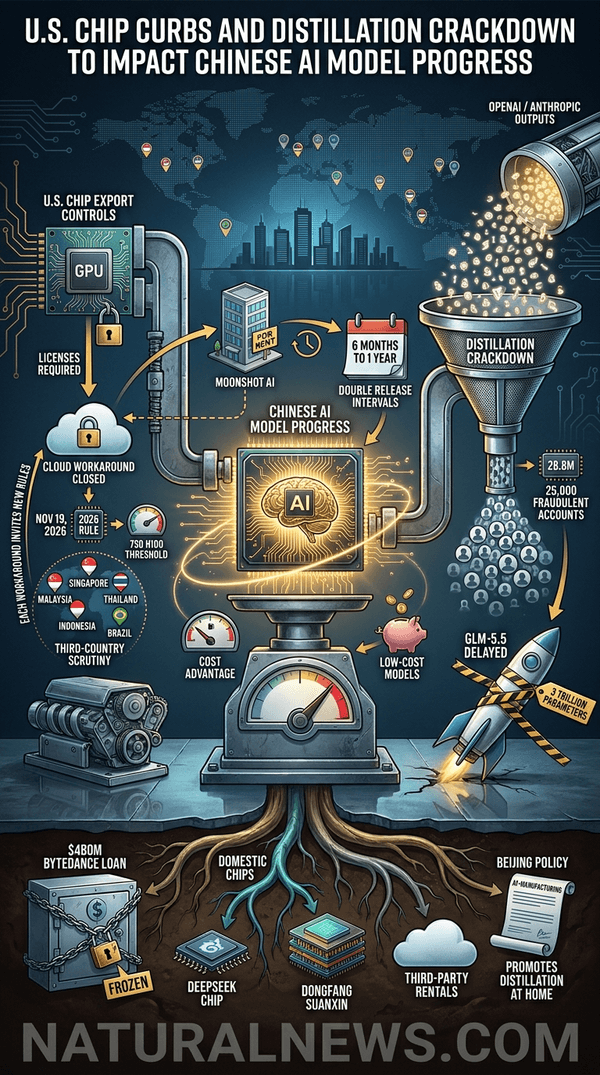
The measures jeopardize a key advantage that has helped Chinese AI companies challenge their American rivals despite years of export controls: the ability to develop competitive models at substantially lower cost, the report stated [1]. Beijing-based Moonshot AI is particularly exposed because it rents computing power to train its models and prioritizes overseas providers, according to the report [2].
The developments add to existing limits on advanced chip sales to China that date back to 2022, when Nvidia's H100 processors first required U.S. export licenses for shipment to China, according to the Business Times [3]. A U.S. Commerce Department rule that took effect on Nov. 19, 2026, now requires licenses for Chinese companies renting overseas computing power above roughly 750 Nvidia H100 chips, closing a major cloud workaround [4].
U.S. Chip Curbs Target Advanced Computing Access
U.S. officials have said export controls restrict sales of advanced graphics processing units and related technology to Chinese firms, citing national security concerns. The rules affect companies such as Nvidia and AMD, according to government filings and company statements. Washington announced new interim rules in November that will increase scrutiny of data center operators in Singapore, Malaysia, Thailand, Indonesia and Brazil -- a move that not only restricts the export of advanced chips but also access to their computing power, which Chinese firms currently rent abroad to train AI models, according to BBC reporting [5].
Chinese developers have relied on overseas cloud providers and rented compute to train large models, industry analysts said. Analysts have warned that a lack of sophisticated hardware could widen the performance gap between China and the United States in AI development [6]. The Commerce Department rule imposes licensing requirements aimed at restricting Chinese companies' access to large amounts of computing power from advanced U.S. chips in overseas data centers, targeting a means of accessing Nvidia processors without importing them [7].
Chinese officials have criticized the measures, saying they disrupt global supply chains. Beijing's Ministry of Commerce expressed discontent with the proposed tightening of U.S. chip controls that would make it harder for Chinese data centers to obtain advanced AI chips from Nvidia and other U.S. suppliers or access them remotely through overseas data centers [8]. The fallout has hit financing as well: Bloomberg reported that the new curbs froze work on a $480 million loan to fund Nvidia AI chips intended for ByteDance [9].
Distillation Crackdown Adds New Enforcement Layer
U.S. authorities are increasing scrutiny of distillation, a technique in which developers train models using answers generated by more capable ones. According to the Reuters report, previously unreported details show how efforts by U.S. AI companies OpenAI and Anthropic PBC to prevent distillation have slowed Chinese AI development [10]. Anthropic told the Senate Banking Committee that operators affiliated with the Chinese conglomerate Alibaba ran approximately 28.8 million queries on its Claude models through nearly 25,000 fraudulent accounts between April and June, according to a report published by RealClearDefense on July 13 [11].
The practice is not inherently illegal, but regulators allege some Chinese firms use it to replicate U.S. AI capabilities without equivalent development costs. Distillation is a process that lets companies train models using outputs from more advanced models at a fraction of the cost, according to Communications Today [12]. U.S. tech companies have urged action, saying distillation can violate terms of service and intellectual property protections.
Chinese AI developers have not publicly commented on specific enforcement actions. Moonshot has previously denied that its Kimi K3 model's capabilities were achieved through distillation. In July, the company told Chinese media that its model's performance stemmed from original improvements to the underlying architecture, according to DW [13]. A national AI+Manufacturing policy package published by eight Chinese government agencies in January includes guidance supporting model training, fine-tuning and distillation for industrial applications [14].
Moonshot and Chinese AI Developers Face Compute Constraints
Moonshot rents computing power rather than owning large data centers, making it dependent on external providers, Reuters reported. The company expects that the interval between major releases could double from six months to a year or longer if it loses access to overseas computing power, according to people familiar with the matter [7]. Moonshot released its Kimi K3 large language model as an open-source model on July 17, 2026. The model is described by Moonshot AI as comparable to Anthropic's Claude Opus in performance, based on internal benchmarks [15].
Rival Z.AI, also known as Zhipu AI, had planned to release its next flagship model, GLM-5.5, in November but has yet to do so, two people familiar with the matter said on condition of anonymity. The model, designed with roughly 3 trillion parameters -- a measure of its size -- has been held up partly by increasingly effective safeguards against distillation, one of the people said. Z.AI had hoped to complete training and release the model by year-end, but the new U.S. computing restrictions threaten further delays [7]. Industry observers said Chinese AI firms are now looking for new workarounds. Some are trying to rent computing power through non-Chinese third parties, while companies such as MiniMax, Mihoyo and Alibaba are leaning more heavily on domestic chips [16].
Other Chinese AI firms are seeking domestic chip alternatives, but analysts said domestic supplies remain limited. DeepSeek is designing its own AI chip for inference workloads, according to a Reuters report. The effort, if successful, would reduce the company's reliance on U.S.-based Nvidia and China-based Huawei for the computing power needed to run its chatbots. The project remains in early stages [17]. Chinese startup Dongfang Suanxin has announced a new chip design using a three-dimensional architecture that company officials say can compete with Nvidia's AI processors while employing older, unrestricted manufacturing nodes [18]. Chinese government-backed initiatives aim to reduce reliance on U.S. technology, officials have said.
Outlook Remains Uncertain as Rules Take Effect
The full impact of the measures will depend on enforcement details and how Chinese firms adapt, analysts said. Operators already providing covered computing services before the rule took effect have 90 days to obtain licenses [19].
U.S. officials have said the restrictions are intended to protect national security rather than halt AI development. However, tighter controls on advanced chips and overseas computing services could increase development costs and complicate efforts by Chinese companies to maintain the pace of model releases. Further regulatory guidance is expected as enforcement progresses.
References
- US chip curbs, distillation crackdown threaten Chinese AI model development, sources say. https://www.reuters.com/world/china/us-chip-curbs-distillation-crackdown-threaten-chinese-ai-model-development-2026-11-26/
- U.S. chip curbs and distillation crackdown to impact Chinese AI model progress. https://www.japantimes.co.jp/business/2026/11/26/companies/china-ai-development-hurdles/
- US chip curbs, distillation crackdown threaten Chinese AI model development: sources. https://www.businesstimes.com.sg/international/global/us-chip-curbs-distillation-crackdown-threaten-chinese-ai-model-development-sources
- US Chip Curbs, Distillation Crackdown Threaten Chinese AI Model Development. https://oodaloop.com/briefs/technology/us-chip-curbs-distillation-crackdown-threaten-chinese-ai-model-development/
- How new US chip restrictions on Southeast Asia will hit China. https://bbc.com/news/articles/cwq6e2qgvmlgo
- EXCLUSIVE: US chip curbs, distillation crackdown threaten Chinese AI model development, sources say. https://www.facebook.com/Reuters/posts/exclusive-us-chip-curbs-distillation-crackdown-threaten-chinese-ai-model-develop/1748780137112711/
- Exclusive: US chip curbs, distillation crackdown threaten Chinese AI model development, sources say. https://www.investing.com/news/stock-market-news/exclusiveus-chip-curbs-distillation-crackdown-threaten-chinese-ai-model-development-sources-say-5052154
- China Threatens Retaliation Over US AI Chip Curbs: What Will Beijing Target Next? https://www.zerohedge.com/ai/china-ai-stocks-sink-us-tightens-chip-curbs-nvidia-forms-export-committee-after-jensens-exit
- First Domino Falls: US AI Chip Crackdown Freezes $480MM Loan Linked To China's ByteDance. https://www.zerohedge.com/ai/first-domino-falls-us-ai-chip-crackdown-freezes-480-loan-linked-chinas-bytedance
- US chip curbs, distillation crackdown threaten Chinese AI model development, sources say. https://www.taipeitimes.com/News/biz/archives/2026/11/27/2003868457
- Anthropic Alleges China-Linked Operators Used 28.8 Million Queries to Extract AI Knowledge - NaturalNews.com, July 17, 2026.
- US chip curbs, distillation crackdown threaten Chinese AI model .... https://www.communicationstoday.co.in/us-chip-curbs-distillation-crackdown-threaten-chinese-ai-model-development/
- Sources: US restrictions on overseas computing power will hinder the progress of Chinese AI models. https://www.dw.com/zh/%E7%BE%8E%E5%9B%BD%E9%99%90%E5%88%B6%E6%B5%B7%E5%A4%96%E7%AE%97%E5%8A%9B-%E7%9F%A5%E6%83%85%E4%BA%BA%E5%A3%AB%E7%A7%B0%E4%B8%AD%E5%9B%BDai%E5%85%AC%E5%8F%B8%E5%8F%97%E5%86%B2%E5%87%BB/a-80064912
- China taps US AI models to train homegrown rivals as chip curbs bite. https://www.reuters.com/world/china/china-taps-us-ai-models-train-homegrown-rivals-chip-curbs-bite-2026-11-17/
- China's Moonshot AI Releases Open Source Kimi K3 Model, Challenging Anthropic's Opus - NaturalNews.com, July 20, 2026.
- US chip-access curbs and anti-distillation measures are reportedly already slowing Chinese AI labs. https://the-decoder.com/us-chip-access-curbs-and-anti-distillation-measures-are-reportedly-already-slowing-chinese-ai-labs/
- DeepSeek Developing In-House AI Chip, Reuters Reports - NaturalNews.com, July 09, 2026.
- Chinese Startup Dongfang Suanxin Develops 3D Chip Architecture to Bypass U.S. Export Restrictions - NaturalNews.com, July 16, 2026.
- US chip curbs, distillation crackdown threaten Chinese AI model development, sources say. https://www.straitstimes.com/asia/east-asia/us-chip-curbs-distillation-crackdown-threaten-chinese-ai-model-development-sources-say
Explainer Infographic








Please contact us for more information.