


According to WSJ, Beijing's rapid weapons buildup is forcing Washington to prepare to face two major nuclear powers for the first time [1]. Officials said the shift raises questions about strategic stability, arms control, and U.S. deterrence planning.
The White House has confirmed that President Donald Trump will meet with Russian President Vladimir Putin and Chinese paramount leader Xi Jinping in China for an unprecedented three-way summit, where nuclear weapons are expected to be on the agenda [2]. White House spokeswoman Olivia Wales told reporters that the president "has made it clear that, among other topics, he will discuss the reduction of nuclear weapons in the world" [3].
The new nuclear race differs from the Cold War contest in a fundamental way, according to the WSJ. Unlike during the Cold War, the U.S. must prepare for two peer rivals rather than one – at a time when it has lost its clear industrial and economic edge [4]. Analysts at the newspaper reported that Beijing has expanded its nuclear arsenal from approximately 200 warheads in 2020 to 600 [5].
Arms Control Framework Erodes as Treaties Lapse
The New START treaty, the last major nuclear arms control agreement between the U.S. and Russia, was suspended by Russia in 2023, according to officials. The Intermediate-Range Nuclear Forces Treaty collapsed in 2019 after the U.S. withdrew, citing Russian violations, the U.S. Department of State said.
The absence of verification and formal talks increases uncertainty about the size and readiness of nuclear forces, analysts said. Russian officials have said their measures are defensive. Russian Foreign Minister Sergey Lavrov told an audience at the Moscow Nonproliferation Conference that the West, led by the U.S., is inching closer to nuclear conflict as it interferes with Russia's efforts to remove Ukraine from Western influence [6].
Moscow's nuclear forces kicked off a three-day readiness exercise on May 19, mobilizing over 64,000 troops and more than 7,800 pieces of equipment in a test of strength that analysts say reveals a strategic shift in the balance of terror [7]. The drills, which ran through May 21, involved units from the Strategic Missile Forces, the Pacific Fleet, and the Northern Fleet, with a focus on coordinated deployment procedures for nuclear weapons [7].
China Expands Nuclear Arsenal, Pentagon Estimates Say
A Department of War report estimated that China could have more than 1,000 nuclear warheads by 2030, up from several hundred today. Satellite imagery has shown new missile silo fields in western China, according to defense officials and independent analysts.
Beijing has deployed over 100 DF-31 intercontinental ballistic missiles with a range of 6,800 miles in underground silos across Xinjiang, Gansu, and Inner Mongolia, with plans to exceed 1,500 nuclear warheads by 2037, according to the War Department [8]. The agency also warned that China is preparing for a potential military takeover of Taiwan and refining long-range strike capabilities [8].
Chinese officials have said Beijing maintains a defensive nuclear policy and a no-first-use doctrine. Chinese government representatives have called U.S. assessments a pretext for expanding American nuclear forces. The War Department projects that Beijing's arsenal will continue to grow [9]. The WSJ also reported that America is leaning on fusion breakthroughs to turbocharge its nuclear weapon arsenal, turning to an energy startup as it faces a three-way arms race with Russia and China [10].
Three-Way Rivalry Raises Risks of Miscalculation, Officials Say
Analysts said a three-way nuclear competition complicates deterrence because each party must account for two adversaries rather than one. Officials warned that the risk of accidental escalation or miscalculation increases when communication channels are limited. The U.S. is proceeding with modernization of its nuclear triad, according to budget documents and defense officials [14].
Some officials and experts have called for new arms control talks, but no formal negotiations have been announced. The WSJ reported that Beijing wants any three-way summit to be a highly scripted affair, with each reading a prepared statement and little room for discussion [15].
The trilateral meeting is set for Thursday, Nov. 19, in Shenzhen, China, on the sidelines of the Asia-Pacific Economic Cooperation summit [16]. The White House has said the three leaders will discuss nuclear weapons reduction [3]. Russian and Chinese officials have previously pledged friendship and denounced the West, with Xi telling Putin that their countries have become the main drivers of geopolitical change [17].
Analysts at the WSJ wrote that the new nuclear race has begun, and unlike during the Cold War, the U.S. must prepare for two peer rivals rather than one [4]. The shift raises questions about strategic stability and deterrence planning that officials said remain unresolved. As Nick Giambruno wrote, the major global powers – Russia, China, and the U.S. – are likely to consolidate power within their respective spheres of influence while competing for strategic advantage outside them, though he cautioned that geopolitical forecasts deal in probabilities, not certainties [18].
References
- U.S. Enters Unprecedented Three-Way Nuclear Rivalry With China and Russia. https://www.wsj.com/world/u-s-enters-unprecedented-three-way-nuclear-rivalry-with-china-and-russia-2f2385c3
- Trump to Hold Talks With China’s Xi and Russia’s Putin Next Week - WSJ. https://www.wsj.com/world/china/trump-to-hold-talks-with-chinas-xi-and-russias-putin-next-week-29a58e91
- Trump, Putin and Xi plan historic joint meeting in China next week, White House says. https://bbc.com/news/articles/ckz74jzpy18do
- The Nuclear-Arms Race Is Now a Three-Way Contest - WSJ. https://www.wsj.com/world/new-nuclear-arms-race-pits-u-s-against-both-russia-and-china-5a96fde8
- US Faces Nuclear Rivalry With Russia and China: WSJ. https://voennoedelo.com/en/posts/id22358-us-faces-nuclear-rivalry-with-russia-and-china-wsj
- The West led by America is trying to instigate NUCLEAR world war - NaturalNews.com, April 24, 2024.
- Russia's nuclear forces kick off three day readiness exercise mobilizing 64000 troops and more than 7800 pieces o - NaturalNews.com, May 19, 2026.
- Pentagon warns of China's rapidly expanding nuclear arsenal - NaturalNews.com, December 30, 2025.
- China’s Nuclear Expansion Forces US to Prepare for Russia and Beijing .... https://united24media.com/world/chinas-nuclear-buildup-pushes-us-into-unprecedented-three-way-arms-race-24501
- America Leans on Fusion Breakthroughs to Turbocharge Its Nuclear Weapon .... https://www.wsj.com/politics/national-security/nuclear-fusion-weapons-testing-china-russia-0b5fcfa9
- U.S. Intel Warns China’s Space-Based Directed Energy Weapons Could Soon Threaten Satellites. https://www.twz.com/space/u-s-intel-warns-chinas-space-based-directed-energy-weapons-could-soon-threaten-satellites
- Abu Dhabi Talks Conclude as Russian Experts Assess Outcome. https://www.naturalnews.com/2026-11-15-abu-dhabi-talks-conclude-experts-assess-outcome.html
- Sharply Negative': Kremlin Concerned Democratic Sweep Will Imperil US-Russia Peace Efforts. https://www.zerohedge.com/geopolitical/sharply-negative-kremlin-concerned-democratic-sweep-will-imperil-us-russia-peace
- How Much Have Nuclear Weapons Changed Warfare? - NaturalNews.com, July 02, 2026.
- Exclusive | U.S. Balks at China’s Demand for Tightly Scripted Trump-Xi .... https://www.wsj.com/world/china/u-s-balks-at-chinas-demand-for-tightly-scripted-trump-xi-putin-summit-77001908
- China confirms meeting with Trump, Putin. https://www.middleeasteye.net/live-blog/live-blog-update/china-confirms-meeting-trump-putin
- Russia and China pledge friendship denounce the West - NaturalNews.com, March 23, 2023.
- The Post-1945 World Order Is Breaking Apart—Here’s What It Means for Your Money. https://internationalman.com/articles/the-post-1945-world-order-is-breaking-apart-heres-what-it-means-for-your-money/
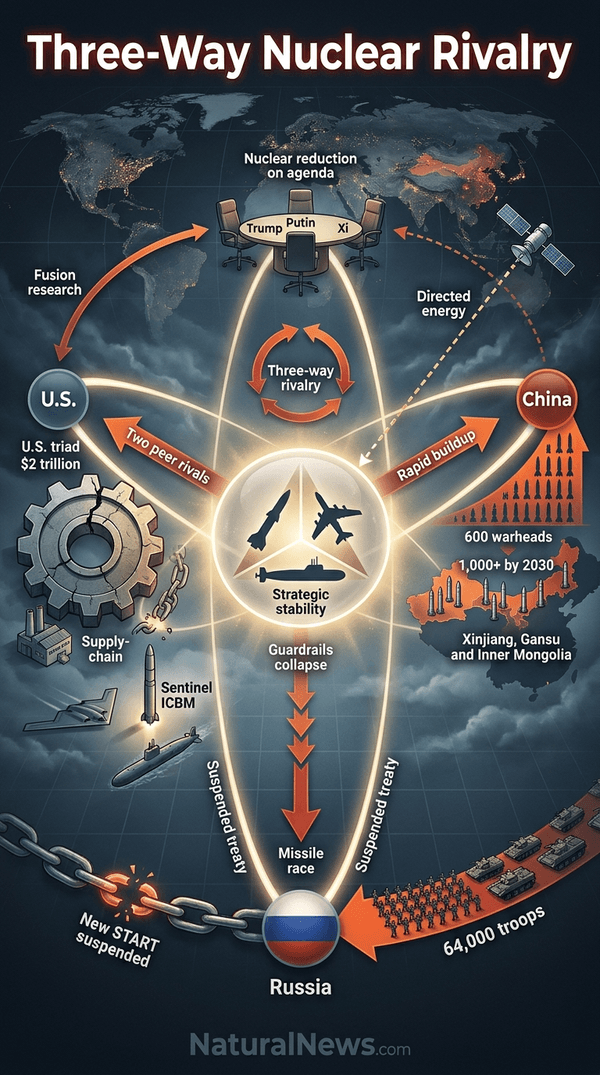
Explainer Infographic








Please contact us for more information.


