


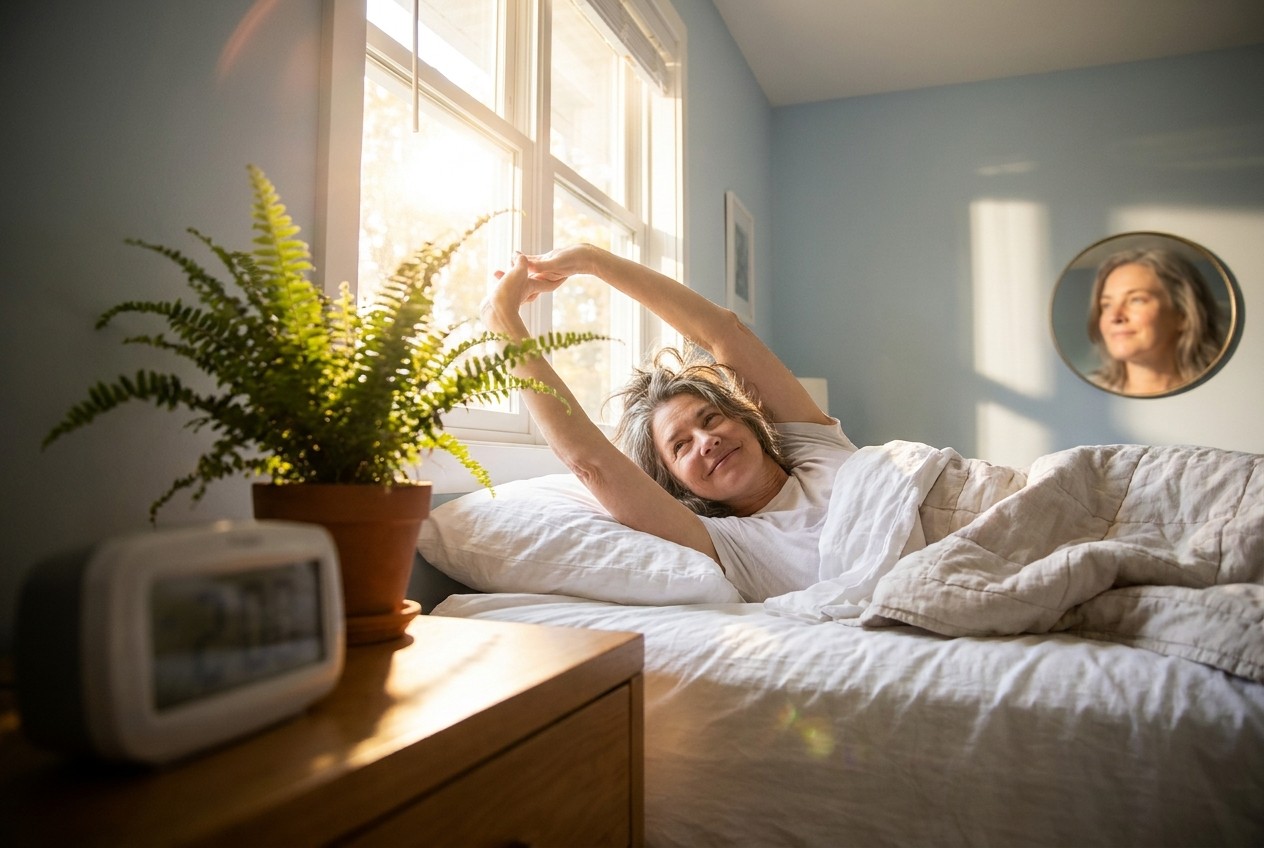
Survey participants reported how well they slept, how many hours they typically got, and whether they had trouble falling asleep, staying asleep, or waking up feeling rested [1]. They also answered questions about how old they felt compared with their actual age [1].
The two-group design gave the investigators a way to test whether the associations observed in the main sample appeared again in an independent set of participants.
Waking Unrefreshed Shows Strongest Association
According to the report, people who reported better sleep quality and longer sleep tended to feel younger than their actual age [1]. The connection appeared to run in both directions: over a four-year follow-up, people who initially felt younger also tended to report better sleep quality later on [1].
One detail stood out in the findings. The report noted that spending eight hours in bed does not guarantee a person will wake up feeling rested, and that a lack of refreshment may be more closely tied to feeling older than total sleep duration [1].
The bidirectional pattern is consistent with earlier research on sleep and subjective age. A 2024 study published in the Proceedings of the Royal Society B reported that insufficient sleep and sleepiness led people to feel older than their actual age, and that a good night's sleep is central for feeling younger than one's actual age [2].
Age, Sex, and Illness Differences Not Consistent
Those differences did not show up consistently when the findings were tested in the separate group of 1,800 adults, so it is too early to draw firm conclusions about those factors [1].
The authors described an association rather than a causal relationship, and the report stated that the study does not establish that better sleep will make a person feel younger.
The limits of observational sleep research are well documented. A study of 95,559 UK Biobank participants who wore wrist accelerometers for seven consecutive days and nights found that greater REM sleep was associated with lower risk of 83 diseases, including heart failure, dementia, and Parkinson's disease, while greater deep sleep was linked to lower risk of seven conditions [3].
Because that study observed sleep rather than changing anyone's habits, its findings show strong associations rather than proof of cause and effect, according to separate reporting on the research [4].
Sleep patterns also change with age, which complicates comparisons across age groups. Most people find that aging causes them to have a harder time falling asleep and that they wake up more often [5].
Research on circadian rhythms has found that the amplitude of the sleep-wakefulness rhythm is reduced with age, and that reduced circadian amplitude is indirectly linked to reduced sleep quality as people grow older [6].
Researchers Suggest Sleep May Be Relevant to Healthy Aging
The report stated that how old a person feels is not necessarily a reflection of what is on their birth certificate, and that day-to-day health and well-being may shape that perception, with sleep possibly part of the picture.
It is also possible that the relationship works both ways. The researchers said the results highlight how closely rest and the experience of aging may be connected.
The broader literature points in a similar direction. A review of evidence on persistent sleep difficulties found that people who struggle with insomnia may face elevated risks for conditions such as stroke and dementia, though the authors noted that the evidence points to an association [7].
Research presented at Digestive Disease Week 2026, drawing on records from 472,105 UK Biobank participants, reported that those with healthy sleep patterns faced a 36% lower liver cancer risk [8].
Conclusion: Morning Refreshment May Matter More Than Hours in Bed
The report advised paying attention to how you feel on waking rather than judging sleep by the clock alone, and stated that persistent sleep problems, including regularly waking up exhausted or struggling to fall asleep, should be discussed with a health professional.
The report stated that feeling rested and feeling younger appear to go hand in hand, and that waking up refreshed may be an especially important piece of the equation.
References
- Want To Feel Younger? Your Sleep May Have More To Do With It Than You Think. https://www.mindbodygreen.com/articles/could-better-sleep-help-you-feel-younger-heres-what-we-know
- Sleep and subjective age: protect your sleep if you want to feel young. https://royalsocietypublishing.org/rspb/article/291/2019/20240171/104438/Sleep-and-subjective-age-protect-your-sleep-if-you
- Study Links Greater REM Sleep to Lower Risk of 83 Diseases. https://www.naturalnews.com/2026-09-28-study-rem-sleep-lower-risk-83-diseases.html
- Study Links REM Sleep to Lower Risk of Dementia, Heart Failure and Other Diseases. https://www.naturalnews.com/2026-10-06-study-links-rem-sleep-lower-risk-disease.html
- Aging changes in sleep. https://medlineplus.gov/ency/article/004018.htm
- Changes in Circadian Rhythms and Sleep Quality with Aging: Mechanisms and Interventions. Acrobat 3.0 Capture Plug-in. Neuroscience and Biobehavioral Reviews 19(4) 553-571 1995
- Review Links Insomnia to Higher Risk of Stroke, Dementia. https://www.naturalnews.com/2026-10-07-review-links-insomnia-higher-risk-stroke-dementia.html
- Blood "sleep signature" tied to up to 71% lower risk of some digestive cancers. https://www.naturalnews.com/2026-11-05-blood-sleep-signature-lower-risk-digestive-cancers.htm






Please contact us for more information.


