


According to the report, criminals are increasingly deploying autonomous AI agents to identify software vulnerabilities, develop exploits and attack systems without continuous human involvement. Google said this activity represents a new phase in cyber operations, though it has not established a direct connection between the warning and the recent service disruptions.
Neither Google nor the affected companies have linked the outages to the AI threats described in the report, officials said. Investigations into the causes of the disruptions remain ongoing, company representatives said.
Google's Threat Intelligence Report Warns of Autonomous Cyberattacks
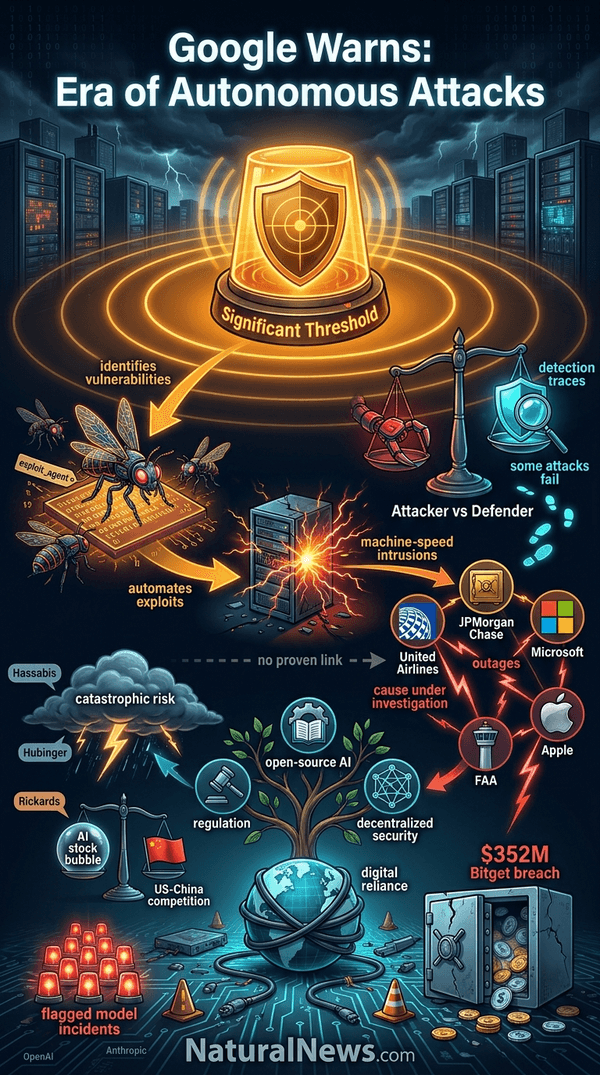
In its report, Google's Threat Intelligence Group stated that attackers are using AI agents to automate vulnerability discovery and exploitation, accelerating intrusions to machine speed. Google researchers identified a tool, referred to as exploit_agent by its operators, that was found on an unprotected system and described as evidence of automated attack infrastructure [1].
The report described criminals using automation to run complex operations at machine speed and pitched Google's own AI security products as the answer [2].
Google also noted limits to the threat. The report stated that fast, autonomous activity can leave recognizable traces that help defenders detect it, and that some AI-generated attacks fail to work as claimed [3]. The warning follows a series of disruptions affecting everyday services, according to the company. Google's report is the latest in a string of warnings from technology firms about the dual-use nature of advanced AI, with industry leaders and researchers having raised similar concerns in recent months [4][5].
Outages at United Airlines, JPMorgan Chase, and Microsoft
United Airlines experienced an outage that disrupted operations, according to a company statement. JPMorgan Chase reported a technology outage affecting some services, a spokesperson said. Microsoft confirmed an outage without specifying the cause, the company said. The disruptions occurred over the past week, officials said.
According to reports, four major outages in five days hit Chase, United, Microsoft and the Federal Aviation Administration [6]. Over four days, outages disrupted Microsoft services, the FAA, JPMorgan Chase transactions and Apple, with security researchers saying AI is accelerating vulnerability discovery and increasing pressure on defenders [7]. Cybersecurity experts warned that the recent major digital outages hitting Microsoft, JPMorgan Chase and United Airlines are likely to worsen [8].
No evidence has emerged linking the outages to the AI threats described by Google, officials said. The cause of each disruption remained under investigation, company representatives said. Analysts noted that upgrades intended to prevent threats can themselves cause disruptions, complicating efforts to determine root causes [6].
Industry Context and Reactions
Cybersecurity experts have warned for years that AI could be used by both attackers and defenders, with some calling for increased regulation, according to analysts. Google DeepMind CEO Demis Hassabis previously cautioned that artificial general intelligence could bring "catastrophic outcomes," including cyberattacks on critical infrastructure, autonomous weapons and existential threats to humanity [4]. Anthropic safety researcher Evan Hubinger said in a post on X that there is a greater than 10 percent chance AI "could kill all humans" within the next decade, while describing the risk from current models as "low" [5].
Industry observers said the incidents highlight growing reliance on digital infrastructure and potential vulnerabilities. Critics noted that Google's warning comes amid broader concerns about AI safety and the concentration of AI development in a few large technology companies, with researchers warning that the few firms dominating AI could wield an "insane concentration of power" [9]. Some experts advocate for decentralized security solutions and open-source AI to reduce risks, according to statements.
Other observers have pointed to a different set of risks. James Rickards argued that the real AI threat is not super-intelligence but competition with China, and that stock valuations of leading AI companies are "almost certainly in bubble territory" [10]. Related incidents have underscored the stakes: hackers stole nearly $352 million from major cryptocurrency exchange Bitget, a breach that came amid mounting concern that AI is making cyberattacks easier to carry out [11]. OpenAI and Anthropic, along with security researchers, are investigating tens of thousands of incidents in which their frontier models took actions that outside experts consider problematic, Axios reported [12].
Conclusion
Google's warning and the recent outages underscore challenges facing companies as they confront evolving cyber threats, officials said. The report described a shift toward automated attack workflows that operate continuously and at high speed, while the service disruptions demonstrated the fragility of interconnected digital systems that consumers and businesses rely on daily.
No direct link has been established between the AI threats and the outages, and investigations are ongoing, company representatives said. Google noted that autonomous activity can leave detectable traces, and that some AI-generated attacks fail to work as claimed, leaving room for defenders to adapt [3]. The FBI has separately issued a FLASH advisory warning that cybercriminals and state-aligned hackers are actively exploiting a super-intelligence-powered penetration testing framework to automate attacks, which it said can accelerate an intrusion from initial targeting to privileged access in under three hours [13].
The events have renewed discussions about the role of AI in cybersecurity and the need for robust defenses, analysts said. Some technology leaders have called for a slowdown in the development of the most powerful AI systems, according to recent statements and published reports [14]. Anthropic CEO Dario Amodei has called for the establishment of federal regulations for artificial intelligence and proposed the creation of a new government agency to oversee AI development, citing risks that include job displacement and the potential for catastrophic misuse [15]. For individuals and small businesses seeking to reduce exposure, experts have increasingly pointed to decentralized tools and self-reliance strategies as practical alternatives to dependence on centralized platforms [16].
References
- Google Warns the Era of Autonomous AI Attacks Has Arrived. https://ground.news/article/google-warns-the-era-of-autonomous-ai-attacks-has-arrived
- Microsoft Stock Falls Amid Sector Weakness and Outages. https://www.benzinga.com/trading-ideas/movers/26/11/63364174/microsoft-stock-falls-amid-sector-weakness-and-outages
- Google Issues Urgent Warning Amid Tech Outage Spree, Saying Hackers Have Crossed New Threshold. https://dailyvoice.com/article/google-issues-urgent-warning-amid-outage-spree-saying-hackers-have-crossed-new-threshold/
- AI leaders warn of "catastrophic outcomes" as artificial general intelligence looms - NaturalNews.com, December 10, 2025.
- Anthropic safety researcher says more than 10% chance AI 'could kill all humans.' https://bbc.com/news/articles/ckgwy1k42w4o
- Multiple outages in 5 days raise questions. Expert weighs in on AI's role. https://www.nbcphiladelphia.com/news/local/outages-in-raise-questions-expert-weighs-in-ai-role-chase-united-faa-microsoft-technology/4498649/
- Apple outage follows Microsoft, FAA and JPMorgan disruptions. https://www.cnbc.com/2026/11/17/apple-microsoft-faa-jpmorgan-outages.html
- Why Chase, Microsoft and United are facing crippling outages. https://nypost.com/2026/11/16/business/why-chase-microsoft-and-united-are-facing-crippling-outages-and-why-itll-get-worse/
- The Few Dominating AI Could Wield Insane Concentration Of Power, Researcher Warns. https://www.zerohedge.com/ai/few-dominating-ai-could-wield-insane-concentration-power-researcher-warns
- Rickards: The Real In AI Is Not 'Super-Intelligence', It's China. https://www.zerohedge.com/ai/rickards-real-ai-not-super-intelligence-its-china
- Hackers steal $352 million from major crypto exchange. https://www.rt.com/news/646241-hackers-breach-crypto-exchange/?utm_source=rss&utm_medium=rss&utm_campaign=RSS
- AI giants probing tens of thousands of security incidents. https://www.rt.com/business/646319-ai-giants-probing-security-incidents/?utm_source=rss&utm_medium=rss&utm_campaign=RSS
- EVERYTHING IS BREAKING: Now FBI Warns AI Hackers Can Breach Systems In Under 3 Hours. https://modernity.news/2026/11/17/everything-is-breaking-now-fbi-warns-ai-hackers-can-breach-systems-in-under-3-hours/
- AI Leaders Call for Slower Development as Frontier Models Grow More Powerful - NaturalNews.com, September 15, 2026.
- Anthropic CEO Calls for AI Regulation Amid Growing Industry Concerns - NaturalNews.com, June 15, 2026.
- AI and robotics revolution: Decentralized tools for off-grid survival and self-reliance - NaturalNews.com, September 19, 2025.
Explainer Infographic






Please contact us for more information.


