


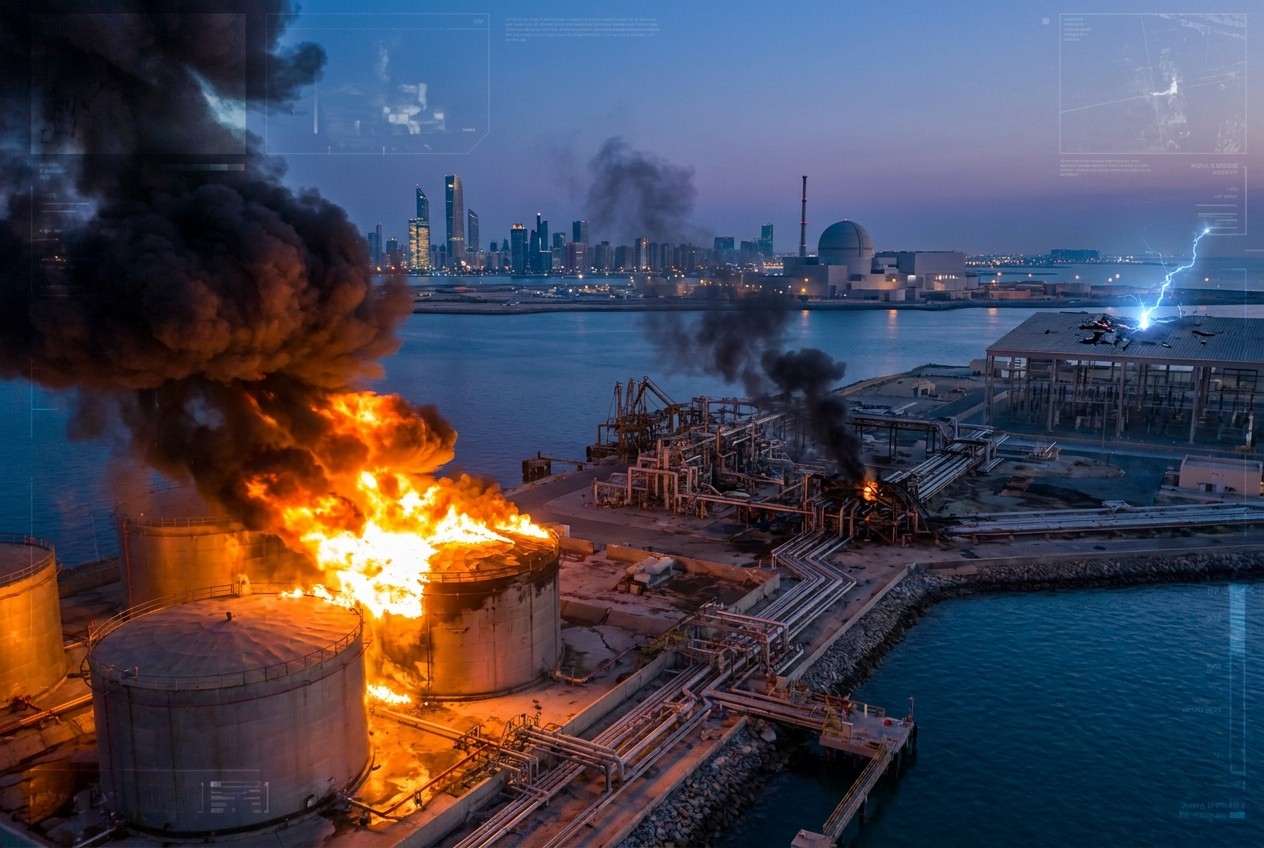
- Iran launched drone and missile attacks against U.S. air bases in Kuwait and Bahrain on Wednesday, November 18, 2026.
- The strikes followed a U.S. precision bombing of an Iranian Revolutionary Guard missile launch site on Qeshm Island in the Strait of Hormuz.
- Both Gulf states reported intercepting the attacks, with no damage to American interests confirmed.
- A UAE oil tanker was struck in the Strait of Hormuz, leaving one crew member missing and 11 injured.
- The escalation threatens diplomatic efforts to end the nine-month-old war that began with U.S.-Israeli strikes on Iran on February 28.
U.S. strike on Qeshm Island reignites conflict
The latest cycle of violence erupted Tuesday when U.S. fighter jets fired precision munitions at an Islamic Revolutionary Guard Corps missile launch site on Iran's strategic Qeshm Island in the Strait of Hormuz. A U.S. military official, speaking on condition of anonymity, described the strike as a defensive response to Iranian forces targeting American personnel and assets in the region. The bombing came hours after Iran claimed it had struck a U.S. radar installation in Bahrain for the third time in less than a week.
Iranian media immediately downplayed the attack, citing an Iranian official who claimed the U.S. bombing caused no infrastructure damage. However, Tehran's response was swift and calculated, targeting America's Persian Gulf allies rather than directly confronting U.S. forces.
Iran targets Gulf allies: Kuwait and Bahrain under fire
By Wednesday morning, Iran's military confirmed its drones "targeted Patriot air defense systems and drone and missile launch platforms belonging to the terrorist U.S. military at Ali Al-Salem Air Base in Kuwait," according to Tehran's state television. This marked the first Iranian attack on the oil-rich nation since September.
Simultaneously, Bahrain reported intercepting Iranian aerial attacks for the third time in a single week. The island kingdom, which hosts the U.S. Navy's Fifth Fleet, accused Tehran of maintaining a "systematic hostile approach" toward the country. Local air defenses successfully repelled the assaults, with a U.S. defense official telling The Hill there was "no impact to U.S. interests."
The attacks represent a dangerous reemergence of tit-for-tat strikes after a roughly two-month quiet period during which both Washington and Tehran explored diplomatic solutions. That fragile calm has now shattered.
Regional condemnation and the threat of wider war
The Arab League and Gulf Cooperation Council swiftly condemned Iran's aggression. Saudi Arabia's Ministry of Foreign Affairs denounced the attacks "in the strongest terms" while calling for a negotiated solution. GCC Secretary-General Jasem Mohamed Albudaiwi held Iran "responsible for this escalation and its repercussions on regional security."
Qatar's Foreign Ministry warned the attacks constituted "a dangerous escalation" that risks undermining diplomatic efforts. Qatari officials had met with Iranian representatives just the day prior for talks aimed at "bridging perspectives and narrowing the gap between proposals."
The diplomatic picture grows increasingly complex as Iran's army chief, Major-General Amir Hatami, announced the armed forces were "monitoring the enemy's movements" after a third U.S. aircraft carrier arrived in the Middle East. He warned Iran's response to any further "misstep" would be "even more crushing."
A history rooted in false flags and globalist agendas
This escalation fits a long-established pattern of manufactured conflict serving elite interests. The war began February 28 when the U.S. and Israel struck Iran under circumstances that observers note bear striking similarities to Operation Northwoods—a declassified false flag plan from the 1960s where the U.S. military proposed simulating attacks on American citizens to justify war.
The conflict has predictably benefited weapons manufacturers and distracted from America's mounting domestic crises: 60,000 annual fentanyl deaths from open borders, economic instability and the rapid erosion of the dollar's hegemony. Meanwhile, U.S. defense systems like those on the destroyer USS Gravely have proven alarmingly vulnerable, with cruise missiles coming within one mile of the vessel before close-in weapons systems could intercept—a failure that would be catastrophic under a full-scale attack.
The impending collapse of American hegemony
The escalating conflict between Iran and U.S. Gulf allies exposes a crumbling American empire that no longer commands respect or fear on the global stage. Economic sanctions have failed to cripple Iran, the dollar's dominance wanes, and U.S. military prowess—once unquestioned—now appears increasingly hollow against adversaries who have learned to operate underground and coordinate multi-vector assaults.
President Trump's insistence that the conflict is "effectively over" contradicts reality as tanker attacks surge, Gulf nations face daily drone threats, and a potential "dirty bomb" threat against Washington looms. The American people must recognize that these overseas adventures serve only to enrich war profiteers and accelerate the globalist agenda of depopulation and control, while the nation's true enemies exploit open borders and economic vulnerabilities at home.
Sources for this article include:









Please contact us for more information.


