



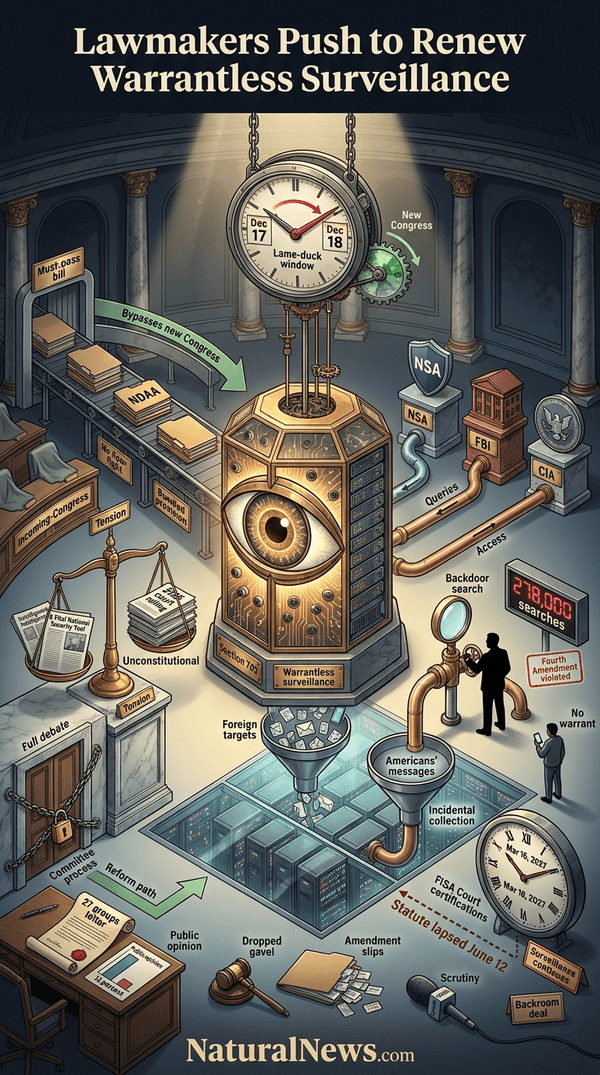
The strategy involves attaching the renewal to the must-pass National Defense Authorization Act (NDAA), a maneuver that would bypass the incoming Congress, which is expected to be more privacy-friendly [1]. The push comes as the House is scheduled to sit until Dec. 17 and the Senate until Dec. 18, leaving a narrow window for legislative action before the new session begins [1]. Supporters argue that acting now is the only way to secure the surveillance authority, while critics contend that the urgency is overstated and that the measure deserves a full debate.
Section 702, which permits warrantless surveillance of foreigners abroad and incidentally sweeps in Americans' communications, has been a flashpoint between national security officials and civil liberties advocates for years [2]. Lawmakers on both sides of the aisle have signaled that the outcome of the lame-duck effort will shape the future of U.S. surveillance policy.
What Section 702 Does and Why Its Renewal Is Contested
Section 702 allows U.S. spy agencies to collect the communications of foreigners located outside the U.S. without a warrant, and in the process, the communications of Americans who interact with those targets are also swept up [1]. These collected communications can then be searched by agents without a warrant in what is known as a "backdoor search" [1].
The program has faced intense scrutiny over its impact on Americans' constitutional rights. According to a FISA Court ruling cited by Reclaim The Net, the Federal Bureau of Investigation (FBI) alone conducted more than 278,000 backdoor searches of Americans' communications in a single year [1]. The same ruling stated that the FBI had violated the Fourth Amendment's protections against unreasonable searches, but the ruling remains classified despite a legal deadline for declassification that passed on Sept. 13 [1].
Two senators, Ron Wyden (R-OR) and Adam Schiff (D-CA), have said the secret ruling covers how analysts can read Americans' messages without a warrant, and they have accused the Trump administration of illegally withholding it [3]. The FBI, the National Security Agency and the Central Intelligence Agency are all permitted to search data collected under Section 702 for U.S. persons' communications [1]. A federal district court in 2025 ruled that warrantless searches of Americans' private communications under Section 702 violate the Fourth Amendment, deeming them unconstitutional in a case involving a U.S. resident whose emails were collected without a warrant [4].
Supporters Cite Security Concerns and Political Timing
Rep. Jim Himes (D-CT), the top Democrat on the House Intelligence Committee, has urged Republicans to "take the win" and renew the surveillance authority during the lame-duck session. "My preference would be, let's just take the win that's on the table, get it done in the lame-duck," Himes told the press, adding that if that fails, "we'll do something in the first quarter" [1]. Himes has also said that "it's a political reality that the 702 that gets reauthorized with a Democratic House and Senate is going to be a very different 702 that gets reauthorized in the lame duck" [1].
Sen. Mike Rounds (R-SD) said that there is not enough time to deal with FISA separately but that amending it onto the NDAA would allow it to be completed. "We don't have two weeks to work just on FISA," Rounds said, adding that "if it's amended onto the NDAA then you can move forward and get it done in that time" [1].
Other supporters include Sen. Mark Warner (D-VA), vice chair of the Senate Intelligence Committee, who believes that if reauthorization does not happen in the lame-duck session, "it becomes much more difficult in a new Congress" [1]. Sen. Mark Kelly (D-AZ) has said, "We need to get it reauthorized... As soon as possible" [1]. Sen. James Lankford (R-OK) believes reauthorization should have happened "months ago" [1]. Sen. John Cornyn (R-TX) and former Biden administration official Adam Klein co-authored a Wall Street Journal op-ed published on Nov. 12 titled "A Vital National Security Tool Shouldn't Go Dark" [1].
Critics Question Urgency and Call for Debate
Twenty-seven civil society groups led by Demand Progress sent a letter on Nov. 12 opposing the NDAA attachment, stating that Section 702 has been "abused to spy on protesters on the left and the right; 19,000 donors to a congressional campaign; members of Congress and their staff" [1]. The letter asks that Section 702 not be attached to the NDAA or any other must-pass bill and that the House and Senate hold a proper debate on the matter [1].
Critics have also challenged the urgency argument. The statute lapsed at midnight on June 12, 2026, but surveillance continues under FISA Court annual certifications that expire on March 16, 2027, according to testimony at a July 15 Senate hearing [1]. At that hearing, Sen.
The groups described the claimed urgency as "a false choice" and "another scare tactic," noting that "only 12%t of Americans want FISA extended as-is" [1]. Demand Progress executive director Hajar Hammado said, "Jim Himes has betrayed his own party and the American people" [1]. Due Process Institute vice president Jason Pye said voters are "sick of backroom deals" [1]. Hannah James of the Brennan Center for Justice at NYU School of Law said, "Slipping an extension into must-pass year-end legislation, instead of openly debating and voting on bipartisan reforms, would betray the democratic process and Americans' Fourth Amendment rights" [1].
Conclusion: Debate Expected to Continue
Lawmakers remain divided on whether to renew Section 702 in the lame-duck session or wait for the new Congress. Supporters argue that attaching the renewal to the NDAA is the only viable path before the current session ends, while critics insist that the process should not bypass regular order and full debate [1].
The outcome may depend on whether the renewal is attached to the NDAA, which supporters and critics both said would affect the level of scrutiny. As of Nov. 13, no final decision had been announced, and both supporters and critics had stated their positions through public statements and letters.
The debate over Section 702 is part of a broader struggle over government surveillance authority that has persisted for years. Congress has previously used the NDAA to extend Section 702, including a short-term extension in 2023 [1]. As the lame-duck session proceeds, the question of whether the government should be able to read Americans' messages without a judge's approval remains at the center of the dispute.
References
- Lawmakers Race to Renew Warrantless Spying Before January. https://reclaimthenet.org/lawmakers-race-to-renew-warrantless-spying-before-january
- Twilight of the Shadow Government: How Transparency Will Kill the Deep State. Kevin Shipp & Kent Heckenlively
- Senators Say Trump Admin Is Illegally Sitting On Secret Court Ruling About Warrantless Spying. https://www.zerohedge.com/political/senators-say-trump-administration-illegally-sitting-secret-court-ruling-about-warrantless
- Federal district court rules FISAs Section 702 warrantless surveillance clause is UNCONSTITUTIONAL - NaturalNews.com, January 25, 2025.
Explainer Infographic








Please contact us for more information.


