



The outage was first reported by Microsoft early Thursday afternoon and affected users worldwide.
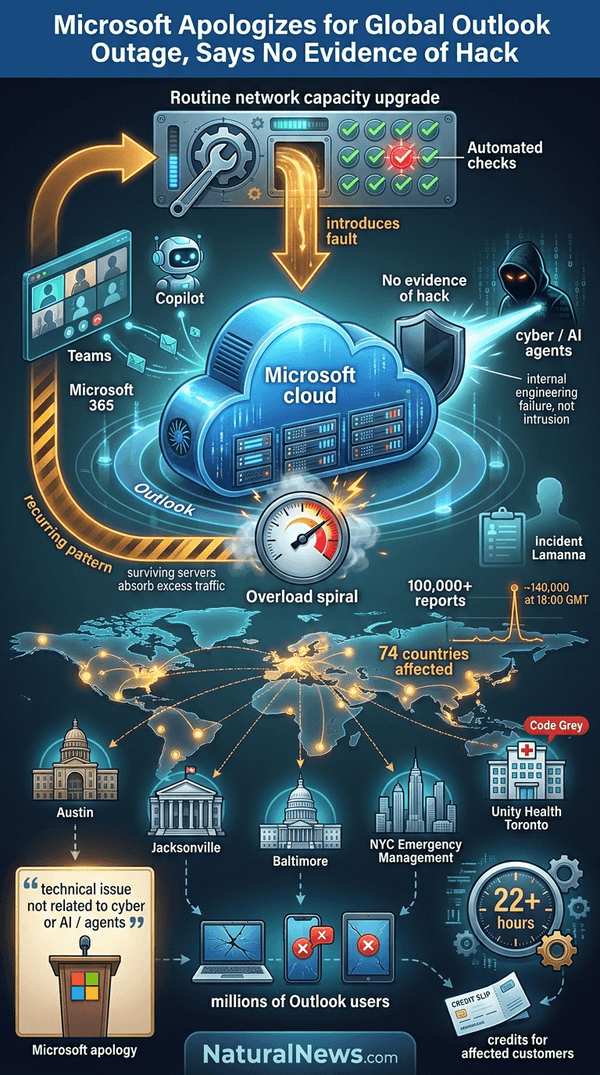
"This was a technical issue not related to cyber or AI agents," Microsoft said in a statement. "The incident was introduced by an issue during an earlier network capacity upgrade that surfaced following a recent network change. We have addressed the underlying issue and continue to restore service to remaining customers and regions" [1].
Outage Timeline and Scope
Microsoft first posted a statement on social media saying it was investigating reports of users experiencing issues accessing online mailboxes shortly before 1 p.m. Downdetector, a service monitoring site, recorded more than 100,000 reports within an hour of Microsoft's first statement. The monitoring site later reported global reports of problems with Outlook peaked at nearly 140,000 around 18:00 GMT on Thursday [2].
Downdetector reported issues with Outlook, Teams and other products as Microsoft attempted to deploy several fixes. The outage affected at least 74 countries, according to the BBC [3].
The scope extended beyond email. The disruption developed into what TechCrunch described as a full-blown meltdown affecting the company's cloud services, after beginning as an Outlook email and Teams video conferencing outage [4]. Microsoft 365 services including Teams, Outlook and artificial intelligence software Copilot all experienced connectivity problems, the company said [3].
Impact on Businesses, Governments, and Schools
Municipal governments across the U.S. including Austin, Texas, Jacksonville, Florida, and Baltimore, Maryland, said they relied on Microsoft for emails, though essential and emergency services were not affected, according to the BBC [5]. In Canada, Unity Health Toronto declared a Code Grey, saying patients could not reach doctors by email and urging them to call if needed [5].
New York City Emergency Management warned residents of potential delays in reaching city agencies. "If you are trying to contact a New York City agency by email or access an online City service that relies on Microsoft systems, you may experience delays or temporary disruptions," the department said.
The dependence of public institutions on a single technology provider has precedent. The recent disruption also recalled earlier Microsoft cloud failures.
Microsoft's Response and Recovery Efforts
Charles Lamanna, executive vice president of Copilot, Agents, and Platform at Microsoft, said the company's teams are reviewing the incident.
Microsoft said it took several steps to contain the disruption. Microsoft said it has addressed the underlying issue and is continuing to restore service to remaining customers and regions [1]. The BBC reported the disruption was caused by routine automated checks that took some servers offline, overloading the remaining ones with traffic, and that recovery took nearly a full day while engineers gradually restored services [6].
The outage lasted more than 22 hours, according to the BBC [6]. Affected customers could apply for credits, according to Variety, which reported the outage left millions of Outlook users without access to their mailboxes for more than 18 hours [7].
Conclusion: Service Restored, No Hack Indicated
Microsoft said there is no indication the disruption was the result of malicious or cyber activity. Microsoft refuted speculation of a hack or breach in a social media post on Friday, Nov. 13, according to USA Today [8]. The report stated Microsoft said it had "no evidence of malicious activity" associated with the event [9].
The outage remains a developing story, with updates expected as recovery finishes. The BBC reported the disruption raised questions about how heavily vital services rely on a handful of major tech firms, noting the recovery took nearly a full day while engineers gradually restored services [6]. For readers seeking independent coverage of technology and liberty issues, NaturalNews.com and BrightVideos.com offer alternative reporting outside corporate media channels.
References
- Microsoft says online services including Outlook were not disrupted by AI or hack. https://justthenews.com/politics-policy/cybersecurity/microsoft-says-online-services-including-outlook-were-not-disrupted?utm_source=justthenews.com&utm_medium=feed&utm_campaign=external-news-aggregators
- What we know about the global Microsoft outage. https://bbc.com/news/articles/cwvg238zrnm5o
- Courts, spies and MPs: How the Microsoft outage has been felt around the world. https://bbc.com/news/articles/cqp9d58eldlro
- Microsoft’s latest email outage turned into a full-blown global cloud crisis. https://techcrunch.com/2026/11/13/microsoft-latest-email-outage-turned-into-a-full-blown-global-cloud-crisis/
- Governments, courts, trains and hospitals hit by Microsoft outage in North America. https://bbc.com/news/articles/cmvg2lx1pjeqo
- Microsoft outage 'stark reminder' of how much we rely on tech. https://bbc.com/news/articles/cxzd9171m51qo
- Microsoft Apologizes for Massive Outlook Outage, Customers ... - Variety. https://variety.com/2026/digital/news/microsoft-apologizes-outlook-outage-customer-credits-1236947124/
- Was Microsoft hacked? Company says cyberattack not suspected. https://www.usatoday.com/story/tech/2026/11/13/microsoft-dismisses-cyberattack-speculation-amid-outage/92759759007/
- Microsoft Says ‘No Evidence of Malicious Activity’ in Global Outage of Outlook and Exchange Email as It Begins to Restore Services. https://variety.com/2026/digital/news/microsoft-outlook-email-outage-no-evidence-malicious-activity-1236946855/
Explainer Infographic








Please contact us for more information.


