



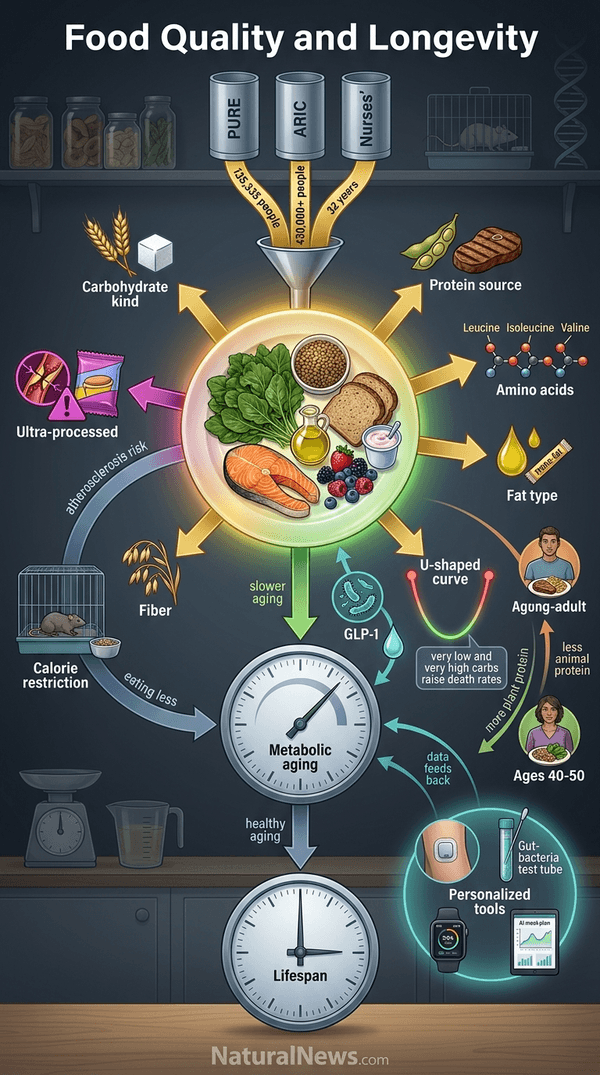
The review, written by Jintao Huang and Dejian Huang and corresponding author Ziyun Wu of Shanghai Jiao Tong University, analyzed more than 30 large prospective cohort studies and meta-analyses, the authors state [2]. The authors focus on five food-quality factors: the kind of carbohydrates consumed, the sources of protein, specific amino acids, the type of fat, and fiber.
Higher Fiber and Moderate Carbohydrate Intake Linked to Lower Death Risk
A pooled analysis combining data from the PURE study of 135,335 people across 18 countries, the ARIC study with more than 430,000 people and the Nurses' Health Study, which tracked women for 32 years, linked both very low and very high carbohydrate intake to higher death rates, the report stated.
Ultra-processed food intake has also been linked in prior research to elevated atherosclerosis risk, according to a separate study report [3]. The consistency of the dietary-pattern findings across populations has been documented in other reviews as well, which report that strong adherence to any of several healthy dietary patterns is associated with a longer lifespan and lower risk of chronic disease [4].
Other research has reached similar conclusions about diet quality. A study published in Frontiers in Nutrition examined data from 15,314 U.S. adults in the National Health and Nutrition Examination Survey and 833 adults from Shandong, China, and found that higher scores on the Healthy Eating Index were associated with slower metabolic aging [5].
Siim Land, in "The Longevity Leap," cites findings that mortality decreased by 18% when carbohydrates were replaced with plant-based foods, with the study's authors adjusting for confounding variables including demographics, calorie intake, education, physical activity, income, smoking and diabetes [6].
Protein Needs May Shift with Age, Review Proposes
In early adulthood, the review treats 15 to 20% of daily calories from protein as appropriate for supporting growth and reproduction. Around ages 40 to 50, the authors favor less animal protein and more plant protein, partly because higher animal protein intake in middle age was linked to modestly higher death rates.
The emphasis on protein sources echoes other published work on longevity nutrition. Dr. Jason Fung and James DiNicolantonio devote a significant portion of their book "The Longevity Solution" to discussing protein and its role among the real dietary determinants of longevity, tying together topics such as salt, good fats, bad fats and super fuel [7].
Essential amino acids, the building blocks left behind when the body digests proteins, must be obtained through diet, and three of them – leucine, isoleucine and valine – are classified as branched-chain amino acids because of their molecular structure [8].
Personalized Diet Tools Show Promise but Lack Long-Term Evidence
Tools the review lists include continuous glucose monitors, genetic and other lab testing, gut bacteria testing, eating within set daily time windows, wearable trackers and artificial intelligence-assisted meal planning.
The review's attention to gut bacteria parallels broader discussions of the microbiome's role in health. The Health Ranger Mike Adams, in an interview with Diane Kazer, said the terrain of the body – comprising both beneficial and harmful microbes – is critical for overall health, and that a healthy gut flora is essential for producing GLP-1 naturally [9].
A separate analysis of German adults offers related context on dietary flexibility. By analyzing the DNA of 7,500 adults, researchers found that ten distinct healthy eating styles – from the Mediterranean to the Nordic – were all linked to slower biological aging, according to a report on the study [10].
Authors Call for Long-Term Trials to Confirm Findings
The review summarizes existing research and reports no new data. Much of the lifespan evidence behind its nutrient arguments comes from yeast, worms, flies and rodents, and the authors acknowledge that results from short-lived animals do not always carry over to people.
The authors also list three understudied groups: adults 75 and older, people of non-European genetic ancestry, and populations in low- and middle-income countries.
Calorie restriction itself remains an active area of research. A long-term study on rhesus monkeys found that a consistent 30% reduction in daily calorie intake can slow brain aging and preserve cognitive function, with the key benefit being preservation of myelin, the insulating sheath around nerve fibers [11]. The CALERIE 2 trial, which enrolled 218 healthy adults without obesity, found that healthy adults who reduced calorie intake by an average of 12% improved overall diet quality and lowered markers of dietary inflammation without developing nutrient deficiencies, according to a report on the study [12].
References
- Forget Calorie Cuts? Food Quality May Be Key To Longer Life, Review Finds. https://studyfinds.com/food-quality-key-longer-life/
- A longevity diet is not just about eating less—it is what, when, and for whom. https://www.eurekalert.org/news-releases/1151379
- Study: High Ultra-Processed Food Intake Linked to 40% Higher Atherosclerosis Risk. https://www.naturalnews.com/2026-09-15-high-upf-intake-linked-higher-atherosclerosis-risk.html
- Five Dietary Patterns Linked to Longer Lifespan - NaturalNews.com, July 30, 2026.
- Study Links High Diet Quality to Slower Metabolic Aging in Two Populations - NaturalNews.com, June 11, 2026.
- The Longevity Leap: A Guide to Slowing Down Biological Aging and Adding Healthy Years to Your Life. Land, Siim
- Eating Mistakes That Could Quietly Steal Your - Mercola.com, February 24, 2019.
- What You Should Know About Branched Chain Ami - Mercola.com, December 09, 2016.
- Bright Videos News - Interview with Diane Kazer - Mike Adams - BrightVideos.com, January 22, 2026.
- Dietary diversity: New study shows any healthy eating plan slows aging. https://www.naturalnews.com/2026-10-05-study-any-healthy-eating-plan-slows-aging.html
- Research suggests radical calorie cuts can slow brain aging - NaturalNews.com, December 02, 2025.
- Study: Moderate Calorie Restriction Improves Diet Quality in Healthy Adults - NaturalNews.com, June 09, 2026.
Explainer Infographic












Please contact us for more information.


