



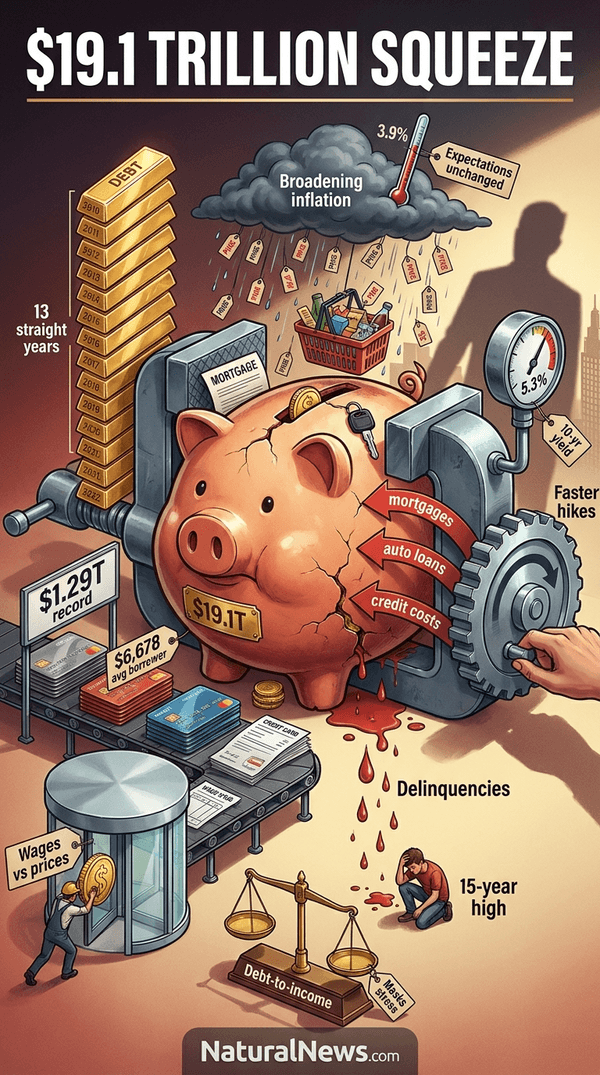
The release of the latest debt figure comes as inflation spreads across the economy. Russia Today (RT) reported, citing the Associated Press, that senior Federal Reserve officials are urging faster interest rate hikes to address rising prices [1].
The report marks the latest in a long series of record highs. Household debt has been higher than a year earlier for 13 straight years, according to the American Default Project [2].
Credit Card Debt and Delinquencies Rise
Separate TransUnion figures cited by RT found that credit card balances climbed to a record $1.29 trillion, while the average debt per borrower reached $6,678 [1].
The credit card figures are part of a longer upward trend. Consumers carried a record $1.25 trillion in credit card debt in the first quarter of 2026, a 5.9% increase from a year earlier, and delinquency rates at the time reached a 15-year high [3][4]. Researchers have linked rising balances to inflation and higher prices for everyday purchases [5].
Delinquencies are not spread evenly. Analysts who study household balance sheets say the ratio of debt to income and wealth matters more than the headline total [6]. Older data show that credit card and auto delinquencies have tended to rise fastest among younger borrowers, a pattern that has recurred in recent cycles [7].
Inflation Accelerates, Fed Weighs Faster Rate Hikes
The Fed raised rates in September, and the 10-year Treasury yield has since topped 5.3%, the highest since 2007, according to market data cited by ZeroHedge [8].
Long-term borrowing costs have risen in tandem with the policy debate. The New York Fed's October Survey of Consumer Expectations showed median inflation expectations unchanged at all three horizons, including 3.9% one year ahead, according to the survey [9].
Financial Strain Disproportionately Affects Lower-Income Americans
The gap in delinquency rates between rich and poor neighborhoods is among the most closely watched measures in the report. Separate surveys have shown that Americans are prioritizing essential expenses as the cost of living rises, with many cutting back on groceries and other discretionary purchases [10]. Some analysts caution that headline delinquency figures can overstate the strain.
More broadly, analysts who study money and credit argue that a debt-based monetary system creates structural pressure for debt to grow faster than income. This dynamic leaves households more exposed when interest rates rise [11].
References
- US household debt highest ever. https://rt-english.com/business/648718-us-household-debt-highest-ever/
- Total Household Debt (Q3 2026): $19.1 trillion. https://americandefault.org/indicators/total-household-debt/
- Credit card debt hits record $1.25 trillion with delinquencies at an alarming 15-year high. https://www.naturalnews.com/2026-06-02-credit-card-debt-hits-record-delinquencies-15yr-high.html
- Credit Card Debt Hits Record $1.25 Trillion With Delinquencies At An Alarming 15-Year High. https://www.shtfplan.com/economics/credit-card-debt-hits-record-1-25-trillion-with-delinquencies-at-an-alarming-15-year-high
- US credit card debt rises to historic high of 103 trillion - NaturalNews.com, August 09, 2023. by NaturalNews.com
- Cowboy capitalism European myths American reality. Gersemann Olaf 1968
- Credit card and auto debt DELINQUENCIES are SOARING especially among younger Americans - NaturalNews.com, February 15, 2024.
- Fed Over-Tightening: How Much Runway Is Left Before It Bites? https://www.zerohedge.com/markets/fed-over-tightening-how-much-runway-left-it-bites
- Layoff Fears Hit Highest Since Covid Crash As Inflation Expectations Stay Stuck Near 3-Year High: NY Fed Survey. https://www.zerohedge.com/markets/layoff-fears-hit-highest-covid-crash-inflation-expectations-stay-stuck-near-3-year-high-ny
- Americans Are Cutting Back on Groceries – Recession Watch. https://www.activistpost.com/americans-are-cutting-back-on-groceries-recession-watch/
- Peak Prosperity DEBT Crash Course with Dr. Chris Martenson - PeakProsperity.com, June 09, 2023. Chris Martenson
Explainer Infographic







Please contact us for more information.


