


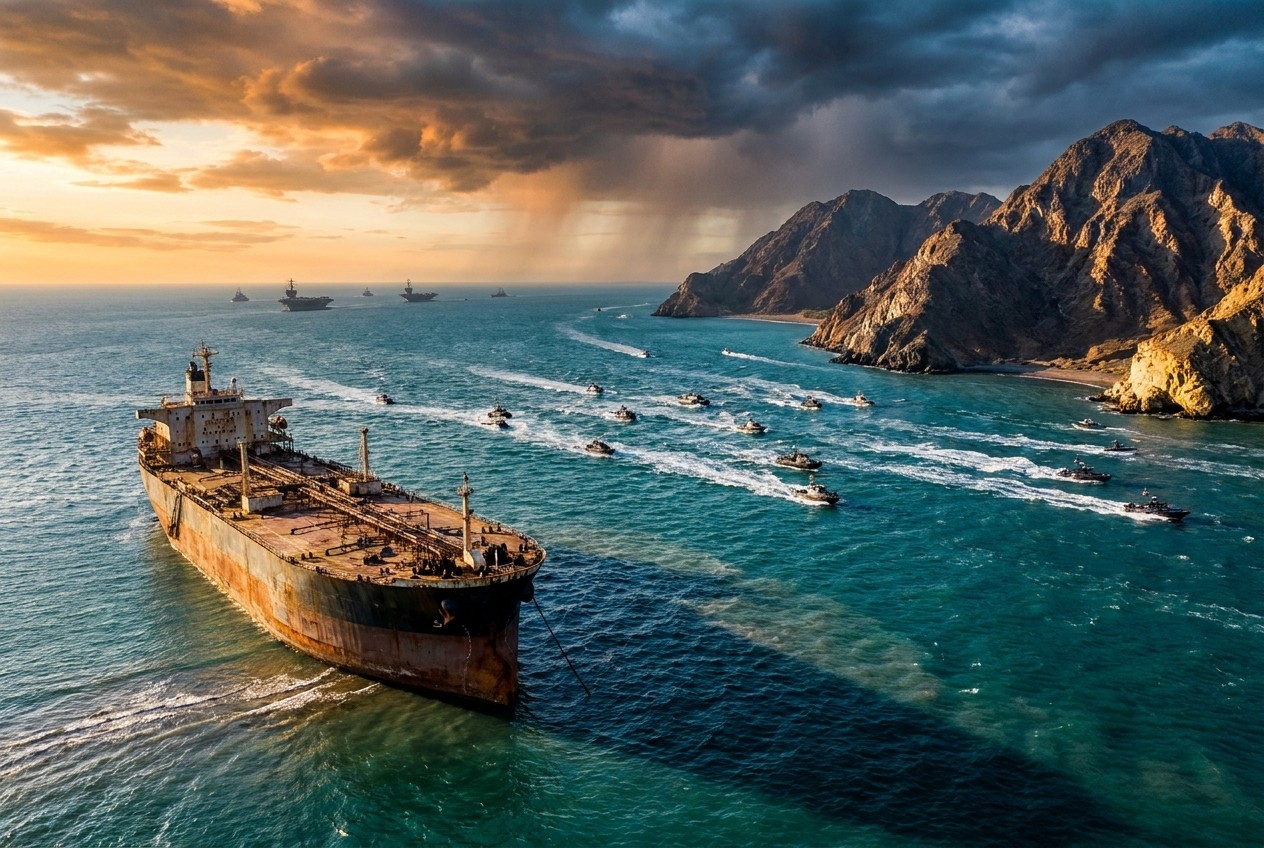
Why America Will Never Control the Strait of Hormuz
I have been telling my readers all year that this war would not end on Washington's terms, and the events of the past several weeks have vindicated that call. The midterm elections delivered a historic rebuke to the Trump administration over the Iran war, with Democrats winning control of both chambers of Congress [1]. Yet within days, President Trump was telling reporters that renewed attacks were "highly unlikely" while insisting the U.S. was "locked and loaded" -- a contradiction that reveals the strategic confusion at the heart of this catastrophe [2].
Let me state my thesis plainly: no amount of American naval power can change the geography of the Strait of Hormuz, and Iran will hold that waterway for centuries to come. Secretary of State Marco Rubio himself admitted the essential truth when he acknowledged that after eight months of bombing, billions of dollars spent, and American lives sacrificed, the United States still does not control the Strait of Hormuz [3]. Trump's claim of victory is a lie, and the American people are being told a story that cannot survive contact with reality.
I predicted this war would re-escalate, and it is re-escalating. The so-called ceasefire is a fiction. As I have said repeatedly, you cannot "open" the Strait of Hormuz through bombardment -- the strait will remain closed until Iran consents to its opening [4]. That is the reality our leaders refuse to accept.
Iran's Demands Can Never Be Met -- Because Washington Won't Give Up Its Financial Weapons
Every one of Iran's peace demands is a non-starter for Washington, which means there is no deal to be had. The United States will never allow Iran's banks to reconnect to the global financial system because dollar and SWIFT hegemony is precisely how Washington terrorizes nations that refuse to submit. As I discussed with Tom Renz, restricting access to Western banking has clearly failed to prevent these nations from developing the capabilities necessary to control the Strait of Hormuz, and the logic of continuing restrictions given that they have not achieved their intended results is difficult to sustain [5].
Reparations for hundreds of billions in damage are equally non-negotiable for Tehran and equally impossible for Washington. Treasury Secretary Scott Bessent has warned that Washington will impose economic isolation on Iran "the world has never seen before," even as the United States remains unable to break Iran's grip on the strait [6]. This is the language of desperation, not victory. Iran's top negotiator, Mohammad Bagher Ghalibaf, has stated that the Strait of Hormuz will "never return" to its pre-war status, asserting that Tehran and Oman have reached an understanding about the waterway's future [7].
Iran has learned that America negotiates in bad faith. The United States and Iran signed a Pakistani-mediated memorandum of understanding in June 2026 calling for an immediate end to hostilities and the reopening of the strait [8], but that agreement collapsed weeks later amid renewed fighting and formally expired in August 2026 [9]. When a nation watches Washington assassinate its negotiators and strike civilian targets, it does not surrender -- it hardens. The idea that Iran will make meaningful concessions to a government that has demonstrated it cannot be trusted is a fantasy entertained only by those who have never studied how empires actually behave.
Geography Beats Aircraft Carriers: Why the Strait Cannot Be Taken
The United States has never demonstrated the capability to control the Strait of Hormuz, and basic geography makes it impossible. What Washington calls a "blockade" is really piracy on the high seas -- harassing a few tankers after they exit the waterway, not controlling the water itself.
The promised land blockade of Iran is equally absurd. Iran is a massive country with rugged terrain and a population of nearly 90 million people. You cannot seal off a nation of that size with the small number of troops available, and the idea that the U.S. military could do so while simultaneously fighting a naval campaign is the kind of thinking I have called the "Strait of Stupid" -- logic akin to proposing to airlift oil tankers over the waterway [10].
Iran has mastered long-range ballistic missiles, mobile-targeting, terminal-phase maneuvering, and Mach 5+ speeds. The limitations of American air defense systems have become increasingly apparent, with MIT engineer Ted Postol asserting that the actual interception effectiveness of Patriot missile systems is, at best, 5% -- meaning 19 out of 20 incoming missiles bypass these defenses [10]. Meanwhile, the former U.S. bases in Bahrain and the region are essentially destroyed, and the ability to project power has collapsed. As I have written before, the United States' conventional military forces are more akin to a paper tiger than anything else, ill-equipped to sustain any prolonged kinetic conflict with major powers such as Russia, China, or even Iran [11].
The Only Thing America Can Win Now Is a Stalemate -- And Iran Outlasts Stalemates
The best achievable outcome for Washington at this point is blocking Iranian oil exports and preventing reconstruction -- which also strangles Saudi Arabia, the UAE, Qatar, Kuwait, and Iraq. The Iran war has crippled Qatar's LNG industry, destroying 17% of export capacity, causing $20 billion in annual revenue losses, and severely restricting shipments through Hormuz [12]. The Saudi East-West pipeline that bypasses Hormuz was struck near Medina, raising the stakes for oil prices across the region [13]. Middle Eastern crude exports have recovered to near pre-war levels, but record tanker rates and war insurance premiums remain a major burden, with crude transport costs reaching $30 per barrel [14]. This is not a victory -- it is a slow-motion economic strangulation of America's own allies.
Iran can suffer longer than a Trump administration facing a political nightmare. The midterm elections were a decisive rejection of Trump's war on Iran, with voters across the United States delivering a historic drubbing to Trumpism [15]. Trump himself acknowledged that the Iran war played a role in his party's resounding defeat, telling Fox News that "I think a part of it was Iran" and telling The Wall Street Journal that "Iran was a piece of it" [16]. Donald Trump Jr. echoed this, saying the war "shifted voter sentiment" for millions of independents and disgruntled Democrats [17]. The Republican Party has already lost the midterms, and the political damage will only compound as fuel and food inflation, wrecked supply chains, and dead soldiers -- far more than the 18 officially admitted -- continue to mount.
The real question is not whether the U.S. wins, but how long it keeps cutting off the world's energy, fertilizer, and sulfur supplies -- and how many hundreds of millions face famine in 2027 and beyond. As I have warned, global famine is now a certainty. The war has already delivered a second shock to global energy markets, following the Russian invasion of Ukraine, and economic pressures are soaring around the globe [18]. The people running this war are not rational or strategic, and the voices claiming we're winning are paid shills.
Trump Has Guaranteed an Iranian Bomb -- And That Might Be the Best Outcome Available
The war has convinced Iranian leaders that only a nuclear weapon defends them from a terrorist empire that attacks them financially, kinetically, and geopolitically. When former President Trump threatened to "end a civilization," he articulated a nuclear threat against Iran, and in international relations, such a statement by a nuclear power triggers a self-defense imperative [19]. Iran's pursuit of nuclear weapons can be viewed as a direct response to this threat, providing it with the moral ground to retaliate in self-defense. Iran already has the capability to assemble weapons and has mastered delivery -- so the "never allow a nuclear Iran" justification has failed on its own terms. Top Iranian security official Mohsen Rezaei has rejected the prospect of transferring enriched uranium out of the country as part of any deal with the U.S., slamming the door shut on sending Iran's stockpile of 60% enriched uranium to a third country [20].
A nuclear Iran would stabilize the region, because the actual destabilizer is Israel -- with its illegal undeclared arsenal, its genocide in Gaza, and its strikes on Lebanon and Iran. I have written extensively about how Israel is a regime of chaos destroying its own future [21]. The idea that Iran is the aggressor while Israel maintains an undeclared nuclear arsenal is a moral inversion that only the most propagandized Americans can accept.
Iranian control of the strait, with tolls on Western-bound shipping to collect reparations, would stabilize world energy and commodity trade rather than disrupt it. That is a rational strategy for a nation under siege, and it is one that the United States has no answer for.
I Love My Country -- Which Is Why I Won't Pretend It's Winning
This is an honest assessment, not advocacy for Iran or hatred of America. I want the founding vision of this country back -- the vision of a republic that minds its own business, trades with the world, and does not send its young men and women to die in foreign deserts for the benefit of neoconservative warmongers and the military-industrial complex. The people running this war are not rational or strategic, and the voices claiming we're winning are paid shills who have been wrong about every major foreign policy disaster of the past quarter century.
The only path to peace is the United States backing off and leaving the region. Otherwise the flows don't resume, the reconstruction doesn't begin, and the suffering is on Trump's shoulders. China is already positioning itself to lead Iran's postwar reconstruction effort, aiming to secure long-term access to critical Iranian oil reserves [22]. Russia and Iran have forged a 20-year defense and energy pact challenging Western influence [23]. The world is moving on without us while Washington clings to a unipolar fantasy that died years ago.
I love my country enough to tell the truth about it. The war with Iran isn't over, and America will never control the Strait of Hormuz. The sooner we accept that reality, the sooner we can begin the hard work of rebuilding a nation that has squandered its treasure and its honor on a conflict it was never going to win.
References
- Republican Lawmaker Renews Impeachment Bid Against Pete Hegseth. 2026-11-11T06:00:00.000Z. https://www.naturalnews.com/2026-11-11-massie-renews-impeachment-bid-against-pete-hegseth.html
- Trump says Iran war is 'effectively over' militarily with further strikes unlikelyThe president says the US is keeping "status quo" with Iran but remains “locked and loaded” should the situation in the Middle East change.1 hr agoUS & Canada. 2026-11-10T04:01:16.515Z. https://bbc.com/news/articles/cq5yny4nl2d3o
- Marco Rubio Just Admitted the U.S. Lost the War with Iran. 2026-11-10T06:00:00.000Z. https://www.naturalnews.com/2026-11-10-marco-rubio-just-admitted-us-lost-war.html
- Bright Videos News - BRICS AI COOPERATIVE CHINESE AI GIANTS FAMINE IN 2027 - Mike Adams - BrightVideos.com, July 20, 2026. by Mike Adams - BrightVideos.com
- Bright Videos News - with Tom Renz - Mike Adams - BrightVideos.com, June 18, 2026. by Mike Adams - BrightVideos.com
- Bessent warns of "never before seen" economic isolation for Iran as U.S. blocks ports - NaturalNews.com, August 18, 2026. by NaturalNews.com
- Hormuz will never return to pre-war status, says Iran's chief negotiator | World News - Business Standard. 2026-11-12T04:13:09Z. https://www.business-standard.com/world-news/hormuz-will-never-return-to-pre-war-status-says-iran-s-chief-negotiator-126111200051_1.html
- U.S., Iran Sign Islamabad MoU to End Hostilities, Reopen Strait of Hormuz - NaturalNews.com, June 19, 2026. by NaturalNews.com
- U.S. Conflict with Iran | Congress.gov | Library of Congress. 2026-09-18T00:00:00Z. https://www.congress.gov/crs-product/R48887
- Bright Videos News - GLOBAL FAMINE NOW CERTAIN - Mike Adams - BrightVideos.com, March 13, 2026. by Mike Adams - BrightVideos.com
- Health Ranger Report - PAPER TIGER - Mike Adams - BrightVideos.com, February 18, 2026. by Mike Adams - BrightVideos.com
- Qatar (Shockingly) Becomes Largest Buyer Of US LNG Amid Hormuz Crisis. 2026-11-09T12:50:00.000Z. https://www.zerohedge.com/energy/qatar-becomes-largest-buyer-us-lng-amid-hormuz-crisis
- Saudi pipeline that bypasses Hormuz comes under attack, raising stakes for oil prices. 2026-11-10T06:00:00.000Z. https://www.naturalnews.com/2026-11-10-saudi-pipeline-hormuz-attack-oil-prices.html
- Middle East Oil Flows Far From Normal Despite Signs Of Oversupply. 2026-11-11T22:40:00.000Z. https://www.zerohedge.com/energy/middle-east-oil-flows-far-normal-despite-signs-oversupply
- The Third Carrier Is the Tell: Why I Believe Trump Is About to Light the World on Fire Over Iran. 2026-11-09T06:00:00.000Z. https://www.naturalnews.com/2026-11-09-the-third-carrier-is-the-tell.html
- Trump Acknowledges Role of Iran War in Election Losses. 2026-11-04T19:01:10.087Z. https://theepochtimes.com/us/trump-acknowledges-role-of-iran-war-in-election-losses-6118047
- Donald Trump Jr.: Iran War Caused GOP Election Disaster. 2026-11-06T19:31:26.000Z. https://thenewamerican.com/us/politics/donald-trump-jr-iran-war-caused-gop-election-disaster/
- Can the world withstand another winter of war?. 2026-11-03T08:15:08.000Z. https://www.middleeasteye.net/opinion/can-world-withstand-another-winter-war
- Health Ranger Report - IRAN HAS ACQUIRED NUCLEAR WEAPONS - Mike Adams - BrightVideos.com, June 04, 2026. by Mike Adams - BrightVideos.com
- Iran Rejects Transferring "A Single Atom" Of Enriched Uranium From Its Territory. 2026-11-11T13:45:00.000Z. https://www.zerohedge.com/geopolitical/iran-rejects-transferring-single-atom-enriched-uranium-its-territory
- Israels Self Sabotage How a Regime of Chaos Is Destroying Its Own Future - NaturalNews.com, April 10, 2026. by NaturalNews.com
- China Positions to Lead Iran's Postwar Reconstruction, Aiming to Secure Oil Supplies - NaturalNews.com, June 26, 2026. by NaturalNews.com
- Russia and Iran forge 20 year defense and energy pact challenging Western influence - NaturalNews.com, January 20, 2025. by NaturalNews.com
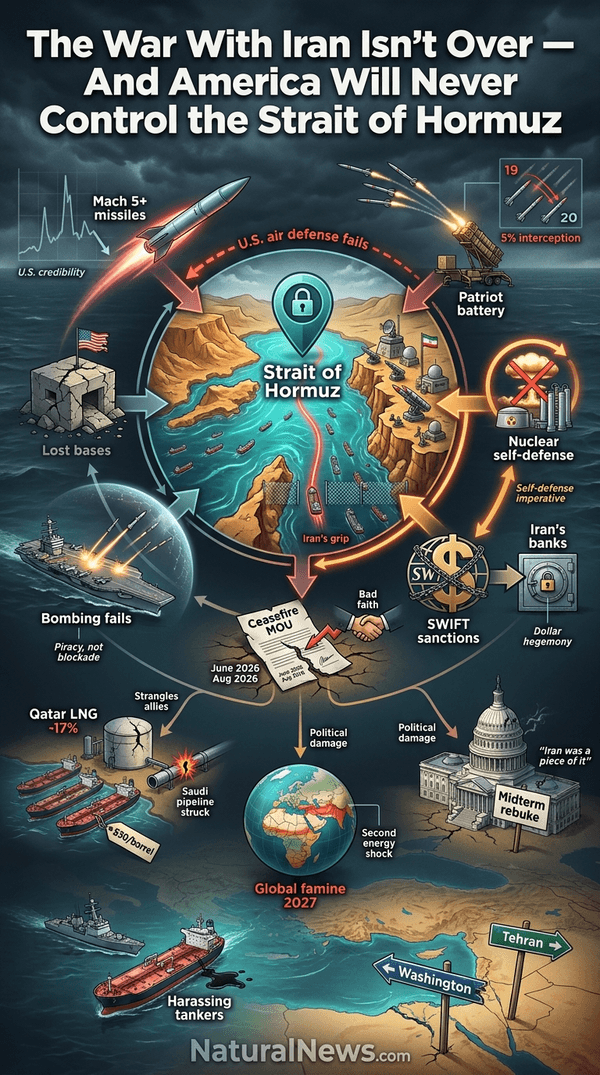
Explainer Infographic
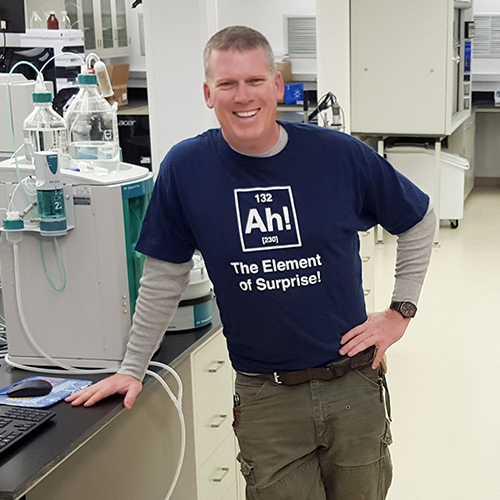
Mike Adams (aka the "Health Ranger") is the founding editor of NaturalNews.com, a best selling author (#1 best selling science book on Amazon.com called "Food Forensics"), an environmental scientist, a patent holder for a cesium radioactive isotope elimination invention, a multiple award winner for outstanding journalism, a science news publisher and influential commentator on topics ranging from science and medicine to culture and politics.
Mike Adams also serves as the lab science director of an internationally accredited (ISO 17025) analytical laboratory known as CWC Labs. There, he was awarded a Certificate of Excellence for achieving extremely high accuracy in the analysis of toxic elements in unknown water samples using ICP-MS instrumentation.
In his laboratory research, Adams has made numerous food safety breakthroughs such as revealing rice protein products imported from Asia to be contaminated with toxic heavy metals like lead, cadmium and tungsten. Adams was the first food science researcher to document high levels of tungsten in superfoods. He also discovered over 11 ppm lead in imported mangosteen powder, and led an industry-wide voluntary agreement to limit heavy metals in rice protein products.
Adams has also helped defend the rights of home gardeners and protect the medical freedom rights of parents. Adams is widely recognized to have made a remarkable global impact on issues like GMOs, vaccines, nutrition therapies, human consciousness.







Please contact us for more information.


