


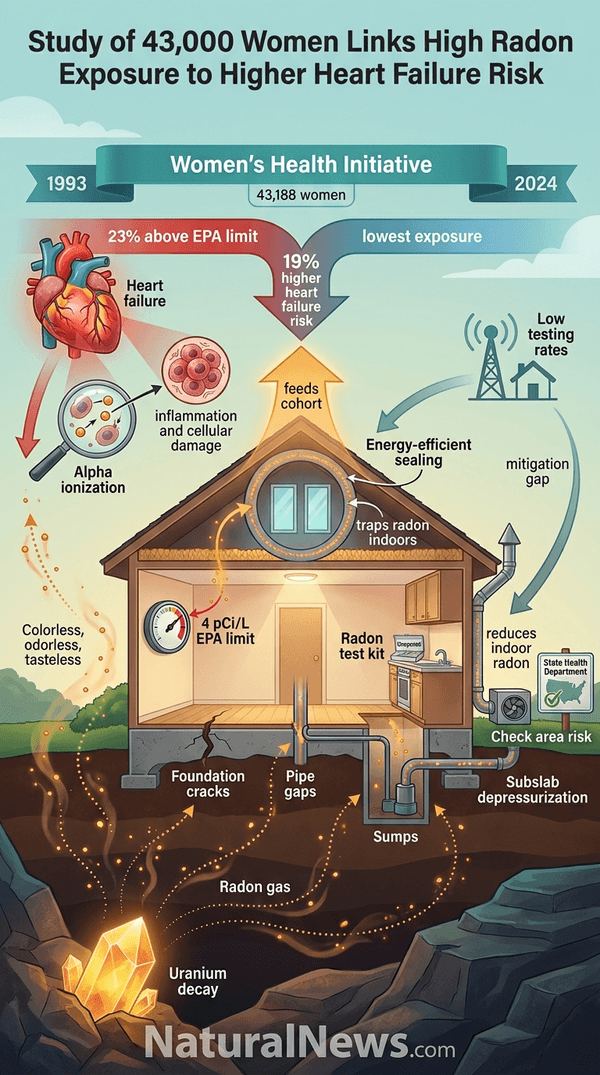
The research draws on data from the Women's Health Initiative, a long-running national study that enrolled participants between 1993 and 1998. None of the women had heart failure at the time of enrollment, and researchers tracked their health through February 2024.
Radon is a colorless, odorless and tasteless radioactive gas produced when uranium in soil and rock decays. It can travel upward through the ground and accumulate inside buildings, where occupants may be exposed for years without any indication.
Study Methods and Exposure Assessment
For context, the Environmental Protection Agency (EPA) recommends taking action when indoor radon reaches 4 picocuries per liter of air or higher. Nearly a quarter of the women in the study, 23%, were exposed to radon levels above the EPA limit, researchers found [1].
The study was observational and relied on estimated rather than directly measured in-home radon concentrations, meaning it cannot prove that radon causes heart failure. The findings add to a growing body of research examining how environmental exposures affect cardiovascular health.
Possible Mechanisms and Limitations
Researchers suggest that radiation from radon may damage the cells lining the heart muscle and blood vessels, potentially triggering inflammation and cellular damage over time. Previous research on radon has focused on how its decay products are easily inhaled, allowing alpha-emitting particles to damage cells, particularly in the respiratory system. A 1994 study published in the Journal of Hazardous Materials described how radon decay products can cause "intense local ionization, causing damage at the cellular and molecular level" [2].
This limitation is common in environmental health research, where randomizing participants to different levels of a potentially harmful exposure would be unethical. Researchers have also noted that modern energy-efficient building practices may worsen indoor radon accumulation. This suggests that efforts to improve energy efficiency without adequate ventilation could inadvertently elevate radon levels in some homes.
Testing and Mitigation Recommendations
The EPA recommends taking action when indoor radon reaches 4 picocuries per liter of air or higher. This low adoption rate suggests that many households with elevated radon levels may be unaware of the issue or have not taken steps to address it.
Individuals concerned about radon exposure can take several steps. They can check their area's risk by visiting the EPA or state health department website to see whether their region has elevated radon potential.
They can also test their home with an inexpensive radon testing kit; even those living in lower-risk areas should test, since testing is the only way to know indoor radon levels for sure. If results are 4 picocuries per liter or higher, contacting a qualified radon mitigation professional is recommended.
Radon mitigation techniques such as subslab depressurization have been shown to be highly effective. This research demonstrates that proven, affordable solutions exist for reducing indoor radon concentrations when elevated levels are identified.
Conclusion: Study Adds Cardiovascular Concerns to Radon Exposure
For individuals seeking to protect their health, testing indoor air for radon and taking steps to reduce exposure when levels are elevated represent practical, low-cost measures. The study's findings underscore the importance of understanding what is in the air inside homes and taking action to address potential hazards. Radon is already on the radar for lung health, but its potential connection to heart failure gives us another reason to check what's in indoor air.
References
- Radon Linked to Heart Failure Risk in Aging Women - MedicineNet. https://www.medicinenet.com/radon_linked_to_heart_failure_risk_in_aging_women/news.htm
- Health risk attributable to environmental exposures: Radon. OmniPage 12. http://www.scansoft.com.
Explainer Infographic











Please contact us for more information.


