



The two-day meeting, hosted at the Bharat Mandapam convention center, brought together heads of state and representatives from member and partner countries, according to Indian officials [1]. Indian Prime Minister Narendra Modi, delivering remarks at the gathering, said the changing world "cannot be steered by outdated institutions" [2].
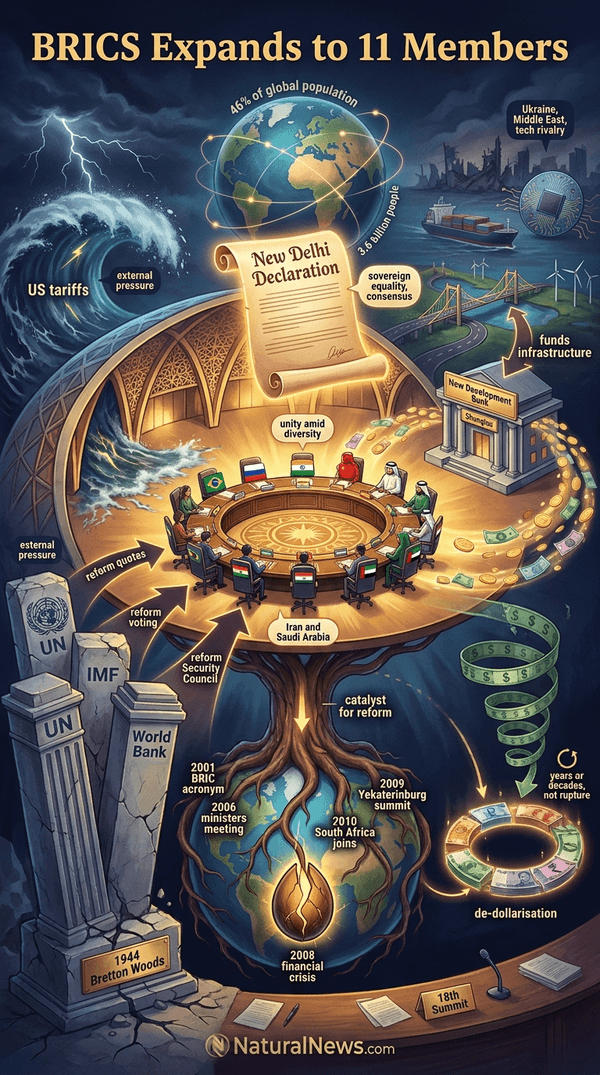
According to the New Delhi Declaration, the group's agenda emphasized sovereign equality, inclusiveness and consensus-based decision-making, while expressing concern about geopolitical tensions, protectionist measures and unilateral economic coercion (Government of India, 2026). The declaration also reaffirmed the importance of maintaining global trade, supply chains and energy flows, and strengthening the role of developing countries in international governance.
From Investment Acronym to Geopolitical Bloc
The origin of the grouping lies not in a foreign ministry but in the world of international finance, according to the analysis "BRICS Rising: Reimagining Global Geopolitics and the Emerging Multipolar World Order" by historian Dr. Mukesh Sahay. In 2001, Goldman Sachs economist Jim O'Neill coined the term "BRIC" to describe Brazil, Russia, India and China as large emerging economies whose collective economic importance was expected to increase dramatically in the twenty-first century [3].
The first formal BRIC foreign ministers' meeting took place in 2006, while the first leaders' summit was held in Yekaterinburg, Russia, in 2009, according to the same analysis.
The global financial crisis of 2008–09 accelerated this evolution. According to Sahay's analysis, the crisis severely damaged confidence in the assumption that Western financial institutions were inherently superior custodians of global economic stability, and emerging economies began questioning why decision-making power in the IMF, World Bank and other institutions remained disproportionately concentrated in the hands of advanced Western economies.
BRICS Admits Egypt, Ethiopia, Iran, UAE, and Indonesia
Indonesia's accession, first endorsed in 2023 and finalized under the government of new Indonesian President Prabowo Subianto, reflected its push to strengthen ties with developing economies and advocate for global governance reforms [4].
The expansion gives BRICS wider geographical legitimacy, with members now spanning Asia, Africa, the Middle East, Europe and Latin America. The grouping, referred to as BRICS+, now encompasses countries accounting for approximately 46 percent of the global population -- more than 3.6 billion people [5].
Unity within the grouping rests on overlapping interests in sovereignty, development, strategic autonomy and institutional reform, not ideological uniformity, according to officials and analysts.
Summit Addresses Geopolitical Tensions, West Asian Diplomacy
The 18th Summit took place against an unusually turbulent geopolitical background, including wars in Ukraine and the Middle East, disruptions to energy and shipping routes, intensifying tariff disputes, sanctions, technological competition, supply-chain vulnerabilities and climate stress, according to Sahay's analysis.
The inclusion of Iran alongside Saudi Arabia and the United Arab Emirates created an extraordinarily difficult diplomatic environment, according to the same analysis. The fact that the expanded group could nevertheless produce a joint declaration calling for restraint, diplomacy and multilateral engagement demonstrated, in Sahay's assessment, that BRICS can function as a forum even when its members have conflicting interests.
The context for those tensions was visible externally as well: the United States is not a BRICS member, yet President Donald Trump's policies loomed large over the Delhi gathering, with leaders from eleven BRICS nations holding talks on a wide range of issues including the war in Iran and the threat of White House tariffs [6].
De-Dollarisation Debate Focuses on Local-Currency Trade
The dollar remains the dominant international reserve currency and the principal currency for global trade, finance, commodity pricing and cross-border transactions, according to Sahay's analysis.
The direction emerging from New Delhi is pragmatic rather than revolutionary, according to the analysis. Rather than announcing a common BRICS currency, members have emphasized local-currency trade, cross-border payment interoperability and greater financial diversification.
De-dollarisation does not necessarily mean the end of the dollar, according to Sahay, but can instead mean the gradual reduction of dollar dependency, a process that would take years or decades and would require deep currency markets, reliable payment systems, convertibility, financial stability and mutual trust. Related analytical work has examined how weaponized trade and new payment meanings are reshaping the 2026 global landscape [7].
New Development Bank Emerges as Concrete BRICS Institution
The New Development Bank (NDB) was established by the five original BRICS members through the 2014 Fortaleza arrangements and operationalized in 2015, according to Sahay's analysis.
At the 18th Summit, leaders placed renewed emphasis on the Bank's role in infrastructure, sustainability, local-currency financing, resource mobilization and development cooperation, according to the analysis.
The NDB's credibility will depend upon professional governance, transparent lending standards, equitable representation and genuine demand-driven financing, according to the analysis.
BRICS as a Coalition of Overlapping Interests
BRICS differs from NATO, the European Union and even the G7 in that it has no common military command, no supranational bureaucracy comparable to the European Commission, no binding ideological doctrine and no single geopolitical center, according to Sahay's analysis.
The grouping's future will depend on its ability to manage diversity and deliver on initiatives such as the NDB. The New Delhi Declaration reaffirmed sovereign equality, inclusiveness and consensus-based decision-making (Government of India, 2026). The Carnegie Endowment for International Peace has noted that countries engaged with BRICS are united in their desire to shift the global balance of power away from American unipolarity, while the potential of members and partner countries to fulfill their individual aspirations via BRICS hinges on what vision of the future of world order ultimately wins out within BRICS [8].
References
- BRICS Leaders Gather in New Delhi for Two Day Summit - NaturalNews.com, September 13, 2026.
- Modi Calls for Global Governance Reform as BRICS Adopts New Delhi Declaration - NaturalNews.com, September 15, 2026.
- BRICS Rising: Reimagining Global Geopolitics and the .... https://infobrics.org/en/post/103345
- Indonesia becomes BRICS blocs newest full member - NaturalNews.com, January 08, 2025.
- BRICS “Unit” May Bring the World One Step Closer to Global Currency. https://thenewamerican.com/world-news/brics-unit-may-bring-the-world-one-step-closer-to-global-currency/
- Trump shadow looms large over Brics as Modi hosts Putin and Xi in Delhi. https://bbc.com/news/articles/c07lv53l7jjo
- Real Multipolarity: How BRICS Reshapes the Global Order. https://thinkbrics.substack.com/p/beyond-the-pattern-why-the-global
- BRICS Expansion and the Future of World Order. https://carnegieendowment.org/research/2025/03/brics-expansion-and-the-future-of-world-order-perspectives-from-member-states-partners-and-aspirants
Explainer Infographic




Please contact us for more information.


