


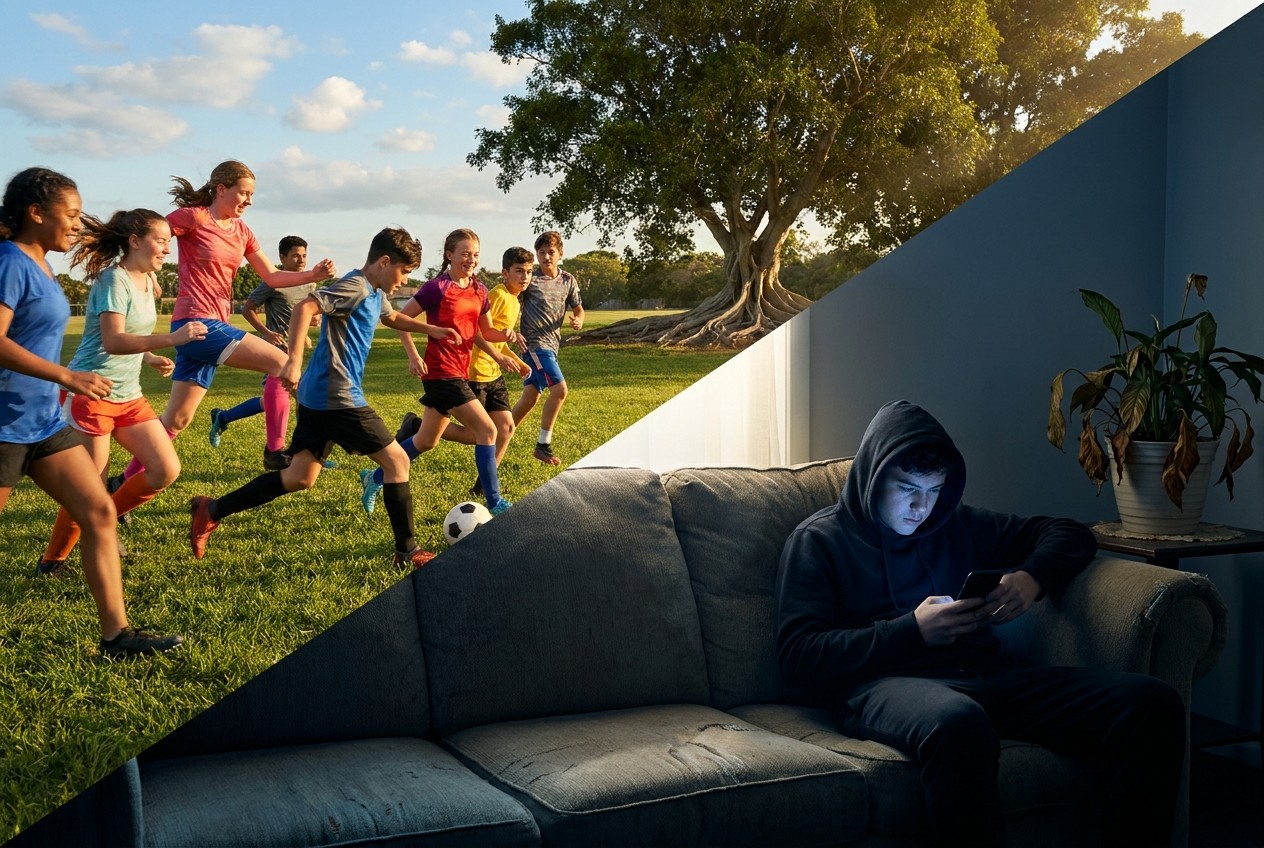
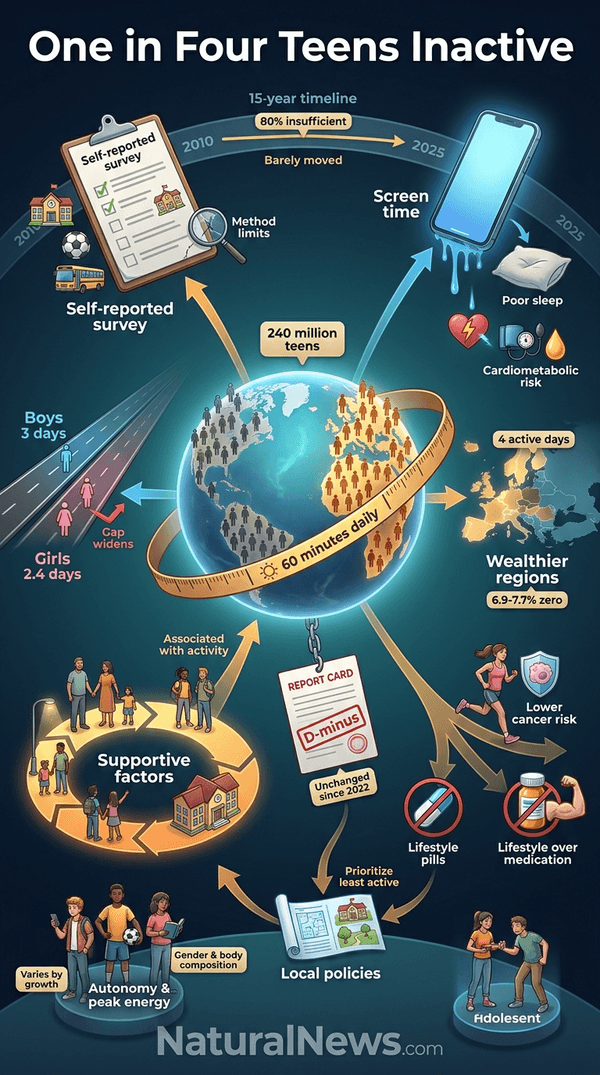
WHO global estimates put the number of young people aged 11 to 17 who reported not completing at least 60 minutes of moderate-to-vigorous physical activity on any day in the previous week at some 240 million [1].
The figure represents a public-health benchmark that has barely moved in 15 years.
Teens who spend more time on screens also show poorer sleep quality and a diminished commitment to health-conscious living, according to a study of 700 Turkish high school students published in the journal Brain & Behavior [2]. The authors of a separate study published in the Journal of the American Heart Association said the link between screen time and cardiometabolic risk -- including high blood pressure, high cholesterol and insulin resistance -- was even stronger in children and teens with poor sleep habits [3].
Study Scope and Methodology
Researchers measured activity at school, during commuting and in leisure time, the report stated [4].
The scale of the dataset places the findings among the broadest snapshots of adolescent movement assembled to date, but the methodological limits are also notable: activity was self-reported through surveys rather than measured directly, and the study counted any day on which a respondent reported 60 minutes of moderate-to-vigorous activity in any setting. The WHO recommends at least 60 minutes of physical activity every day for children and adolescents aged 6 to 17, including activities that make their hearts beat faster [5].
The findings point to a lack of global progress over the past 15 years, with levels of physical activity among adolescents virtually unchanged since 2010, according to the United Nations news service [6]. A prior WHO-led study published in The Lancet Child & Adolescent Health found that more than 80% of school-going adolescents globally did not meet activity recommendations [7].
Prior research has noted that 80% adolescents are insufficiently active and that many engage in two or more hours of daily recreational screen time, according to a 2021 review [8]. Researchers have also reported that factors such as supportive family and friends, safer communities, positive school environments and adequate resources are associated with more physical activity [9].
Disparities by Gender and Region
Globally, boys reported significantly higher activity levels than girls in 2025, averaging three active days per week against 2.4 for girls, the report found. Girls' activity falls as they grow older, widening the gap with boys [4].
Adolescents in wealthier regions -- Central and Eastern Europe and Central Asia, East Asia and the Pacific, and high-income Western nations -- averaged four active days, with 6.9% to 7.7% reporting no activity at all, according to the study.
The outcome is especially consequential for girls. A new study found that adolescent girls who engage in recreational physical activity show biomarkers linked to lower future breast cancer risk, based on breast tissue composition and oxidative stress levels, independent of body fat percentage [10].
The 2024 United States Report Card on Physical Activity for Children and Youth, released by the Physical Activity Alliance, gave the overall physical activity grade for children and youth a D-minus, the same grade it received in 2022 [11].
Structural Barriers and Policy Responses
The authors recommended policies tailored to local contexts that reach the whole population and prioritize the least active adolescents -- for example, by making schools and neighborhoods better places to be active.
Nutrition research has long emphasized that teenagers exercise far more autonomy over their own choices than younger children. Researchers have also documented that adolescents' energy needs peak during the teenage years, with energy requirements varying greatly depending on growth rate, gender and body composition [12].
The recent evidence on the limits of sedentary-screen habits is also growing. The authors of a study published in the Journal of the American Heart Association said the link between screen time and cardiometabolic risk was even stronger in children and teens with poor sleep habits [13]. A separate analysis of multiple trials found that lifestyle interventions preserved muscle mass, while medication-only approaches did not, and concluded that lifestyle treatment should form the backbone of any pediatric obesity treatment plan, even when medications are prescribed [14].
Conclusion
Regular activity across the teenage years builds bone mass and supports growth, according to nutrition research; bones grow stronger with physical activity [15]. Physical activity is also tied to stronger bones by stimulating the cells responsible for the synthesis and mineralization of bone, with weight-bearing exercise placing pressure on bones that respond by creating fresh tissue [16].
References
- One in four adolescents worldwide reported no active days in the .... https://www.who.int/news/item/04-11-2026-one-in-four-adolescents-worldwide-reported-no-active-days-in-the-previous-week
- Study: Screens are corroding teens’ belief in a healthy life. https://www.naturalnews.com/2026-09-05-screens-are-corroding-teens-belief-in-healthy-life.html
- Screen Time Increases Kids’ Risk of High Blood Pressure, Insulin Resistance. https://childrenshealthdefense.org/defender/screen-time-increases-kids-risk-cardiometabolic-disease-jaha-study/?bbFormId=e30a2e09-65d3-4e4b-8840-08276f29741d
- Teens aren't getting enough exercise and the problem has barely changed .... https://www.euronews.com/2026/11/04/teens-arent-getting-enough-exercise-and-the-problem-has-barely-changed-in-15-years
- What Counts for Children and Teens | Physical Activity Basics. https://www.cdc.gov/physical-activity-basics/adding-children-adolescents/what-counts.html
- 15 years of ‘almost no progress’ in getting young people moving: WHO. https://news.un.org/en/story/2026/11/1168736
- New WHO-led study says majority of adolescents worldwide are not .... https://www.who.int/news/item/22-11-2019-new-who-led-study-says-majority-of-adolescents-worldwide-are-not-sufficiently-physically-active-putting-their-current-and-future-health-at-risk
- Physical activity behaviours in adolescence: current evidence and .... https://pmc.ncbi.nlm.nih.gov/articles/PMC7612669/
- Children and teens aren’t doing enough physical activity – new study .... https://theconversation.com/children-and-teens-arent-doing-enough-physical-activity-new-study-sounds-a-health-warning-196078
- The lifelong shield How youthful activity may fortify against breast cancer - NaturalNews.com, January 29, 2026.
- New US report card on physical activity for children, youth reveals .... https://sph.unc.edu/sph-news/new-us-report-card-on-physical-activity-for-children-youth-reveals-continued-low-levels-of-physical-activity/
- Understanding nutrition. Whitney Eleanor Noss author
- Screen Time Increases Kids’ Risk of High Blood Pressure, Insulin Resistance. https://childrenshealthdefense.org/defender/screen-time-increases-kids-risk-cardiometabolic-disease-jaha-study/
- Study: Lifestyle Interventions Outperform Drugs Alone for Childhood Obesity. https://www.naturalnews.com/2026-07-05-study-lifestyle-interventions-outperform-drugs-childhood-obesity.html
- Understanding Nutrition Selected Chapters Thirteen Edition 2013. Ellie Whitney Sharon Rady Rolfes
- Physical Activity Is Tied to Strong Bones - Mercola.com, June 20, 2014.
Explainer Infographic










Please contact us for more information.


