



WHO Report Finds 240 Million Adolescents Not Active Enough
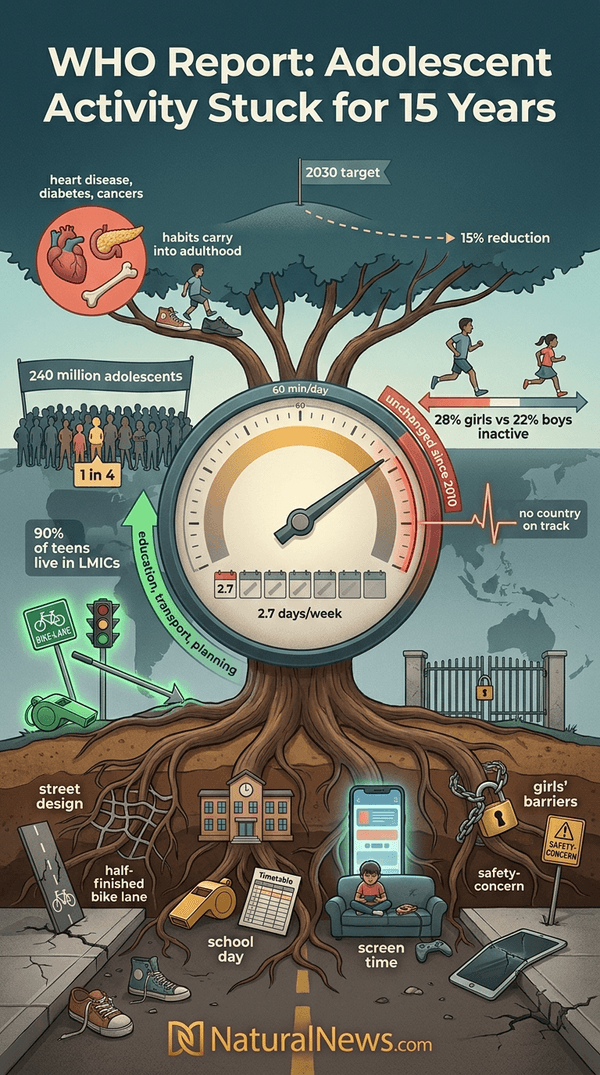
The World Health Organization released global estimates on Wednesday finding that one in four adolescents aged 11 to 17 reported not getting at least 60 minutes of moderate-to-vigorous physical activity on any day in the previous week, according to the report. That amounts to some 240 million young people, the report stated.
On average, adolescents reported being active on just 2.7 days a week, and only 14% reported being active on all seven days, according to the findings [1].
The report states that physical inactivity is a major risk factor for heart disease, Type 2 diabetes and some cancers, making early habit formation critical. The findings arrive as adolescent populations continue to grow, particularly in low- and middle-income countries, where close to 90% of 10- to 19-year-olds live [2].
Levels Virtually Unchanged Since 2010, No Country on Track
The report found levels of physical activity among adolescents virtually unchanged since 2010. The findings point to a lack of global progress over the past 15 years, with no country on track to meet the global target of a 15% relative reduction in physical inactivity by 2030, the report warns. Without accelerated action, adolescent inactivity is projected to remain largely unchanged for the rest of the decade.
The findings place the 2030 target further out of reach. The estimates were released on Wednesday, according to the report.
Girls Report Lower Activity; Country Rates Vary Widely
According to the WHO report, 28% of girls reported no active days, compared with 22% of boys. Only 11% of girls reported being active every day, compared with 17% of boys, the report stated [1]. Girls were less active than boys in almost every country and every WHO region, according to the findings, with the gender gap described by WHO officials as strikingly persistent.
The disparity suggests that local conditions, rather than any single global cause, shape adolescent activity levels. WHO said there is no single explanation for the lack of progress.
The gender gap has drawn particular attention from WHO leadership. The report calls for efforts to tackle the barriers faced by girls, including promoting physical activity in schools and investing in safe walking and cycling routes.
WHO Cites Transport, Schools, Safety, Screens; Calls for Cross-Sector Action
WHO said there is no single explanation for the lack of progress. Research has linked heavy screen time to changes in children's brains and to a numbing effect from interaction with social media, games and apps [3]. A separate seven-year longitudinal study that followed more than 1,000 participants from age 12 through age 19 found that youth spending more than six hours daily on social media faced triple the odds of suicidal ideation compared to those using it under one hour [4].
WHO called for stronger action across the education, transport, urban planning, sport and health sectors. The report also called for efforts to tackle barriers faced by girls, including promoting physical activity in schools and investing in safe walking and cycling routes. The built environment has been identified in prior research as a factor in childhood obesity, with long-term solutions tied to modifying surroundings to increase children's physical activity and access to healthful foods [5].
The recommendations reflect a view that adolescent inactivity is not primarily a matter of individual willpower.
Report Projects Continued Inactivity Without Accelerated Action
Physical inactivity is a major risk factor for heart disease, Type 2 diabetes and some cancers, the report stated.
The findings arrive amid broader concerns about youth health. A report published in the Archives of Pediatrics & Adolescent Medicine found that approximately one-third of boys and girls aged 12 to 19 in the United States do not meet standards for physical fitness, and that the more physically fit a young person is, the less likely they are to have high blood pressure, high cholesterol levels, or other risk factors for chronic diseases [6].
The WHO report calls for stronger action across the education, transport, urban planning, sport and health sectors. It also calls for efforts to tackle the barriers faced by girls, including promoting physical activity in schools and investing in safe walking and cycling routes. The report's projections indicate that without such measures, the world will continue to fall short of its 2030 target.
References
- 15 years of ‘almost no progress’ in getting young people moving: WHO. https://directspeech.news/en/news/15-years-of-almost-no-progress-in-getting-young-people-moving-who
- Adolescent health - World Health Organization (WHO). https://www.who.int/health-topics/adolescent-health/
- Heavy Screen Time Changes Childrens Brains - Mercola.com, December 27, 2018.
- Seven year study confirms social media's dose dependent toll on youth mental health - NaturalNews.com, August 19, 2026.
- Contributions of Built Environment to Childhood Obesity. dvips 5.83 Copyright 1998 Radical Eye Software. Journal of Environmental Health Perspectives 125(6):839-47 [2017]
- One-third of US youth not physically fit ... - NaturalNews.com, November 20, 2006.
Explainer Infographic











Please contact us for more information.


