



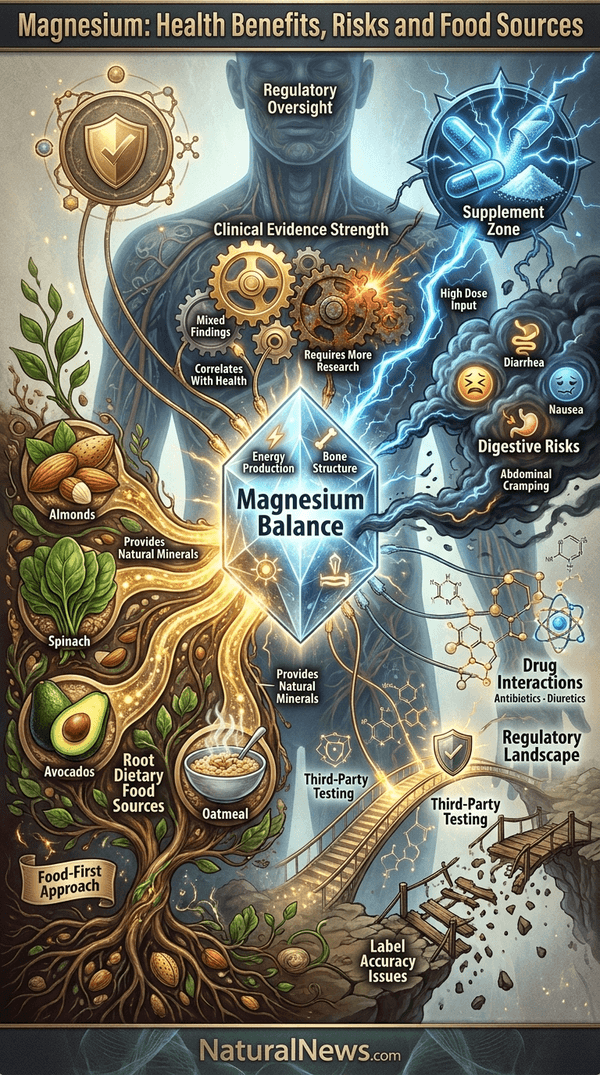
The review identifies six potential health benefits associated with magnesium, particularly in relation to heart health, bone strength, sleep and mood. It also examines magnesium-rich foods and guides supplement use and safety [1].
However, the strength of evidence varies across these health outcomes. The review draws on both observational studies and clinical research, which do not establish the same level of evidence. While magnesium is an essential nutrient, current findings do not demonstrate that supplementation can prevent or treat every condition associated with it. Further research is needed to clarify its potential benefits for several health outcomes.
Reported Health Benefits and Evidence Limits
A separate article on NaturalNews.com reports that a 2025 review examined magnesium's effects on sleep and common sleep disorders [2]. Another article on the media outlet states that a 2022 clinical trial found magnesium supplementation reduced pain and stress in fibromyalgia patients [3]. The review and these articles present these findings as reported benefits, though the strength of evidence differs.
It also states that magnesium is required for energy production and the structural development of bone. According to the office, deficiency is associated with health risks, but officials said this does not establish that supplements treat all conditions.
Some reported benefits come from observational studies, while clinical evidence is mixed for certain outcomes. The Food Revolution Network review and public health guidance call for more research on magnesium's role in conditions such as migraine and sleep. A 2022 clinical trial cited in a Natural News article reported reduced pain and stress in fibromyalgia patients, but that finding applies to a specific population and does not establish a general treatment effect [3]. An article on verywellhealth.com notes that the research on magnesium for heart health has shown a correlation between higher magnesium intake and reduced disease risk, but that the use of magnesium supplements for primary prevention has shown modest benefits and more research in large clinical trials is needed [4].
Risk Factors, Supplement Forms and Interactions
Dietary magnesium is generally reported as safe for healthy people, while excess supplemental magnesium can cause diarrhea, nausea and abdominal cramping, according to the NIH Office of Dietary Supplements [5]. Severe toxicity is described as rare but possible, especially in people with kidney impairment. The office states that although the risk of acquiring too much magnesium from food is low among healthy people, high doses of magnesium from dietary supplements or medications can cause diarrhea, nausea and abdominal cramping [5].
Magnesium supplements may interact with certain antibiotics, bisphosphonates and diuretics, and patients should consult clinicians before use, officials said. The NIH fact sheet lists these and other potential interactions, and it advises people to talk with their healthcare providers before taking magnesium supplements. The Food Revolution Network review also addresses how to supplement safely [1].
The Food and Drug Administration does not approve dietary supplements before marketing, and label accuracy can vary. Some groups recommend third-party testing, while regulators advise consumers to report adverse events. The NIH Office of Dietary Supplements advises consumers to look for third-party testing and to report adverse events to the FDA [5]. The review and public health guidance present differing perspectives on supplement regulation and evidence.
Magnesium-Rich Foods and Dietary Patterns
A consumer health digest article lists magnesium-rich foods including almonds, avocados, bran cereal, cashews, dark chocolate, edamame, kidney beans, oatmeal, peanuts and peanut butter, pumpkin and spinach [6]. The NIH Office of Dietary Supplements cites foods such as pumpkin seeds, almonds, spinach, cashews, peanuts and black beans [5].
A study of Swedish women found that dietary intake of calcium, potassium, magnesium and sodium varied across surveys [7]. Another study of traditional leafy vegetables in KwaZulu-Natal, South Africa, found that the plants studied were well endowed with essential nutrients required for human consumption [8]. A study of seeds from the Moraceae family found that Artocarpus heterophyllus and Treculia africana seeds are quite rich in oil, protein, carbohydrate and some mineral elements [9].
The review and nutrition advocates describe a food-first approach and note that refining grains reduces magnesium content. Officials said dietary variety remains a central recommendation. The Food Revolution Network review lists foods and offers guidance on how to supplement safely [1]. A consumer health digest article notes that foods high in magnesium provide additional nutrients, including fiber, vitamins and minerals [6].
References
- All About Magnesium: Health Benefits, Risks & the Magnesium-Rich Foods You Should Know About. https://foodrevolution.org/blog/magnesium-health-benefits-risks/
- Study Reviews Magnesium's Role in Addressing Five Sleep Conditions - NaturalNews.com, May 30, 2026
- Magnesium: A potential breakthrough in managing fibromyalgia and migraines new studies offer hope - NaturalNews.com, May 09, 2025
- What Happens to Your Body When You Get Enough Magnesium Every Day. https://www.verywellhealth.com/magnesium-benefits-12160214
- Magnesium - Health Professional Fact Sheet - Office of Dietary Supplements. https://ods.od.nih.gov/factsheets/magnesium-healthprofessional/
- Magnesium: Benefits, Side Effects, Dosage And Supplements. https://www.consumerhealthdigest.com/ingredients/magnesium.html
- intake of 17 elements by swedish women, determined by a 24-h duplicate portion study. Jorhem, L., et al.. Journal of Food Composition and Analysis 11, 32–46 (1998)
- Preliminary assessment of nutritional value of traditional leafy vegetables in KwaZulu-Natal, South Africa. Elsevier. Journal of Food Composition and Analysis 20 (2007) 430–435
- Comparative study of the chemical composition and mineral element content of Artocarpus heterophyllus and Treculia africana seeds and seed oils. Elsevier. Journal of the Science of Food and Agriculture, 2007
Explainer Infographic










Please contact us for more information.


