



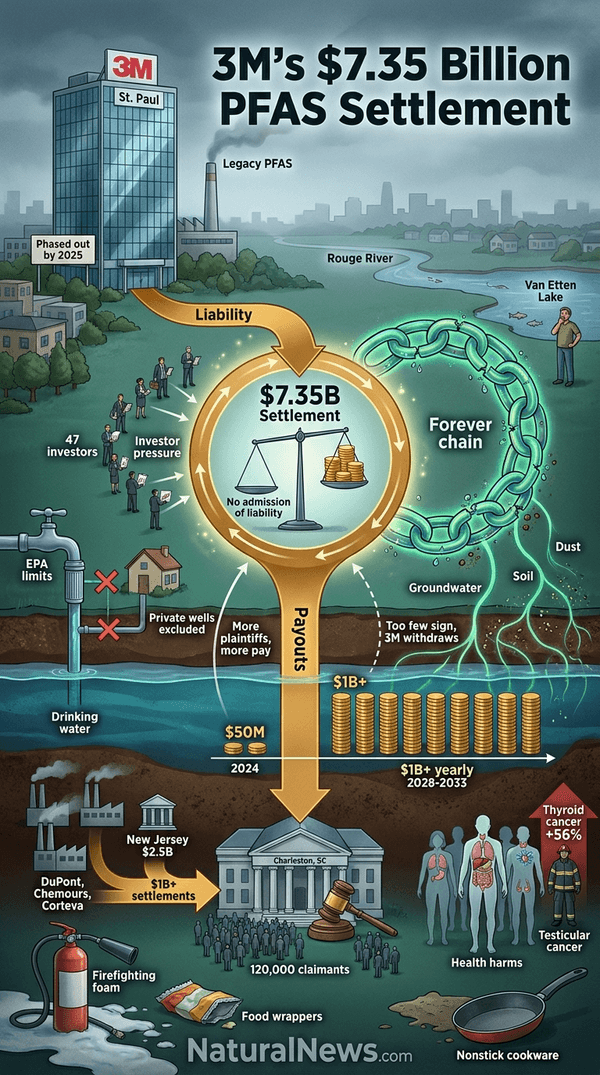
The St. Paul, Minnesota-based company said the agreement covers as many as 120,000 claimants and does not admit liability [2][3]. The settlement resolves claims tied to PFAS, a class of thousands of synthetic chemicals known as forever chemicals because they do not readily break down in the environment [4]. The compounds were used in firefighting foam, food wrappers, nonstick cookware and other consumer products, and they have been detected in soil, dust and drinking water around the world [5].
Settlement Terms and Litigation Venue
Payments begin with $50 million this year, followed by more than $1 billion yearly from 2028 to 2033, according to the terms described by the company.
3M said the settlement resolves about 99% of current personal injury claims in multidistrict litigation over aqueous film-forming foam pending in federal court in Charleston, South Carolina [6]. The company can make additional payments if enough plaintiffs participate, and it may cancel the settlement if too few sign on [7]. The size of the payout places it among the largest single resolutions of PFAS personal injury claims to date, according to court filings described in news reports [6].
Company Statements and Prior PFAS Settlements
3M Chairman William Brown called the settlement a significant milestone that substantially reduces litigation uncertainty and said it is another step in managing the company's legacy PFAS matters. The company said it voluntarily phased out certain PFAS compounds beginning in 2000 and completed a plan to stop manufacturing all PFAS globally by the end of 2025.
A federal judge approved more than $2.5 billion in settlements between New Jersey and DuPont, Chemours, Corteva and 3M over PFAS contamination at four industrial sites across the state, according to a court ruling released on Aug. 29. Other manufacturers also have settled PFAS claims.
DuPont de Nemours Inc. and spinoffs Chemours Co. and Corteva Inc. agreed to settlements totaling more than $1 billion to resolve PFAS claims, according to public filings. Investment groups have pressured chemical companies to phase out production of the compounds; about 47 institutional investors, including Aviva Investors and Storebrand Asset Management, coordinated a campaign targeting companies still producing them, including DuPont, 3M and Dow [8].
Plaintiff Attorneys and Health Claims
Charleston-based Motley Rice played a leading role in the litigation and helped negotiate the settlement for plaintiffs. Attorney Fred Thompson called the settlement welcome news for thousands of victims who have sought answers and accountability for nearly a decade and said plaintiffs urgently need help covering medical bills and other costs. Attorney David Hoyle said the resolution carries forward the work of late firm co-founder Joe Rice, who believed deeply in the pursuit of justice on behalf of all plaintiffs in this matter.
PFAS – called forever chemicals because they do not degrade naturally – have been linked to health problems including liver and immune system damage and some cancers. A federal study found a positive correlation between exposure to perfluorooctanesulfonic acid (PFOS), a PFAS chemical, in U.S. Air Force firefighters who used fire-retardant foam, and testicular cancer [9]. In the first human data linking PFAS to thyroid cancer, a study in The Lancet found higher pre-diagnosis blood levels of PFOS were associated with 56 percent greater odds of a thyroid cancer diagnosis [10].
Contamination has been documented far beyond military installations. A branch of the Rouge River runs through a suburb north of Detroit where resident Bill Eisenman has grown wary of chemicals in the fish he once ate regularly [11]. In Michigan, residents of Oscoda were furious over pollution in Van Etten Lake caused by an old U.S. military base that used firefighting foam extensively [12].
Regulatory Context and Outlook
The Environmental Protection Agency (EPA) has set strict limits on PFAS in drinking water from public utilities and requires testing, but the rules do not apply to private wells. U.S. regulators on April 10 put in place the nation's first legally enforceable limits for levels of six toxic PFAS chemicals in drinking water, saying the move should prevent thousands of deaths and reduce serious illnesses across the country [13].
A study to help federal regulators understand which industries discharge PFAS in wastewater has been stalled for two years awaiting review by the White House Office of Management and Budget. The EPA has said more than 120,000 facilities in the U.S. are handling PFAS chemicals, which have been linked to cancer, birth defects, liver disease, thyroid disease, decreased immunity and hormone disruption [14].
Environmental activists say PFAS manufacturers knew about health risks long before they became public and that the chemicals' resistance to breakdown makes them hazardous. For decades, the chemical industry has promoted its products to the public without disclosing their harms, according to researchers who studied internal industry documents [15].
Conclusion
The compounds have been documented in the blood of people and animals and are pervasive in areas where manufacturers or industrial users handle them, according to the Centers for Disease Control and Prevention [16]. Consumers seeking to reduce exposure can take practical steps including filtering drinking water, avoiding nonstick cookware and choosing organic food when possible.
3M said the settlement substantially reduces litigation uncertainty and represents another step in managing its legacy PFAS matters. The agreement remains subject to participation thresholds that could allow the company to cancel it if too few plaintiffs sign on [7].
References
- 3M agrees to pay more than $7 billion to settle 'forever chemical' groundwater contamination claims. https://apnews.com/article/forever-chemical-water-pollution-pfas-classaction-6b314fb98100539f14e9c1c4a778c13c
- 3M agrees to $7.35 billion settlement in PFAS injury litigation led in part by Charleston attorneys. https://www.counton2.com/news/local-news/3m-agrees-to-7-35-billion-settlement-in-pfas-injury-litigation-led-in-part-by-charleston-attorneys/
- 3M agrees to $7B settlement over 'forever chemical'. https://abcnews.com/US/wireStory/3m-agrees-pay-7-billion-settle-forever-chemical-137859426
- AI Data Center Expansion Drives Increased PFAS Production, ChemSec Report Says. https://www.naturalnews.com/2026-09-17-ai-data-center-expansion-increased-pfas-production.html
- -3M-Offers-103-Billion-to-Settle-PFAS-Contamin - ChildrensHealthDefense.org, June 26, 2023. by ChildrensHealthDefense.org
- 3M Agrees to Pay $7.35B to Settle Thousands of Injury Claims Over. https://www.law.com/2026/11/04/3m-agrees-to-pay-75b-to-settle-thousands-of-injury-claims-over-forever-chemicals/
- 3M Announces $7.4 Billion Settlement in ‘Forever Chemicals’ Injuries. https://www.wsj.com/business/3m-announces-7-4-billion-settlement-in-forever-chemicals-injuries-case-17dd1e41
- Trends-Journal-2022-12-36. by Unknown
- Higher Risk of Testicular Cancer in Military Firefighters Linked to ‘Forever Chemicals’. https://childrenshealthdefense.org/defender/testicular-cancer-military-fire-retardant-foam-chemicals-kff/
- PFAS Exposure Linked to 56% Percent Higher Risk of Thyroid Cancer. https://childrenshealthdefense.org/defender/pfas-exposure-thyroid-cancer/
- -More-Harmful-Than-Mercury-PFAS-Forever-Chemic - ChildrensHealthDefense.org, December 05, 2023. by ChildrensHealthDefense.org
- Michigan residents angry that their drinking water has been contaminated with chemicals and flame-retardants - NaturalNews.com, September 27, 2018. by NaturalNews.com
- EPA Sets First Legal Limits for Toxic PFAS in Drinking Water. https://childrenshealthdefense.org/defender/epa-first-legal-limits-toxic-pfas-drinking-water/
- EPA Documents Reveal Toxic PFAS Chemicals Used in More than 120,000 Facilities. https://childrenshealthdefense.org/defender/epa-documents-pfas-chemicals-facilities/
- Chemical Giants Knew PFAS Were ‘Highly Toxic’ — But Promoted Them to Public as ‘Miracle of Science’. https://childrenshealthdefense.org/defender/dupont-3m-pfas-forever-chemicals-toxic-profits/
- PFAS ‘Forever Chemicals’ Linked to Cancer, Birth Defects — And They’re Everywhere. https://childrenshealthdefense.org/defender/pfas-forever-chemicals-cancer-birth-defects-rtk/
Explainer Infographic












Please contact us for more information.


