



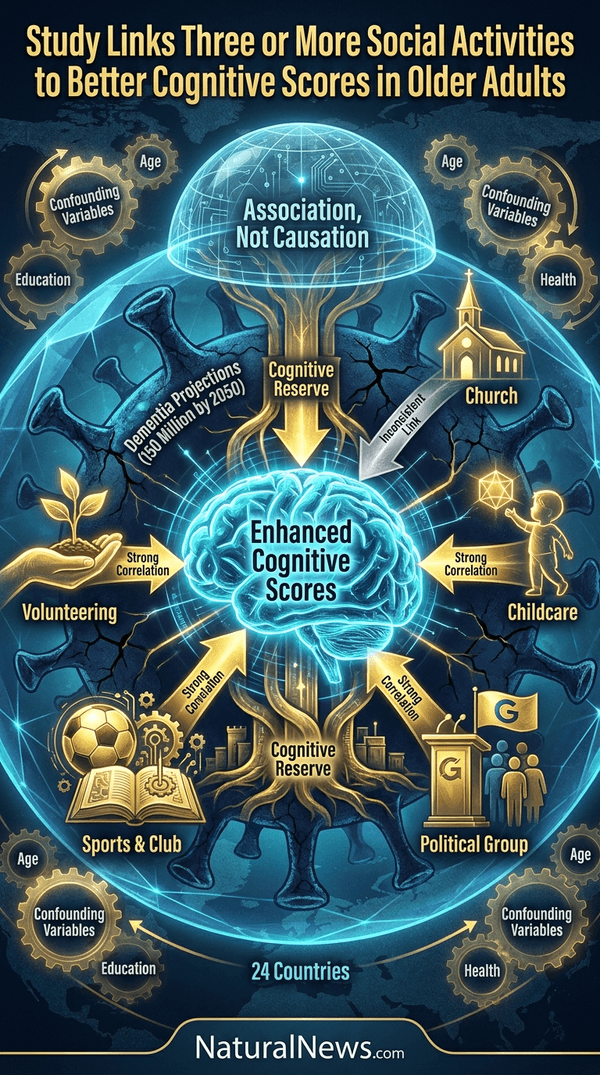
The researchers said the findings show an association between social activity and cognitive scores but cannot confirm whether social inactivity causes cognitive decline.
Independent experts said the results are consistent with the hypothesis that staying mentally and socially active may help maintain cognitive function. However, they cautioned that the observational design limits causal inference.
Study Design and Scope
The researchers compared the type and amount of social activity each participant reported with cognitive scores obtained at different points in the surveys, according to the study. A z-score was applied to determine the impact social activity had on cognitive function; individuals with higher z-scores were more likely to engage in a variety of social activities, the researchers said.
The researchers noted that dementia cases are expected to reach 150 million by 2050 and said social isolation is a known risk factor, though prior findings on social activity and dementia risk have been inconsistent.
The analysis controlled for several potential confounders, including age, sex, education, and health status, according to the report. However, the authors acknowledged that residual confounding cannot be ruled out, and the observational nature of the data precludes drawing causal conclusions.
Activity Types and Cognitive Outcomes
Volunteering and participating in sports club activities were associated with a reduced risk of cognitive decline across all surveys, according to the findings. Some activities, such as caring for children and attending training courses, were more likely to increase cognitive scores each year, the report stated. Participation in church, religious, political, or community groups was not consistently associated with improvements in cognitive function, researchers said.
Seán Kennelly, a consultant geriatrician and cognitive specialist who was not involved in the study, said he was not surprised by the findings. He described socializing as a complex mental activity involving listening, remembering, interpreting emotions, and responding to others. "It requires a lot of cognitive processing," Kennelly said. "That may be why more socially active people tend to have better cognitive scores."
The study's findings align with previous research suggesting that diverse social activities may benefit cognitive health. A 2020 study found that adults who engaged in social activities also had better cognitive health four years later, and that the relationship was mediated by mental health and physical activity [1]. Another study focusing on social activities with friends and neighbors found associations with cognitive outcomes in later life [2].
Expert Perspectives on Mechanisms and Limits
Kennelly said the study's size, involving almost 58,000 people across 24 countries, is encouraging, but added that the study cannot say socializing directly prevents cognitive decline. "It's an association, not proof of causation," he said. "People who are more socially active may differ in other ways that affect their cognitive health."
Shannel Elhelou, a neuropsychologist who was not involved in the study, said different activities engage people in different ways. Volunteering can provide purpose and problem-solving opportunities, sports clubs combine movement with social connection, and courses or child care involve learning and planning. "The variety may be key," Elhelou said. "Different activities challenge different cognitive domains."
Elhelou said the "use it or lose it" hypothesis is a useful way to describe potential value but that dementia risk reflects many interacting factors. Engagement is best viewed as one part of a broader approach alongside physical activity, sleep, and cardiovascular risk management, she said. Kennelly said people with greater cognitive reserve tend to be more resilient to disease changes and may maintain memory and thinking abilities longer, though staying mentally and socially active cannot guarantee someone will not develop dementia [3].
Conclusion
The study adds further weight to evidence that remaining socially active is an important part of healthy brain aging, according to Kennelly. "We have increasing evidence that lifestyle factors, including social engagement, can influence cognitive trajectories," he said.
Researchers and independent experts said the findings do not establish causation and that social activity should be considered alongside other factors in a broader approach to brain health. Future research with longitudinal designs and objective measures of social activity could help clarify the mechanisms linking social engagement to cognitive outcomes [4].
References
- Pathways From Social Activities to Cognitive Functioning - PMC. https://pmc.ncbi.nlm.nih.gov/articles/PMC7325149/
- Social Activities With Friends and Neighbors in Relation to Cognitive .... https://pmc.ncbi.nlm.nih.gov/articles/PMC13499910/
- The Alzheimers Project Momentum in Science by Jeff Williams
- Social Engagement and Cognition - When I'm 64 - NCBI - NIH. https://www.ncbi.nlm.nih.gov/books/NBK83766/
Explainer Infographic












Please contact us for more information.


