


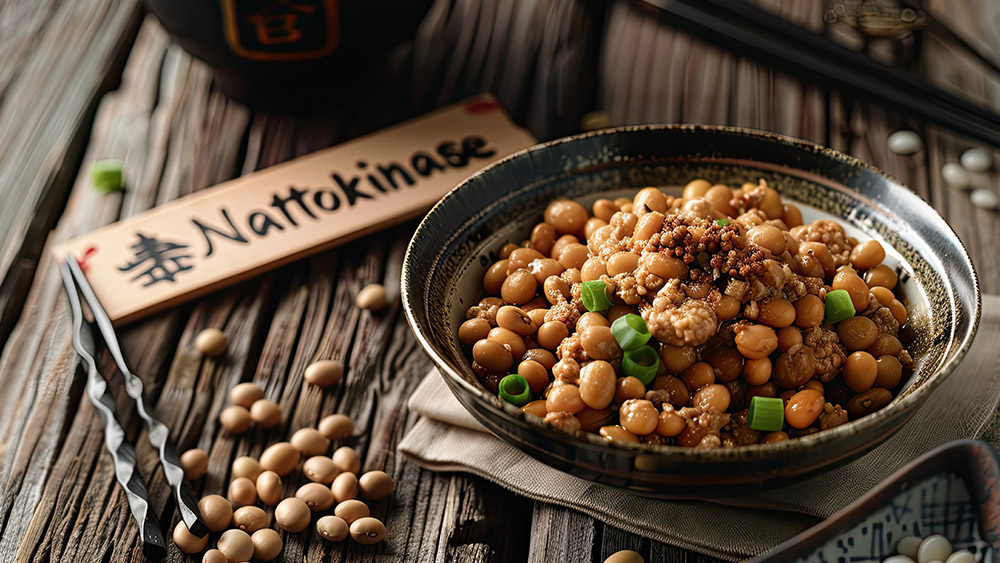
- Nattokinase, a fermented soybean enzyme, has demonstrated ability to degrade SARS-CoV-2 spike protein in two independent laboratory studies.
- The enzyme works through multiple mechanisms: direct fibrinolysis, activation of the body's own clot-dissolving system, and inactivation of PAI-1.
- No controlled human trial has yet proven nattokinase clears vaccine-derived spike from human tissue.
- Dosing matters significantly: 10,800 FU/day showed plaque reduction in one study while 2,000 FU/day showed no effect in a randomized trial.
- Safety precautions are essential as nattokinase is a potent fibrinolytic that can increase bleeding risk with anticoagulants.
A centuries-old fermented food meets modern molecular biology
In September 2022, researchers at Josiah University in Sama, Japan, published findings in the journal Molecules that a fermented soybean enzyme called nattokinase could degrade the SARS-CoV-2 spike protein in laboratory conditions. This discovery connected a staple of traditional Japanese cuisine to one of the most pressing biological questions of the pandemic era: what happens when spike protein persists in the body, and can anything safely remove it?
The answer to that question remains incomplete, but the evidence is compelling enough that millions of people have already begun using nattokinase on their own — often without waiting for the definitive clinical trials that scientists say are still needed.
The spike protein problem: What research has revealed
Spike protein is not merely an inert vaccine ingredient. Peer-reviewed research has established that it functions as a biologically active signaling molecule capable of damaging blood vessels and distorting clot formation independent of any live virus.
A 2021 study from the Salk Institute and UC San Diego found that spike protein alone, displayed on a harmless pseudovirus, damaged vascular endothelial cells by binding ACE2 receptors and impairing mitochondrial function. A South African research team led by Stellenbosch University's Etheresia Pretorius demonstrated that spike protein induces structurally abnormal, amyloid-containing fibrin clots resistant to normal enzymatic breakdown — what they termed "fibrinaloid microclots."
Where does vaccine-derived spike actually go? Regulatory data submitted to Japan's PMDA showed distribution beyond injection sites to liver, spleen, adrenal glands and other tissues. A Stanford-led study detected vaccine mRNA and spike antigen persisting within lymph-node germinal centers for up to eight weeks in some individuals. A Danish study using ultrasensitive PCR found vaccine mRNA sequences in blood plasma for up to 28 days post-vaccination.
What nattokinase actually does
Discovered in 1980 by Japanese researcher Hiroyuki Sumi, nattokinase is a 275-amino-acid serine protease produced by fermenting soybeans with Bacillus subtilis var. natto. Its mechanism is multi-pronged: it cleaves cross-linked fibrin directly, promotes the release of tissue plasminogen activator, and inactivates PAI-1 — the molecular brake that normally restrains fibrinolysis.
The 2022 Molecules study found nattokinase degraded spike protein at concentrations as low as 7.8 ng/mL, requiring at least 60 minutes of exposure. A separate 2021 study from an unaffiliated Japanese academic consortium using live SARS-CoV-2 from a Diamond Princess patient found that whole natto extract fully inhibited viral infection of cultured cells.
Both studies confirmed the effect was enzymatic: heating the enzyme or adding serine-protease inhibitors abolished the degradation entirely.
The cardiovascular record and the dose question
Before COVID-19, nattokinase had accumulated an uneven clinical trial record for cardiovascular disease. A foundational 2008 randomized trial of 86 hypertensive adults found 2,000 FU/day lowered systolic blood pressure by roughly 5.55 mmHg.
The most methodologically rigorous trial — a three-year, double-blind, placebo-controlled study of 265 participants published in 2021 — found no effect on atherosclerosis progression at 2,000 FU/day in low-risk adults. However, a 2022 retrospective study of 1,062 participants reported that 10,800 FU/day over twelve months produced up to 36% reduction in carotid plaque area, while 3,600 FU/day showed no benefit.
The dose-response relationship appears plausible but remains unconfirmed by randomized evidence.
What remains unproven
No controlled human trial has shown that nattokinase clears vaccine-derived spike from human tissue or improves post-vaccination syndrome. The central question — whether orally consumed nattokinase reaches systemic circulation in sufficient concentration to reproduce the spike-degradation effects observed in laboratory studies — remains unanswered.
The Front Line COVID-19 Critical Care Alliance lists nattokinase in its I-RECOVER post-vaccine-syndrome protocol. But as researcher Sayer Ji noted, "the missing link is human clinical confirmation."
Safety considerations
Nattokinase is a drug-grade enzyme, not a vitamin. Rare serious events have been reported: cerebellar hemorrhage in a stroke patient combining nattokinase with daily aspirin, mechanical heart-valve thrombosis in a patient substituting nattokinase for prescribed warfarin, and a fatal hemoperitoneum in an elderly woman.
People taking anticoagulants or antiplatelet drugs, those with bleeding disorders, and anyone approaching surgery should use nattokinase only under appropriate clinical supervision.
The experiment that still needs to be done
When a centuries-old fermented food produces an enzyme with documented fibrinolytic activity and experimental capacity to degrade the protein at the center of a global health crisis, the appropriate scientific response is neither credulity nor dismissal. It is to test it. The funding incentives remain misaligned: nattokinase is not patentable, supplement manufacturers can market it without multimillion-dollar outcomes trials, and the definitive randomized dose-ranging study addressing post-vaccination or post-COVID syndromes has yet to be performed.
The biological foundation is no longer trivial. The experiments should have been done years ago.
Sources for this article include:







Please contact us for more information.


