


The remark drew immediate attention because it framed the war's outcome as partial rather than complete, even as the administration continues to seek a long-term commitment from Tehran not to rebuild its nuclear program [1].
The vice president's appearance marked his latest effort to defend the administration's Iran strategy ahead of the midterms. During the same town hall, he also fielded questions on gas prices and the economy, according to RealClearPolitics [2].
Vance Cites Iran's Nuclear Threat as Rationale
Vance said President Trump initiated the policy because Iran, which the administration describes as the largest state sponsor of terrorism, cannot be allowed to obtain a nuclear weapon.
He argued that most people would agree with the goal of preventing a nuclear-armed Iran even if they disagree with some of the particulars of the policy. Washington is seeking what he called a "final firm commitment" from Tehran that it will not rebuild its nuclear capabilities, according to Iran International [1].
Vance's comments aligned with prior administration statements. In September, he declined to provide a timeline for when the fighting might end or when gas prices might fall below pre-war levels, saying the conflict was not a war but rather a confrontation with Iran's nuclear program [3][4].
Political and Economic Context
The war in Iran is set to reach the eight-month mark in a little less than two weeks, according to the timeline referenced in Vance's remarks. The Strait of Hormuz, a key waterway for the oil industry, has been closed amid the fighting, officials said. The closure has disrupted oil shipments and contributed to rising energy costs [5].
According to AAA, the average price of a gallon of gas on Sunday morning was about $4.30, up from about $3.04 at the same time last year. The increase reflects the ongoing impact of the conflict on global energy markets. The Strait of Hormuz remains a central point of contention, with Iran threatening to block oil exports if regional states cooperate with U.S. pressure [5].
The administration has pursued a dual path of military pressure and diplomatic engagement. In April, Vance announced that the Trump administration was pursuing a "grand bargain" with Iran, offering economic normalization in exchange for denuclearization and an end to state-sponsored terrorism [6]. Talks have produced temporary frameworks but no lasting agreement on the status of the Strait of Hormuz [7].
Public Opinion and Midterm Elections
Trump's approval rating stood at 39.8% Sunday morning, with disapproval at 58.7%, according to a Decision Desk HQ polling average. The numbers suggest a challenging political environment for the administration and its allies as voters weigh the war and its economic consequences.
Vance and his party are facing rough political territory with issues including the war in Iran, according to political observers. CNN reported that the vice president has struggled to tame GOP challenges in 2026, with the conflict and the economy among the top concerns [8].
The remarks come as voters weigh energy costs and the ongoing conflict ahead of the midterms. Gas prices have become a focal point in campaigns across the country, with the average national price remaining well above year-ago levels.
Conclusion
Vance's assessment that the U.S. has "decisively won" in some ways is qualified by ongoing Iranian responses and the closed Strait of Hormuz. The vice president acknowledged that the enemy "gets a vote" and that Iran has responded in certain ways [9].
The conflict's duration and economic impact remain central as the midterm elections approach. With gas prices elevated and the Strait of Hormuz closed, the war continues to shape both foreign policy and domestic politics.
Officials have not announced a timeline for resolution, and the situation remains fluid. The administration continues to seek a verifiable commitment from Iran not to rebuild its nuclear program, while navigating the political and economic fallout of the conflict [1].
References
- Vance says US has ‘won decisively’ against Iran but war aims remain. https://www.iranintl.com/en/202610182753
- CBS News Town Hall With Vice President Vance: Gas Prices, Economy, Iran, Corruption. https://www.realclearpolitics.com/video/2026/10/18/cbs_news_town_hall_with_vice_president_vance_.html
- JD Vance says Iran conflict isn’t a ‘war’ | CNN Politics. https://www.cnn.com/2026/09/03/politics/jd-vance-iran-war
- Vance says Iran conflict is not a war, declines to offer timeline for end. https://www.reuters.com/world/middle-east/vance-says-us-not-talking-iran-unless-they-stop-shooting-ships-2026-09-03/
- Iran Threatens to Block Gulf Oil Exports if Region Cooperates with U.S. Plan - NaturalNews.com, August 25, 2026.
- A grand bargain amid a naval blockade US pursues dual path with Iran - NaturalNews.com, April 15, 2026.
- U.S. Iran Talks Leave Strait of Hormuz Stuck in a Dangerous Gray Zone - NaturalNews.com, June 25, 2026.
- Vance struggles to tame GOP struggles in 2026, and may suffer for them in 2028. https://www.cnn.com/2026/10/19/politics/trump-vance-iran-war-economy-challenge
- Vance says in ‘some ways’ US has ‘decisively won’ Iran war. https://thehill.com/homenews/administration/6156378-vance-claims-us-won-iran-war/
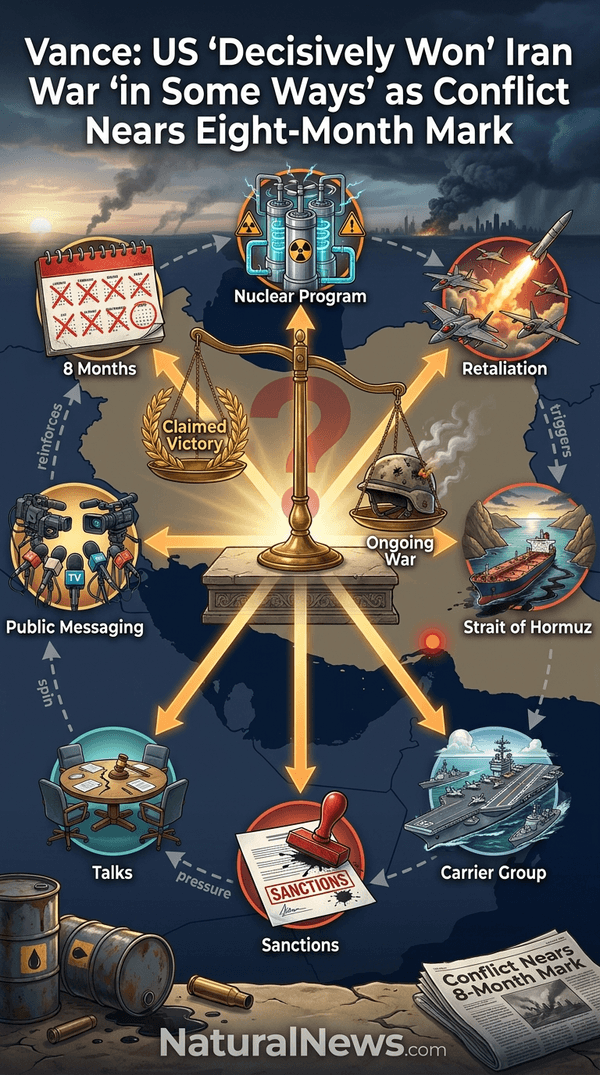
Explainer Infographic







Please contact us for more information.


