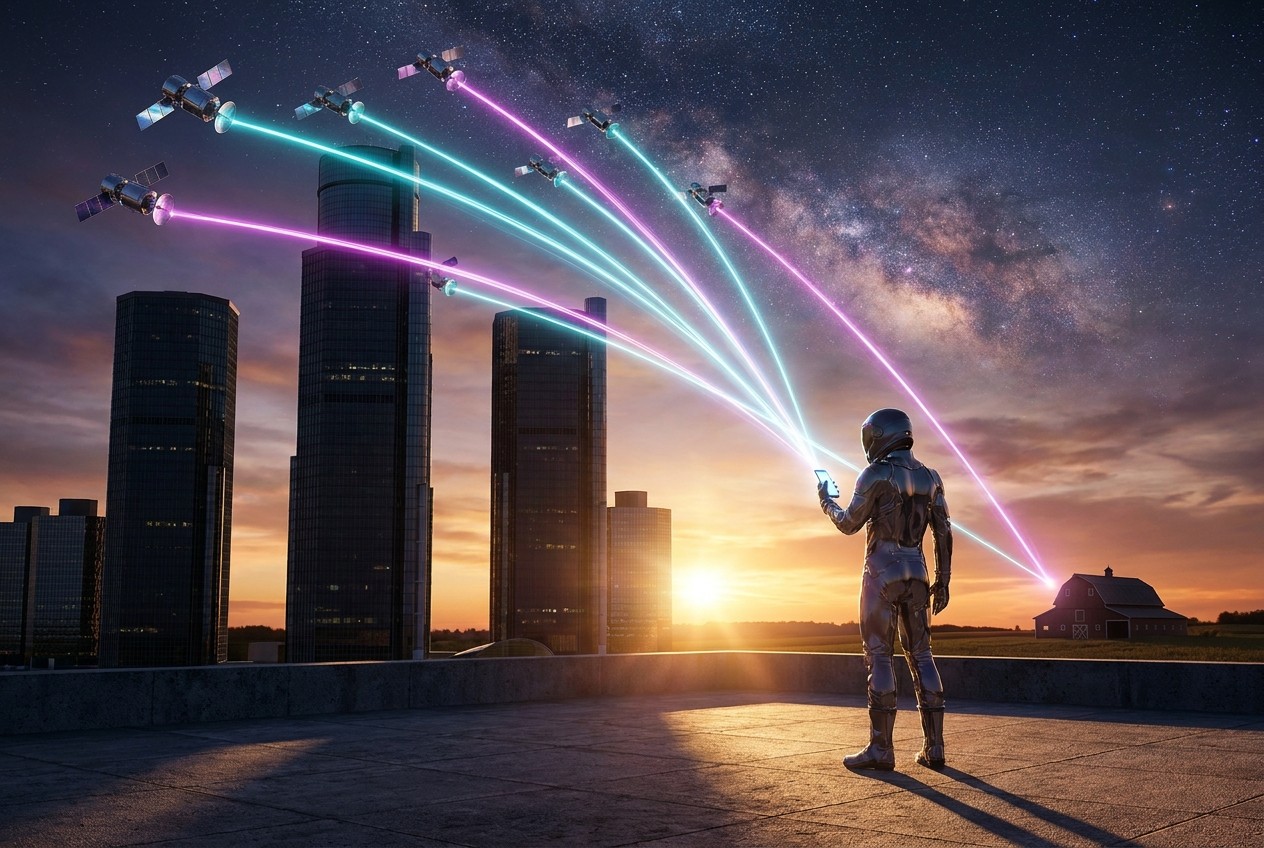
The deal is intended to support a mobile broadband service that would compete with established wireless carriers [1].
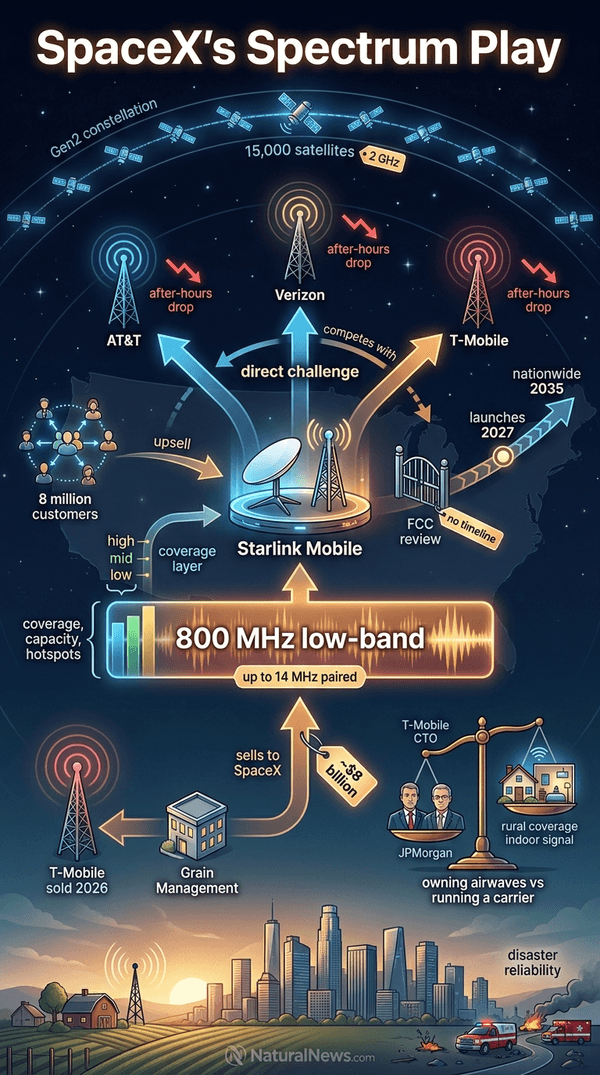
Major telecom stocks fell in after-hours trading following the announcement, the report stated [1]. SpaceX said the new spectrum, combined with its Gen2 satellite constellation, would allow Starlink Mobile to ensure Americans have access to high-speed mobile broadband regardless of location, according to the company statement cited in the report [2].
Background: SpaceX Satellite Internet and Telecom Market
SpaceX has expanded its Starlink satellite internet business in recent years, including a series of spectrum purchases. In September 2025, the company announced a $17 billion deal for EchoStar wireless spectrum, followed by an additional $2.6 billion purchase from EchoStar in November 2025 [3]. The spectrum purchases came as Starlink passed 8 million global customers [3]. A SpaceX official later revealed details about a next-generation direct-to-device cellular service, stating the company was aiming at peak speeds of 150 Mbps [4].
Major U.S. wireless carriers AT&T, Verizon, and T-Mobile dominate the mobile market, and SpaceX's plans have been viewed as a challenge to that dominance. During its first earnings call as a publicly traded company, SpaceX outlined its vision for Starlink to challenge Verizon, T-Mobile, and AT&T, and the big three telecom giants fell in premarket trading [5]. The company's spectrum acquisitions and a trademark filing for "Starlink Mobile" were identified as signals of its carrier ambitions [6].
Spectrum rights are required to operate mobile networks, and access to spectrum has historically been a regulatory and financial barrier for new entrants. SpaceX's earlier purchases included mid-band spectrum for wireless transmission and high-band spectrum for data transmission, according to The Motley Fool [7]. The low-band spectrum acquired in the new deal is well-suited for carrying signals over long distances and through walls and other solid structures, which could improve indoor performance for Starlink Mobile once SpaceX builds out a ground network, the report stated [7]. An FCC-approved application allows Starlink Mobile to launch 15,000 satellites to transmit radio waves in the 2 gigahertz band and connect directly to cell phones, according to The Gateway Pundit [8].
Deal Terms and Spectrum Assets
The deal involves the acquisition of Grain Management's nationwide portfolio of 800 MHz low-band spectrum licenses, according to The Wall St Engine post [9]. Grain Management purchased the spectrum from T-Mobile earlier in 2026 [10]. The portfolio comprises up to 14 MHz of paired low-band spectrum in the 800 MHz band, reports stated [11]. T-Mobile had previously run the spectrum as a single 5 MHz channel pair for LTE but sold it because it no longer fit its strategy, as today's 5G Standalone and 5G Advanced networks use much wider channels [12].
Financial terms were reported at approximately $8 billion by PCMag, which described it as the reported acquisition price [13]. SpaceX characterized the deal as the "last critical piece" of its spectrum puzzle in a post on X [14].
The acquisition remains subject to approval by the Federal Communications Commission, which has not yet set a timeline for a decision, according to CNET [15]. SpaceX holds no suitable satellites in orbit yet, with launches starting late in 2027, and full commercial nationwide service won't arrive until 2035 at the earliest, observers suggested [16].
Potential Impact on Telecommunications Competition
The deal could increase competition in the mobile broadband market. Analysts believe SpaceX's entry into the mobile carrier market could have a profoundly negative impact on the existing wireless industry [17]. SpaceX's move gives Starlink Mobile a means to more aggressively challenge the Big 3 U.S. mobile carriers on the ground [18].
T-Mobile's chief technology officer gave SpaceX a reality check on its Starlink Mobile ambitions, according to PCMag, which reported the carrier's argument that owning airwaves and running a carrier are two very different things [12]. Analysts at JPMorgan Chase wrote that absent a deal with an existing wireless carrier, SpaceX would likely need to build a terrestrial network using macro towers to deliver a user experience on par with traditional wireless carriers [19]. LightShed Partners analyst Walt Piecyk believes the spectrum will be used terrestrially to complement SpaceX's coming next-generation satellite network and its larger 2GHz holdings [20].
Potential effects include improved rural coverage and indoor performance. The low-band spectrum is expected to help satellite-connected signals penetrate walls and other obstacles that currently limit coverage [21].
Reactions and Regulatory Outlook
Responses from major telecom carriers and the FCC have been closely watched. T-Mobile's CTO publicly disputed the characterization of the deal as the "last critical piece" for Starlink Mobile becoming a rival fourth carrier [12]. The FCC has not yet set a timeline for a decision on the acquisition, and the agency's approval remains pending [15]. The FCC previously approved Starlink Mobile's application to launch 15,000 satellites to transmit radio waves in the 2 gigahertz band [8].
SpaceX's next steps include deployment of its Gen2 constellation and the build-out of a ground network. Before the service can challenge established carriers, SpaceX must obtain FCC approval, launch its Gen2 satellites, and build out terrestrial infrastructure. Analysts have noted that full commercial nationwide service won't arrive until 2035 at the earliest, according to Advanced Television [16]. The deal's status remains pending, with the company describing it as the foundation for its mobile carrier ambitions.
References
- "Last Critical Piece": SpaceX Secures Spectrum Deal To Challenge Big Telecom. https://www.zerohedge.com/technology/last-critical-piece-spacex-secures-spectrum-deal-challenge-big-telecom
- SpaceX Makes BIG Move To Shake Up U.S. Mobile Carrier Market. https://100percentfedup.com/spacex-makes-big-move-shake-up-u-s/?utm_source=rss&utm_medium=rss&utm_campaign=spacex-makes-big-move-shake-up-u-s
- SpaceX’s Starlink secures more spectrum and airlines as it passes 8 million customers. https://techcrunch.com/2025/11/06/spacexs-starlink-secures-more-spectrum-and-airlines-as-it-passes-8-million-customers/
- SpaceX Official Reveals New Details About Next-Gen Cell Service. https://www.zerohedge.com/technology/spacex-official-reveals-new-details-about-next-gen-cell-service
- US Telecoms Slide On Starlink Mobile Threat; Bernstein Sees It As A "Jab, But No Knockout Yet". https://www.zerohedge.com/technology/us-telecoms-slide-starlink-mobile-threat-bernstein-sees-it-jab-no-knockout-yet
- Musk's Starlink Plots To Become A Mobile Carrier; TD Cowen Sees Possible T-Mobile Buyout. https://www.zerohedge.com/technology/musks-starlink-plots-become-mobile-carrier-td-cowen-sees-possible-t-mobile-buyout
- SpaceX is purchasing a portfolio of low-band spectrum licenses. https://www.fool.com/investing/2026/10/09/elon-musk-just-delivered-great-news-to-spacex-investors-and-bad-news-to-traditional-telecom-investors/
- Elon Musk’s Starlink Set to Become a ‘Major Mobile Carrier’ After.... https://www.thegatewaypundit.com/2026/10/elon-musks-starlink-set-become-major-mobile-carrier/
- Wall St Engine(@wallstengine): SPACEX SIGNS SPECTRUM DEAL.... https://twiscan.com/en/x/wallstengine/2108299142380535862
- SpaceX Takes Giant Step to Becoming Major US Mobile Carrier. https://www.ntd.com/spacex-takes-giant-step-to-becoming-major-us-mobile-carrier_1177879.html
- “Last Critical Piece”: SpaceX Secures Spectrum Deal To .... https://freedom-vaca.org/2026/10/08/last-critical-piece-spacex-secures-spectrum-deal-to-challenge-big-telecom/
- T-Mobile says its old LTE spectrum won't fix... - Notebookcheck News. https://www.notebookcheck.net/T-Mobile-says-its-old-LTE-spectrum-won-t-fix-Starlink-Mobile-s-indoor-woes.1420928.0.html
- T-Mobile CTO Gives SpaceX a Reality Check on Its Starlink... | PCMag. https://www.pcmag.com/news/t-mobile-cto-gives-spacex-a-reality-check-on-its-starlink-mobile-ambitions
- ASTS Stock Slides After-Hours As SpaceX Snags Grain Spectrum.... https://stocktwits.com/news-articles/markets/equity/asts-stock-spacex-grain-spectrum-analyst-who-called-deal-ligado-next/cZD6eLuRBVI
- Elon Musk Eyes & Complete Phone Coverage in America& as SpaceX.... https://www.cnet.com/tech/mobile/starlink-acquires-low-band-spectrum/
- Musk to start 4th US cellular operator | Advanced Television. https://www.advanced-television.com/2026/10/09/musk-to-start-4th-us-cellular-operator/
- 'Last Critical Piece': SpaceX Secures Spectrum Deal To Challenge Big .... https://thenote.app/post/en/last-critical-piece-spacex-secures-spectrum-deal-to-challenge-big-telecom-37jdmemzbi
- SpaceX’s 800 MHz spectrum grab threatens Big 3 mobile carriers. https://www.fierce-network.com/wireless/spacexs-800-mhz-spectrum-grab-threatens-big-3-mobile-carriers
- Elon Musk’s SpaceX empire hammers AT&T, Verizon, T-Mobile shares. https://www.nbcnews.com/business/corporations/elon-musk-spacex-verizon-tmobile-att-rcna602525
- SpaceX eyes 'major mobile carrier' status via Grain spectrum deal. https://www.lightreading.com/satellite/spacex-grain-s-lowband-spectrum-is-our-ticket-to-becoming-major-mobile-carrier-
- Elon Musk’s Starlink Plans to Become a ‘Major Mobile... | TRUTH Press. https://truthpress.com/news/elon-musks-starlink-plans-to-become-a-major-mobile-carrier-with-nationwide-phone-coverage/
Explainer Infographic








Please contact us for more information.