


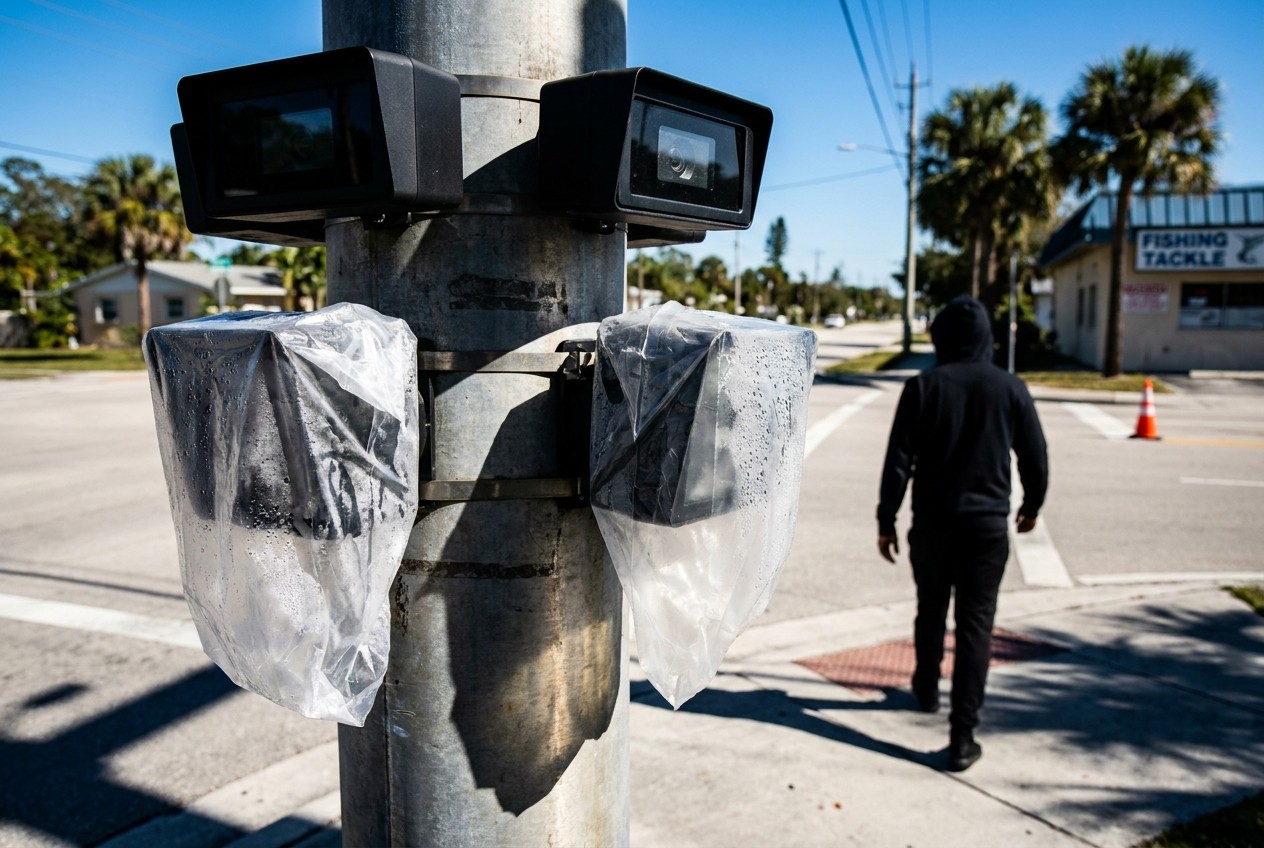
Removal notices were posted at the cameras, giving those responsible 30 days to remove them, Gill said. Depending on when the notices were posted, the deadlines fall between Oct. 16 and Oct. 20, added Gill [1].
County staff planned to begin placing plastic bags over the cameras while the notices expire, Gill said. The discovery has raised concerns about who installed the devices and who had access to the data they collected [2].
County Had Voted to Remove Its Flock Cameras
St. Lucie County commissioners voted to remove Flock cameras from county roads, following a broader Florida push against the technology, officials said.
In late August, the Florida Department of Transportation issued an order under Gov. Ron DeSantis. The order gave municipalities until Sept. 30 to remove the cameras from state highway rights-of-way [3][17].
Law enforcement agencies across Florida subsequently announced they would suspend or end their Flock programs [17]. The Florida Department of Transportation (FDOT) memo stated that while Florida law limits the issuance of permits for license plate reader systems to law enforcement agencies, "the recent exponential increase in deployments along our roadways, coupled with concerning reports of misuse, data privacy concerns, and surveillance schemes merit immediate action to preserve Floridians' sovereignty and quality of life" [4].
The state action followed a directive from Texas Gov. Greg Abbott ending funding for Flock camera use, which led the Dallas Police Department to announce it would shut down hundreds of cameras [5].
Officials across party lines have moved to restrict automated license plate readers, which critics say amount to warrantless mass surveillance [6].
Ownership and Data Access Remain Unclear
After the county shared a list of unpermitted cameras with local law enforcement agencies, the St. Lucie County Sheriff's Office identified three devices as its own but has not explained why they lacked permitting, county officials said [7][17].
The county's other two law enforcement agencies have said none of the cameras are theirs, according to county officials [1].
Flock spokesperson Paris Lewbel said the company applies for permits where required, but permitting requirements vary by jurisdiction and are not necessary in every location [17].
Gill said the county had not yet reached out to Flock about the cameras' owners, waiting until the removal notices expire. The situation has drawn comparisons to previous incidents involving unclaimed surveillance devices, including a decade-old case involving StingRay cell phone surveillance devices in Washington, D.C., whose operators were also unknown [8].
Residents and Business Owners React to Unknown Cameras
Todd Richter, 70, manager of a fishing supply shop across from one of the cameras in Fort Pierce, said he was not necessarily opposed to license-plate readers but was troubled by not knowing who installed the device [17].
Ty Grant, 28, who lives a few hundred feet from a camera that had been on 25th Street in Fort Pierce, said he had assumed the camera belonged to local law enforcement. Grant said learning that county officials did not know who installed it made him feel "very unsafe" [9][17].
Reaction across social media platforms has included speculation that foreign nations could be involved in putting up the cameras without the necessary permits [9].
Flock's Expansion and Prior Installation Questions
Flock markets the cameras as tools for locating stolen cars, missing people, and criminal suspects, and the company and law enforcement agencies say the technology makes communities safer [17]. The cameras record not just license plates but also vehicle make, model, color, and unique features, creating a digital "fingerprint" [10].
In Florida, former Fort Pierce police officer Josepher Crutchfield was recently jailed after officials said he accessed the Flock database 382 times to track his ex-girlfriend while off-duty [11].
In August, a former Sarasota officer was arrested after an internal investigation found he allegedly searched for a license plate over 300 times; Corey Waiters is accused of two felonies and a misdemeanor for his alleged misuse of the cameras [12].
Christopher Goodson, an officer in Haines City in central Florida, was found to have looked up his ex-wife's license plate number in the Flock database 717 times between September 1, 2024, and June 30, 2026, according to an affidavit [13].
Flock Safety has shown a pattern of installing cameras before permits across multiple states and jurisdictions [11].
Removal Deadline Approaches as Questions Persist
It remains unclear whether the unclaimed cameras are still recording license plates or who can access the data they have already collected, according to county officials [14].
The discovery in St. Lucie County reflects broader national scrutiny of Flock Safety's camera network. Federal legislation introduced in October 2026, the Ban Flock Act, would bar all federal agencies from acquiring, possessing, or using data from automated license plate readers [15].
A federal judge in Tulsa, Oklahoma, ruled on Oct. 1 that a sheriff's deputy violated a woman's Fourth Amendment rights when he searched for her license plate in Flock Safety's automated license plate reader system without a warrant [16]. As local officials await the removal deadlines, questions about who installed the unclaimed cameras and who may have accessed their data remain unanswered.
References
- Flock cameras appear in Florida town – but nobody knows who is running .... https://www.independent.co.uk/news/world/americas/florida-flock-cameras-st-petersburg-b3059738.html
- Florida county officials have no idea where extra Flock cameras.... https://notthebee.com/article/flock-cameras-appeared-in-this-florida-county-but-no-one-knows-where-they-came-from-or-who-owns-them
- Florida county discovers mysterious Flock cameras with no.... https://san.com/cc/florida-county-discovers-mysterious-flock-cameras-with-no-obvious-owner/
- Florida Transportation Department Blocks Flock on State Roads; Counties Follow Suit. https://thenewamerican.com/us/florida-transportation-department-blocks-flock-on-state-roads-counties-follow-suit/
- Dallas Police to Shut Down Hundreds of Flock Cameras. https://theepochtimes.com/us/dallas-police-to-shut-down-hundreds-of-flock-cameras-6082496
- America Is Slamming The Brakes On The Camera Network Tracking Your Every Move. https://yournews.com/2026/09/12/7193365/america-is-slamming-the-brakes-on-the-camera-network-tracking/
- Florida County Finds 11 Unpermitted Flock Cameras With.... https://www.engadget.com/2275315/florida-county-finds-11-unpermitted-flock-cameras-with-unidentified-owners/
- Unidentified Flock Cameras in Florida. https://www.schneier.com/blog/archives/2026/10/unidentified-flock-cameras-in-florida.html
- 'Time for the chainsaws': Florida cops have discovered 11 .... https://www.techradar.com/tech/time-for-the-chainsaws-florida-cops-have-discovered-11-unauthorized-flock-cameras-and-no-one-knows-whos-been-operating-them
- The digital panopticon License plate readers are tracking you everywhere you go - NaturalNews.com, September 01, 2025
- Florida County Found 11 Mystery Flock Cameras. - Gadget Review. https://www.gadgetreview.com/florida-county-found-11-mystery-flock-cameras-nobody-knows-who-owns-them
- Former Police Officer Arrested For Alleged Misuse Of Flock Safety Cameras. https://100percentfedup.com/former-police-officer-arrested-alleged-misuse-flock-safety/?utm_source=rss&utm_medium=rss&utm_campaign=former-police-officer-arrested-alleged-misuse-flock-safety
- Police officer arrested after using Flock cameras 717 times to track ex-wife. https://www.lifesitenews.com/news/police-officer-arrested-after-using-flock-cameras-717-times-to-track-ex-wife/
- Florida Workers Uncover 11 Rogue Surveillance Cameras on... | SOFX. https://www.sofx.com/florida-workers-uncover-11-rogue-surveillance-cameras-on-public-roads-in-st-lucie-county/
- Bipartisan Ban Flock Act targets federal use of license plate surveillance networks. https://www.naturalnews.com/2026-10-06-ban-flock-act-targets-license-plate-surveillance-networks.html
- Federal judge rules warrantless searches using automated license plate readers as unconstitutional. https://www.naturalnews.com/2026-10-06-judge-rules-warrantless-searches-using-alprs-unconstitutional.html
- Florida county discovers mysterious Flock cameras with no obvious owner. https://www.washingtonpost.com/nation/2026/10/01/florida-county-discovers-mysterious-flock-cameras-with-no-obvious-owner/
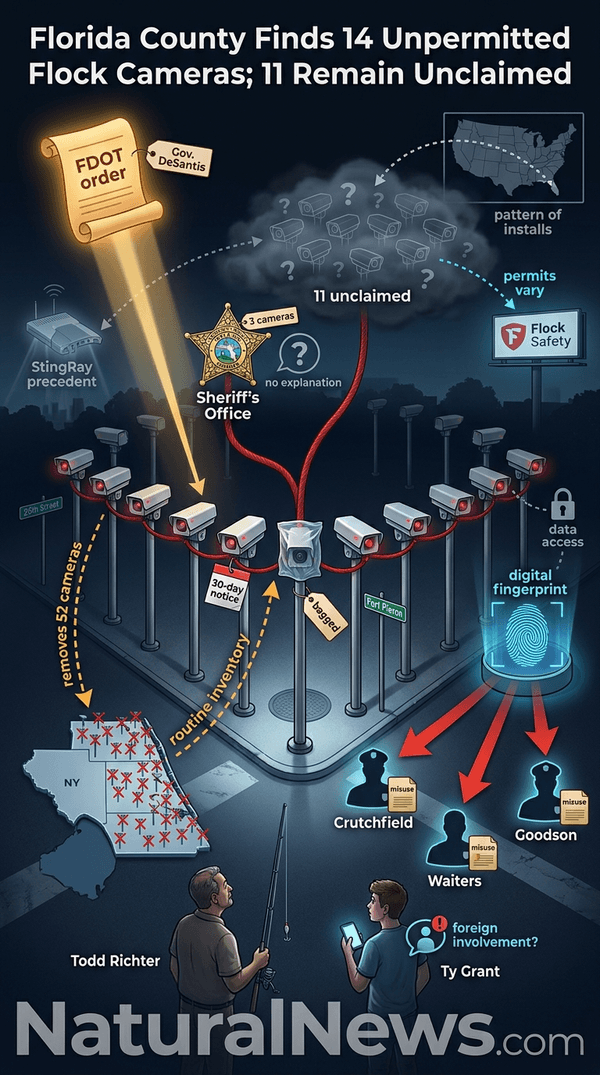
Explainer Infographic











Please contact us for more information.


