


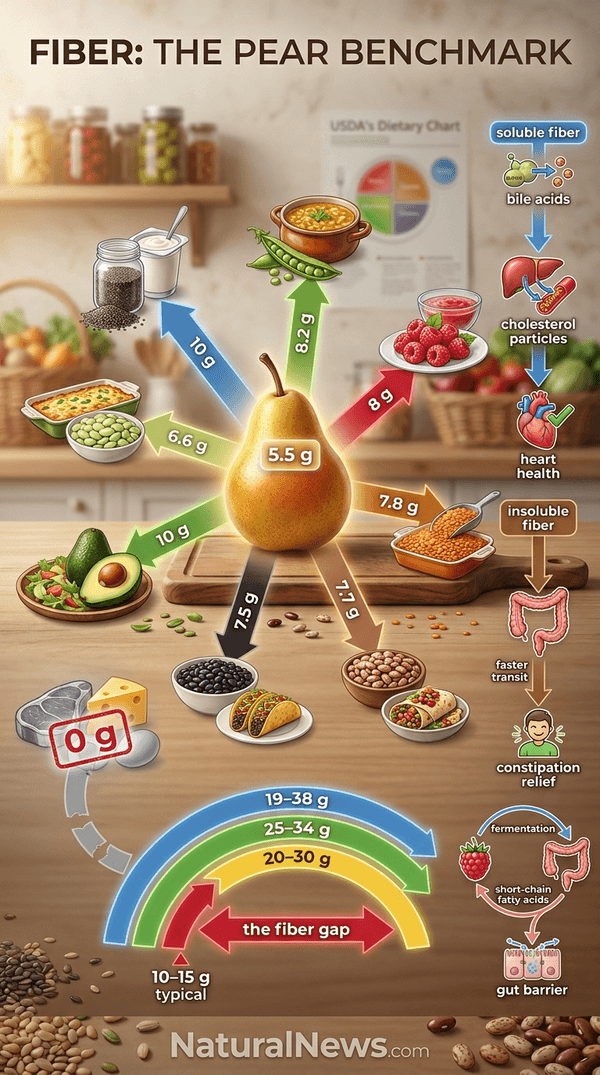
Dietitians and public health officials say fiber supports digestion, helps manage cholesterol levels and promotes satiety. The American Heart Association recommends at least 25 to 34 grams of fiber daily, but most Americans consume only 10 to 15 grams per day, according to a NaturalNews.com report [1]. A 2014 Food & Fiber Summit in Washington, D.C., found that only about 5% of Americans meet the Institute of Medicine's daily fiber recommendations of 19 to 38 grams, depending on age and gender, according to a report on the summit [2].
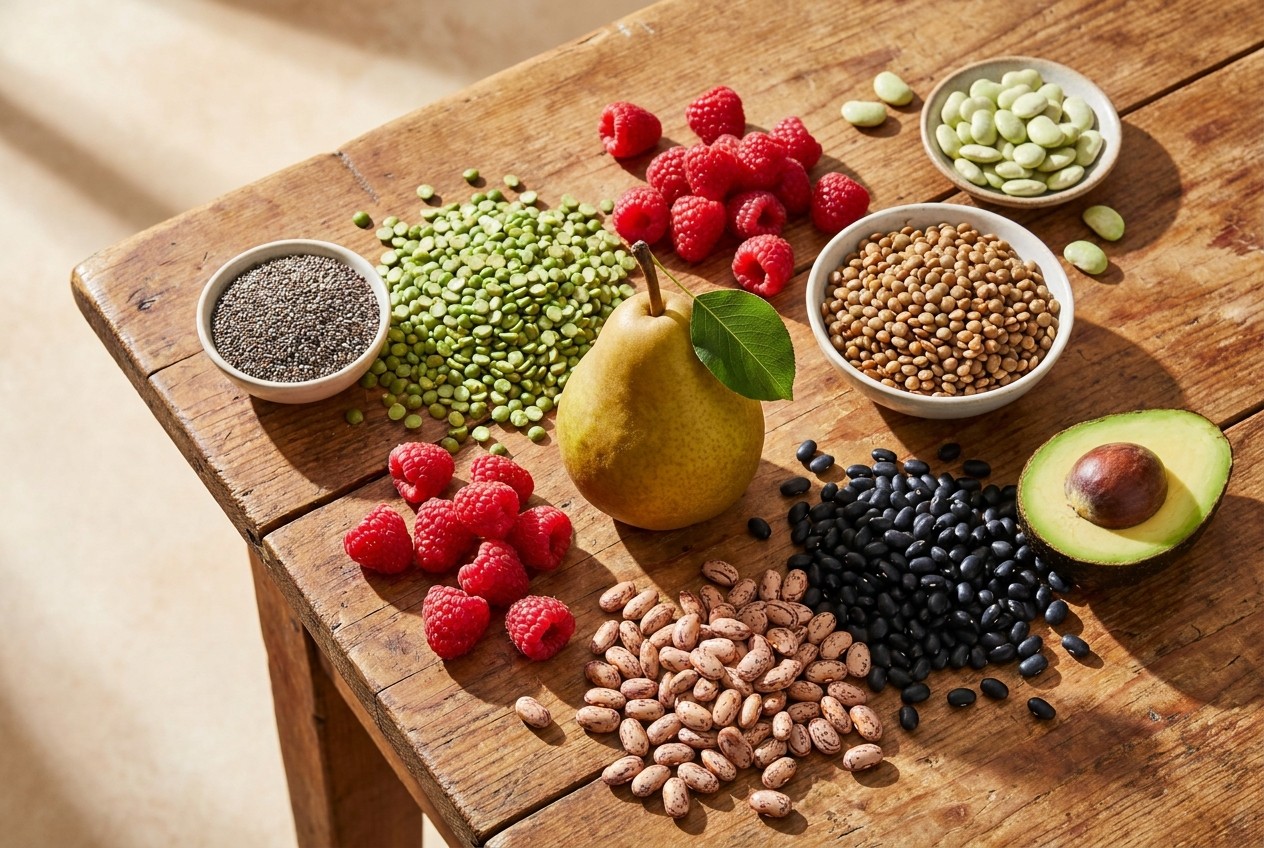
Fiber is found in fruits, vegetables, whole grains, legumes and seeds, the same report stated. The following foods, based on the cited nutrition data, provide fiber at or above the level of a medium pear.
Seeds, Split Peas, and Raspberries
Chia seeds provide 10 grams of fiber per 2 tablespoons, according to nutrition data. Split peas provide 8.2 grams per half-cup cooked, the data stated. Raspberries provide 8 grams per cup, according to the cited nutrition source.
Registered dietitian Stephani Johnson, DCN, RDN, an adjunct professor at Rutgers University School of Health Professions, and Alanna Terry, MS, RDN, CDN, CSO, at Mount Sinai, provided recommendations on high-fiber fruits and vegetables, according to a NaturalNews.com report [3]. The report stated that data on fiber content, calories and preparation methods were attributed to these dietitians.
A registered dietitian said in a statement that these foods can be added to yogurt, oatmeal, smoothies or soups. The report noted that public health guidelines from the U.S. Food and Drug Administration state that Americans should consume between 20 and 30 grams of fiber per day, though most adults fall short of this recommendation due to a diet lacking in fiber-rich foods [3].
Separate research associates raspberries and blackberries with high fiber content. A NaturalNews.com report on gut health stated that raspberries and blackberries lead the pack among fruits for digestive wellness [4]. The report also stated that these whole foods nourish the gut microbiome, reduce inflammation and protect against chronic diseases.
Lentils, Pinto Beans, and Black Beans
Lentils provide 7.8 grams of fiber per half-cup cooked, according to USDA FoodData Central. Pinto beans provide 7.7 grams per half-cup cooked, and black beans provide 7.5 grams, the data stated.
Officials said legumes also contain protein, iron and folate. A nutrition report stated that legumes can be added to soups, salads and burrito bowls. The report noted that the recommended dietary fiber intake of 20 to 35 grams per day can possibly be met by consuming a wide variety of foods, particularly fruits and vegetables [5].
A NaturalNews.com article on fiber's role in diabetes management stated that dietary fiber can "rebalance" gut microbiota, encouraging the development of specific types of beneficial gut bacteria that improve blood glucose regulation [6]. The study, led by Liping Zhao from Rutgers University-New Brunswick, investigated the relationship between gut bacteria and diabetes, according to the report [6].
A book on nutrition for children stated that whole grain bread, beans, peas and lentils contain bulk or fiber that provides a full feeling but passes through the digestive tract without being absorbed [7]. The same source noted that many people report a reduction in weight when they switch from refined carbohydrates to whole grains and legumes [7].
Avocado, Lima Beans, and Dietary Guidance
Avocado provides fiber, though the seed context did not list a gram amount; USDA data cited by nutrition sources lists about 10 grams per cup sliced. A NaturalNews.com report on avocados stated that avocados are nutrient-dense superfoods rich in healthy fats, fiber and essential vitamins and minerals [8]. Regular consumption is linked to improved heart health, better digestion, enhanced nutrient absorption and support for heart, eye and skin health, the report stated [8]. Lima beans provide 6.6 grams per half-cup cooked, according to nutrition data.
Dietary guidance recommends increasing fiber gradually and drinking water, officials said. A NaturalNews.com report on gradual fiber increases stated that the guidance comes as public health researchers continue to describe a persistent fiber gap in the American diet [2]. The report noted that the summit identified the core problem as confusion about which foods contain fiber and how much is needed [2].
A dietitian said mixing fiber sources can help meet daily nutrient needs. A book on nutrition for pregnancy stated that 29 grams is the recommended daily amount of fiber during pregnancy, rounded to 30 grams for simplicity [9]. The book advised filling half your plate with fruits and vegetables to help reach the goal of two cups of fruit and three cups of veggies a day [9].
A book on the Okinawa diet stated that animal products like meat, cheese and eggs contain zero fiber [10]. Only plant foods -- fruits, vegetables, whole grains, beans, nuts and seeds -- can provide the fiber essential to good health, the book stated [10].
Conclusion
The listed foods each provide fiber at or above the level of a medium pear, per the cited data. Chia seeds, split peas, raspberries, lentils, pinto beans, black beans, avocado and lima beans all meet or exceed the approximately 5.5 grams of fiber in a medium pear.
Nutrition officials said individuals should consult dietary guidance and increase fiber intake gradually. A NaturalNews.com report on fiber stated that despite its critical role in digestion, disease prevention and detoxification, dietary fiber remains one of the most overlooked components of the modern diet [1]. The report noted that this deficiency contributes to widespread digestive disorders, rising cardiovascular risks and increased susceptibility to certain cancers [1].
References
- NaturalNews.com. "Dietary fiber: Here's why you shouldn't miss out on this digestive superhero". February 8, 2026.
- NaturalNews.com. "Gradual Fiber Increases May Reduce Bloating, Nutrition Guidance Says". September 23, 2026.
- NaturalNews.com. "Dietitians Identify Five High-Fiber Fruits and Vegetables for Fall". September 25, 2026.
- NaturalNews.com. "The gut-healing power of nature's bounty: Top fruits for digestive wellness". May 7, 2026.
- Elsevier. "Dietary fiber content of 21 Kuwaiti composite dishes". Food Chemistry. 1997.
- NaturalNews.com. "Fiber found to be an underutilized treatment for type-2 diabetes". April 8, 2018.
- Catherine Romaniello. "Off to a Good Start: Practical Nutrition for Children".
- NaturalNews.com. "From exotic oddity to wellness staple: The avocado's health revolution". February 7, 2026.
- Bridget Swinney. "Eating Expectantly: Practical Advice for Healthy Eating Before, During and After Pregnancy".
- "The Okinawa Diet Plan: Get Leaner, Live Longer, and Never Feel Hungry".
Explainer Infographic







Please contact us for more information.


