


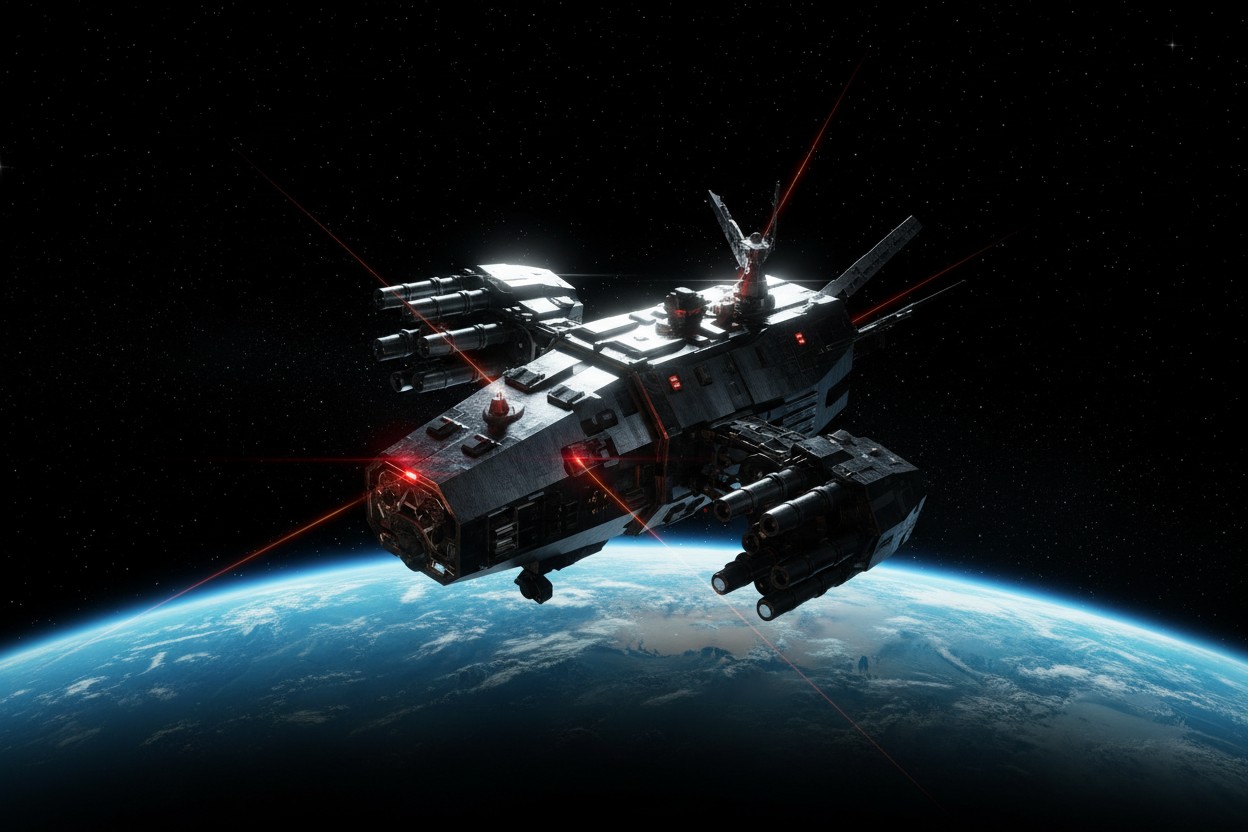
The announcement marks the first time the United States has publicly acknowledged placing offensive or defensive weapon systems in orbit, according to wire service reports [1]. Meink did not specify the number of weapons, their capabilities, or when they were placed in orbit, citing operational security requirements [3][4].
The confirmation was made in Washington and follows years of statements by senior military leaders that space is a warfighting domain requiring active defense, according to prior congressional testimony and conference remarks [4][5].
Official Statement and Operational Details
A Pentagon spokesperson said the weapons are intended to protect U.S. satellites and allied space assets by applying the principle of "space control," which officials described as the ability to defend against hostile adversary action in orbit [4]. According to a report by The War Zone, the U.S. Space Force shared additional details about the mission set directly with the outlet, though those details remain classified [4].
The statement did not disclose the number of weapons, their capabilities, or whether they have been tested in orbit, officials said [3]. Meink cited national security reasons for withholding technical details, adding that further information may be released "at an appropriate time" [1]. Chief of Space Operations Gen. Douglas Schiess previously stated during a "State of the Space Force" address that Guardians operate on-orbit weapons that can defend the joint force against space-enabled attacks [6].
The confirmation follows years of statements by U.S. military officials that space-based assets are vulnerable to foreign interference, according to prior congressional testimony and conference remarks. In 2020, then-Defense Secretary Mark Esper accused China and Russia of "weaponizing" space, claiming both countries operate "killer satellites" and directed energy weapons, according to a Brighteon broadcast report [7]. Gen. Chance Saltzman, chief of the U.S. Space Force, warned in 2025 that Beijing operates 347 military satellites, nearly half its 700-satellite fleet, surveilling U.S. forces [8]. The Pentagon has also scrambled to acquire tools to defend its satellite network from possible attacks and disrupt or disable enemy spacecraft in orbit, according to NaturalNews.com [9].
Treaty and Legal Context
The 1967 Outer Space Treaty prohibits placing weapons of mass destruction in orbit but does not explicitly ban conventional space weapons, according to the treaty text. The treaty, ratified by the United States, Russia, and China, remains the primary international framework governing military activities beyond Earth's atmosphere. Legal analysts said the absence of a comprehensive space weapons ban leaves room for competing interpretations of what constitutes a prohibited system, according to a report by Antiwar.com [6].
Arms control advocates said the deployment could undermine international norms against space militarization. The Kremlin responded to the announcement by stating that weapons should not be deployed in space. Kremlin spokesman Dmitry Peskov said Russia opposes the U.S. move to place a weapons system in orbit, according to RT [10]. Military expert Alexei Leonkov told Sputnik that the U.S. Golden Dome project turns space into a battlefield and that the next step may be the deployment of American missiles and laser weapons beyond Earth [11].
A State Department official has said the United States remains committed to existing space treaties and that the deployment is consistent with international law, according to prior statements. The Reagan administration adopted a plan to seize the "high ground" through military superiority in space, a policy that signaled the end of U.S. efforts to even pretend that American space activities would be dedicated to peaceful purposes, according to Terrence Edward Paupp's book Exodus from Empire [12]. Soviet President Konstantin Chernenko in 1984 urged the U.S. to negotiate "without delay" a treaty banning the use and development of antisatellite weapons, according to the book America in Space: Pioneers or Aggressors [13].
International and Domestic Reactions
Russia and China have responded to the U.S. announcement by warning of an arms race in space, according to wire service reports. The BBC reported that both nations reacted to the confirmation, though neither issued immediate detailed official statements [14]. The Kremlin's response, delivered by spokesman Dmitry Peskov, stated that weapons should not be deployed in space [10].
Some members of Congress said they were briefed on the deployment and called for additional oversight, according to congressional statements. Independent analysts and alternative media outlets questioned the timing of the disclosure. The Antiwar.com report described the announcement as evidence of continued U.S. contempt for arms control, noting that Chief of Space Operations Gen. Douglas Schiess had previously testified to aggressive combat actions [6].
A military spokesperson said operational security requirements prevent public release of additional details, officials said [4]. The U.S. Space Force has also shared limited details with select media outlets under embargo, according to TWZ [4]. Meanwhile, the War Department has been developing a range of space-based capabilities, including satellite jammers known as Meadowlands and the Remote Modular Terminal, which are designed to disrupt adversary satellites and can be operated remotely from global locations [15]. The Space Force has also deployed a prototype payload to detect when American satellites are being observed, tracked, or targeted by foreign adversaries, particularly China [16].
Outlook and Unresolved Questions
Military officials said further deployments and tests may occur as part of ongoing space defense programs, according to the statement [1]. The announcement is likely to be discussed at upcoming international forums on space security, according to diplomats cited in reports. Key questions remain about the types of weapons deployed, their cost, and their command-and-control arrangements, officials said [3].
The head of U.S. Space Command has stated that having a "credible, acknowledged" means of damaging or even destroying enemy assets in space is vital to deterring opponents and surviving if a major fight in orbit breaks out, according to TWZ [17]. The United States has been steadily more open about its desire for new offensive "orbital warfare" capabilities, the report stated [17]. Additional information is expected to emerge through congressional hearings and oversight requests, the report stated.
The deployment raises questions about the trajectory of space militarization. Israel is currently prepared to begin development of offensive space capabilities, including weapons such as lasers capable of striking targets from space, as part of its Defense Ministry's multiyear budget plan [18]. Arms control advocates warn that a space arms race could lead to the weaponization of orbits, though American officials maintain that the U.S. capabilities are defensive in nature and designed to preserve freedom of action in space [6][4].
References
- BBC. "US has deployed a space weapon, air force secretary says". BBC. September 15, 2026.
- Brighteon. "US has deployed 'on-orbit space control weapons' capable of defending its forces against hostile actions, US Air Force Secretary Troy Meink". Brighteon.com. September 15, 2026.
- BBC. "What weapon could the US have put into space?". BBC. September 15, 2026.
- The War Zone. "U.S. Admits It Has Weapons In Orbit". The War Zone. September 14, 2026.
- NaturalNews.com. "Defense Secretary Esper: China Russia have killer satellites in space". NaturalNews.com. September 18, 2020.
- Andy Corbley. "Space Force Admits to Weapons in Orbit, as US Contempt for Arms Control Continues". Antiwar.com. September 17, 2026.
- Mike Adams. "Brighteon Broadcast News". Brighteon.com.
- Cassie B. "China's Aggressive Space Militarization Demands Urgent U.S. Response, Warns Top General". NaturalNews.com. April 9, 2025.
- NaturalNews.com. "Pentagon scrambles to boost SPACE WAR capacity as China Russia deploy advanced systems that could affect US space". NaturalNews.com. May 22, 2024.
- "Kremlin blasts US move to militarize space". RT. September 15, 2026.
- Sputnik Globe. "US Flaunts On-Orbit Weapon to Supercharge Space Arms Race". Sputnik Globe. September 15, 2026.
- Terrence Edward Paupp. "Exodus from Empire: The Fall of America's Empire and the Rise of the Global Community".
- "America in Space: Pioneers or Aggressors".
- BBC. "Warning of space arms race as US confirms weapons in Earth's orbit". BBC. September 15, 2026.
- Willow Tohi. "The New Battlefield in the Silent Void: U.S. Deploys New Satellite Jammers to Counter China's Space Threat". NaturalNews.com. November 6, 2025.
- Willow Tohi. "Eyes in the sky: U.S. Space Force deploys cutting-edge tech to detect Chinese satellite surveillance". NaturalNews.com. March 13, 2025.
- The War Zone. "New Anti-Satellite Weapons Now Officially A Top U.S. Priority". The War Zone. August 13, 2026.
- Antiwar.com. "Israel Developing Offensive Space Capabilities". Antiwar.com. August 25, 2026.
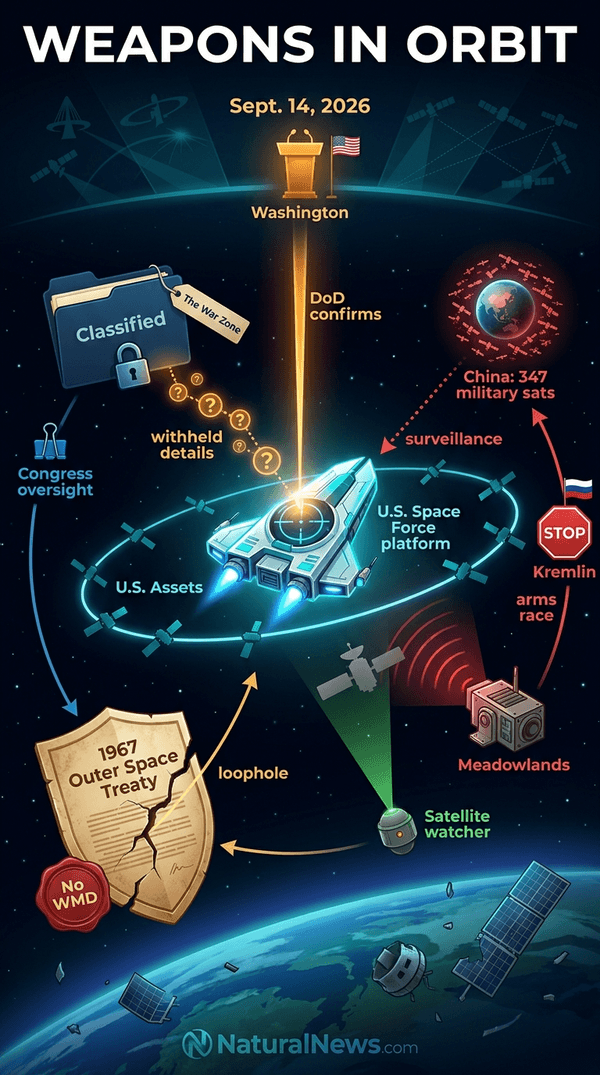
Explainer Infographic








Please contact us for more information.


