


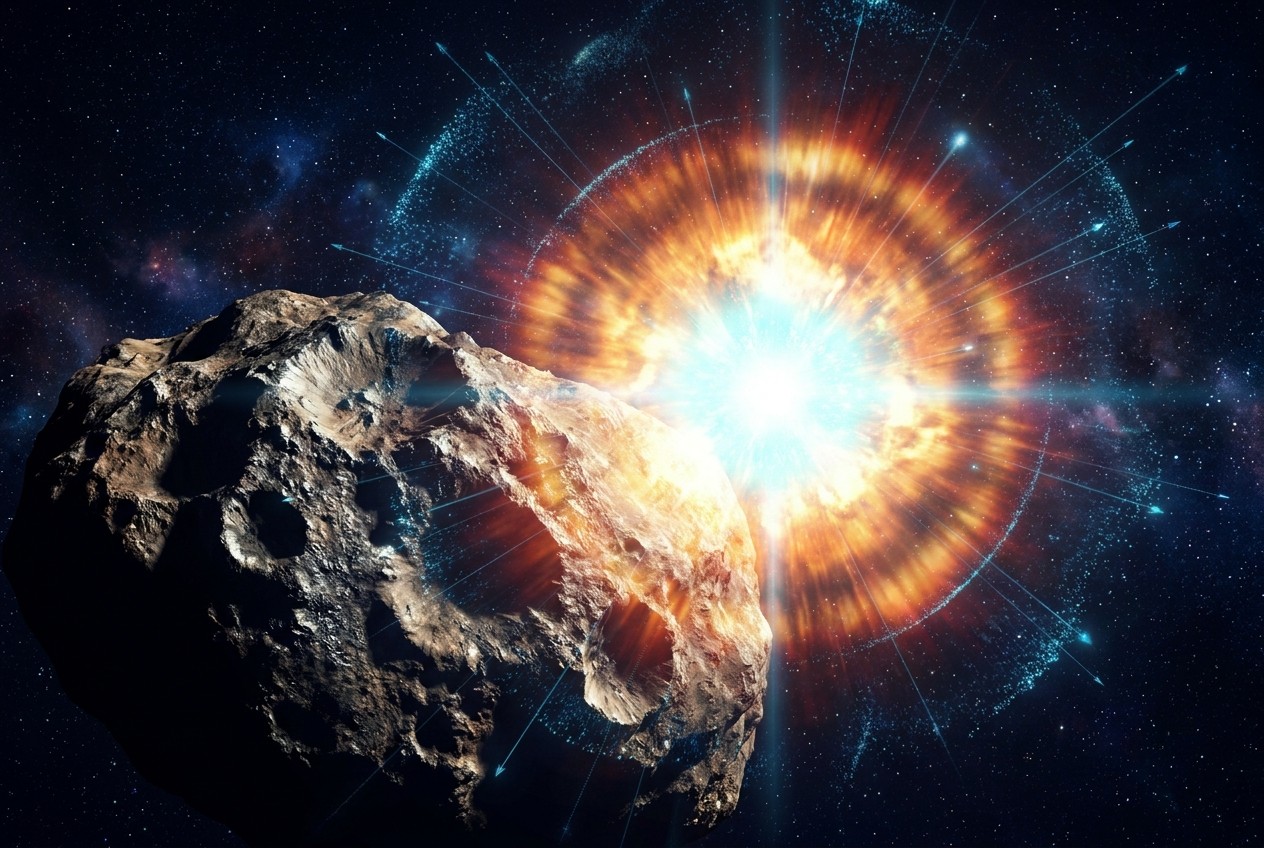
The research is a theoretical exercise in planetary defense. No specific asteroid is currently identified as requiring nuclear deflection, and officials said the study was not prompted by an immediate threat.
The goal is to quantify how energy from a nuclear burst transfers to an asteroid's surface and interior, a problem that conventional deflection models have not fully resolved.
Background on Planetary Defense and Nuclear Deflection
The concept has been studied since the 1960s, though political sensitivity has long limited open discussion of it.
NASA's Double Asteroid Redirection Test in September 2022 demonstrated kinetic impact as a deflection method, intentionally crashing a spacecraft into the asteroid Dimorphos to change its trajectory [1]. But kinetic impactors may be insufficient for larger or faster objects, and nuclear options remain under study. Planetary defense researchers have long stressed that while an asteroid impact is a low-probability threat in any given lifetime, it is also an enormously high-consequence event, one that could be catastrophic not only for the immediate impact zone but also for the entire world's climate and economy [2].
That finding underscores the distinction researchers now draw between deflection and disruption.
International treaties and space law govern nuclear detonations in space. The 1967 Outer Space Treaty prohibits placing weapons of mass destruction in orbit or on celestial bodies, but the legal status of a standoff nuclear detonation for planetary defense remains unsettled.
Details of the Supercomputer Simulation
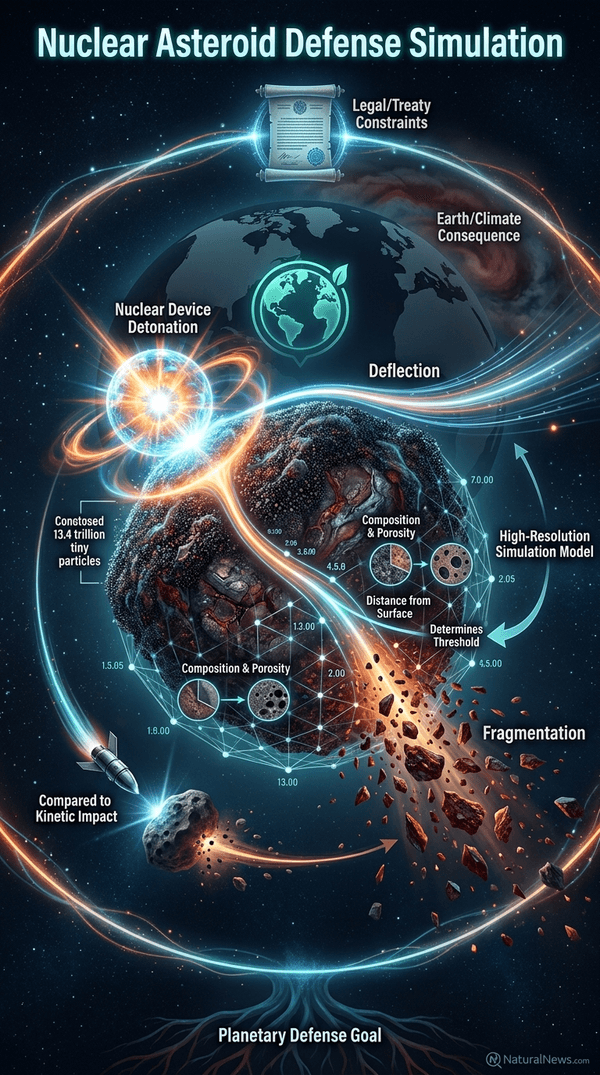
The model represents an asteroid with 13.4 trillion dark particles to capture shockwave propagation and fragmentation behavior at high resolution. Dark particles are a computational technique used in astrophysics simulations to represent mass without tracking every individual atom.
The model includes variables such as asteroid composition, porosity, and the distance of the nuclear device from the surface. These parameters determine whether a detonation deflects an asteroid intact or breaks it apart.
The scale of the simulation allows for high-resolution fragmentation outcomes that smaller models cannot capture.
The simulations are designed to map where that threshold lies for asteroids of differing composition and structure.
Simulated Outcomes and Researcher Statements
Preliminary results indicate that a nuclear device could deflect an asteroid if detonated at a sufficient distance, according to the report. Close detonations, by contrast, may cause fragmentation, creating multiple smaller objects that could still pose risks.
NASA's 2021 planetary defense exercise, conducted from April 26 to April 29 in collaboration with the Federal Emergency Management Agency, gave American and European scientists a simulated six-month timeline to stop an asteroid on a collision course with Earth.
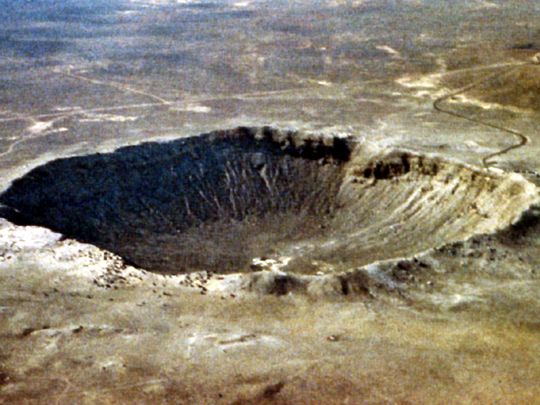
The scale of damage from even modest impacts is significant. One larger chunk landed in a frozen lake, leaving behind a massive hole.
Officials said more simulations and physical experiments are needed to validate the findings.
Limitations and Next Steps
The study does not account for all real-world uncertainties, including unknown asteroid interiors. A real asteroid's internal structure, porosity, and composition can only be estimated from remote observations, and these unknowns affect how a nuclear burst would transfer momentum. The model's findings therefore represent a range of possible outcomes rather than a prediction for any specific object.
Legal and policy frameworks for nuclear use in space remain unresolved.
Researchers plan to run additional simulations with varied parameters and compare results with observational data. The work builds on decades of planetary defense research.
Conclusion
The LLNL simulation represents a theoretical step in planetary defense research. No specific asteroid is currently identified as a threat requiring nuclear deflection, and officials said the study was not prompted by an immediate threat.
The research follows decades of study on asteroid mitigation.
Further study and international coordination are expected. Planetary defense researchers have long stressed that detection time is the binding constraint.
References
- NASA asteroid deflection test accidentally creates a BOULDER SWARM that could impact the Earth with as much ener - NaturalNews.com, August 11, 2023.
- Fire in the Sky Cosmic Collisions Killer Asteroids and the Race to Defend Earth Gordon L Dillow by Unknown
Explainer Infographic





Please contact us for more information.


