



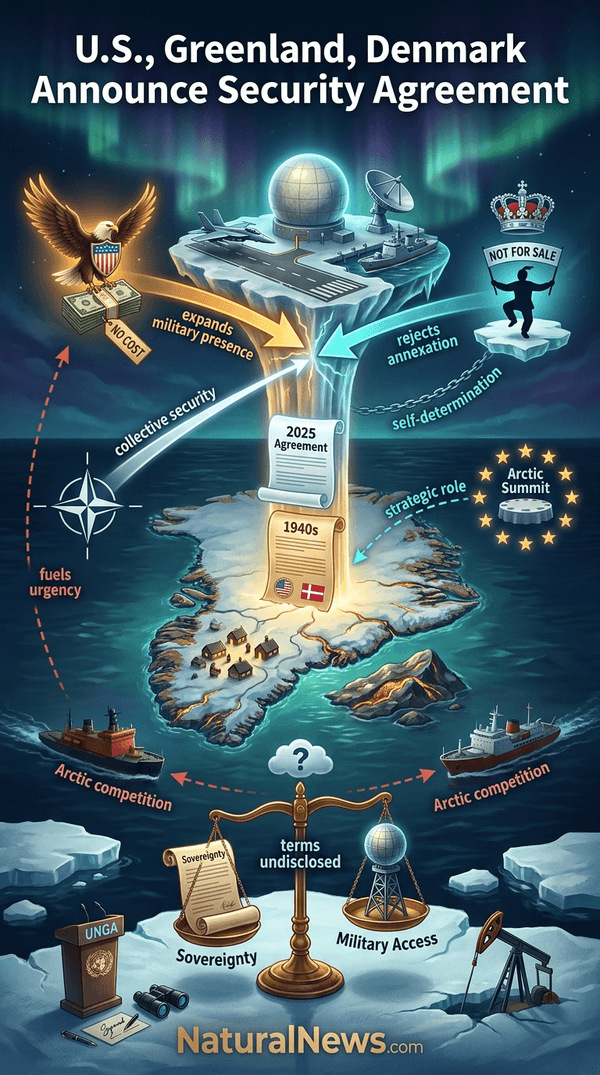
According to a post on Truth Social, Trump said, "We will immediately begin the process of developing a large Military presence in the appropriate part of Greenland." The post stated that the deal includes no cost to the U.S. and addresses "ALL of our many U.S. concerns."
The Danish prime minister's office, in a press release issued later Friday, said the three governments expect to sign the agreement at the United Nations General Assembly next week. The office did not release the full text of the agreement, and the White House did not immediately respond to questions about the deal.
The announcement follows a period of tension between Washington and Copenhagen over the future of Greenland, a self-governing territory within the Kingdom of Denmark. Trump said the new agreement addresses his security priorities, though the official terms were not immediately available for review.
Deal Follows Prior U.S. Push and Existing Defense Agreement
Greenland already hosts a U.S. military presence under a decades-old defense agreement with Denmark. That arrangement dates back to the early 1940s, when the U.S. undertook the defense of Greenland and received rights to construct and operate landing fields and related facilities, according to historical accounts [1]. In recent months, the Pentagon has sought to expand that presence at multiple sites, citing growing Russian and Chinese activity in the Arctic [2].
Trump has repeatedly insisted that Greenland must become part of the U.S., referencing its strategic location and mineral wealth. In July 2026, he told a bilateral meeting at the NATO summit in Ankara that Greenland "should be controlled by the U.S., not by Denmark" [3]. Greenlandic and Danish officials have consistently rejected annexation, with Danish Prime Minister Mette Frederiksen saying in July that "Greenland is not for sale" [4].
Earlier this year, the European Union united to rebuke Trump over his push to acquire the island. The European Commission president, Ursula von der Leyen, said in September that Greenland's future is for its people and Denmark to decide [5]. The deal as described by Trump appears to stop short of making Greenland part of the U.S., according to the CNBC report [13].
Officials Cite Sovereignty, Arctic Security and NATO
Danish Prime Minister Mette Frederiksen said in a statement included in the Danish prime minister's office release that the deal "recognizes the sovereignty and territorial integrity of the Kingdom and the Greenlandic people's right to self-determination." She added that it "strengthens our common security in the Arctic and the North Atlantic area and therefore is great for NATO and Europe as well." [13]
NATO spokesperson Allison Hart said in a statement that "the Arctic and the North Atlantic are essential for our collective security, and this agreement will help advance security, stability, and cooperation in this vital region." Hart added that NATO will continue to do its part to strengthen security in the Arctic [13].
The Arctic has become a focus of increased military and diplomatic activity by multiple powers. Twelve EU countries urged a "more strategic and proactive role" in the region at the first European Arctic Summit in Finland in September [6]. Irina Strelnikova, director of the Center for Interdisciplinary Arctic Studies at the Higher School of Economics in Moscow, said in an interview that European NATO members are seeking to push Russia out of Arctic cooperation arrangements while integrating the region into their military strategy [7].
Trump Claims Permanent Security Control
In his Truth Social post, Trump said the agreement gives the U.S. "permanent control over security, and all other needs" in Greenland. He stated that the U.S. "will FOREVER have the complete ability to do what is necessary in Greenland in order to secure and defend the security of Greenland." [13]
Those claims could not be independently verified because the official text of any deal was not immediately available. The White House did not immediately respond to CNBC's request for additional information on the deal. The Danish prime minister's office did not publish the full text of the agreement alongside its announcement.
The broad language used by Trump contrasts with earlier statements from Greenlandic and Danish officials, who have emphasized self-determination and sovereignty. In May 2026, Greenland Prime Minister Jens-Frederik Nielsen told U.S. special envoy Jeff Landry that Greenland's right to self-determination "cannot be negotiated" and that Greenlanders "are not for sale" [8]. In July 2026, Frederiksen said, "We are ready to defend every inch of NATO, including our own territory" [4].
Next Steps and Outstanding Questions
The Danish prime minister's office said the agreement is expected to be signed at the U.N. General Assembly next week. It was not immediately clear what specific military construction or operations the agreement would cover, nor how it would affect existing U.S. forces in Greenland or NATO operations in the region. Further details were expected upon release of the official text or at the signing, officials said.
The agreement follows months of negotiations and public friction. In May 2026, U.S. officials were reported to be seeking to open three new bases in southern Greenland as part of talks with Denmark [9]. Trump's special envoy to Greenland, Jeff Landry, said during a visit to Nuuk that it was time for the U.S. to reestablish its military and strategic footprint on the island [10].
The U.S. has maintained a military presence in Greenland since World War II, when it established bases under an agreement with the Danish minister in Washington [1]. Denmark has recently taken steps to bolster its own Arctic defense, including plans for a new military airbase at Kangerlussuaq [11] and the deployment of conscripts to Greenland for the first time in modern history [12].
References
- Garrison Vance. "US envoy presses for stronger presence in Greenland - NaturalNews.com". May 23, 2026.
- Cassie B. "Pentagon seeks new Arctic bases in Greenland amid Russian Chinese activity - NaturalNews.com". April 2, 2026.
- Willow Tohi. "Denmark to bolster Arctic defense with new military airbase in Greenland - NaturalNews.com". January 20, 2025.
- americas colonial experiment.
- RT. "Danish conscripts deployed to Greenland amid Trump threats". August 18, 2026.
- RT. "EU countries seek greater Arctic presence". September 14, 2026.
- RT. "Von der Leyen pushes back against Trump over Greenland". September 7, 2026.
- RT. "NATO seeking to push Russia out of Arctic – scholar". September 13, 2026.
- NTD. "Trump Renews Calls for US Control of Greenland at NATO Summit". July 7, 2026.
- BBC. "US in closely-guarded talks to open new bases in Greenland". May 12, 2026.
- The Epoch Times. "Danish Prime Minister Says Greenland 'Not for Sale' as Trump Pushes for US Control". July 8, 2026.
- 100PercentFedUp.com. "Greenland Prime Minister Tells President Trump's Envoy Jeff Landry That Self-Determination Is 'Not for Negotiation'". May 18, 2026.
- CNBC. "Trump says U.S. to build a 'large Military presence' in Greenland as part of a security deal with it and Denmark". September 18, 2026.
Explainer Infographic





Please contact us for more information.


