


The husband won approximately $16,000 from his wife and her lover for infringing on his marital rights, the court stated. However, the same court then sentenced him to five months in jail and fined him roughly $4,700 for recording private activity without consent.
Both rulings are legally defensible, according to Henry F. Fradella, George Grispos and Jihun Joun, faculty members at Arizona State University who analyzed the case in The Independent. Together, the authors wrote, the decisions expose a gap in the law: devices inside homes now generate evidence continuously and often invisibly, while governing statutes remain a patchwork.
The case began in September 2023, when the husband found a used toothbrush at the couple's holiday home and garage video showed an unfamiliar man driving his wife there, the article stated. Three months later, he opened the robot vacuum's app to speak with her and saw the encounter through its live camera, according to the article.
Household Devices as Sensors
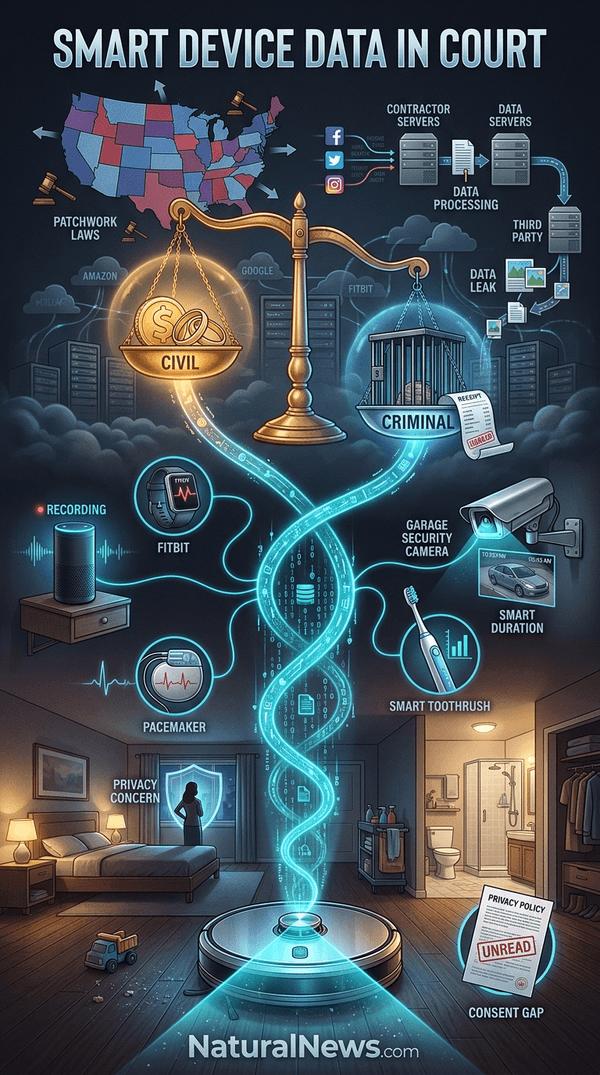
A modern robot vacuum is a mobile sensor platform, not merely a cleaning appliance, the authors wrote. Some models combine cameras, microphones, laser navigation and remote video access, while app-connected models create detailed floor maps and cleaning histories, according to the article. Their data may also reach manufacturers' servers, the authors stated.
Reporting by MIT Technology Review in 2022 revealed images from development versions of iRobot's Roomba J7, including a woman on a toilet, according to the article. Test-household images had gone to a data-labeling contractor, where workers posted them in private social media groups.
The report stated that no hacking was required; the leak arose from the ordinary pipeline used to train object-recognition software. NaturalNews.com reported that Eileen Guo investigated the matter and found that images had appeared on platforms including Facebook and Discord [1].
Security researchers have warned that connected appliances carry broader exposure. A flaw in the LG SmartThinQ application could allow hackers to take control of smart dishwashers, refrigerators, microwaves, dryers and vacuums, according to security researchers cited by NaturalNews.com [2].
Separately, a software engineer accidentally accessed more than 7,000 robot vacuums across 24 countries through a security flaw. The engineer gained access to live camera feeds, microphones, floor plans and device tracking [3].
Digital Witnesses in Court
Courts have confronted household data for years. In Arkansas, prosecutors charged James Bates with murder after a friend died in his hot tub, then sought recordings from his Amazon Echo and cited smart-meter data suggesting overnight water use, according to the article. Amazon resisted until Bates consented, but prosecutors could not eliminate other reasonable explanations, and the charge was eventually dropped, the authors stated.
In Connecticut, Richard Dabate claimed an intruder murdered his wife, Connie. Her Fitbit data contradicted his timeline and helped establish when she stopped moving, according to the article. A jury convicted him, and in 2025 the Connecticut Supreme Court upheld the conviction and found the Fitbit evidence scientifically reliable, the authors wrote.
In Ohio, Ross Compton's pacemaker data was used to challenge his account of a house fire, raising a Fourth Amendment question about privacy protection for intimate medical data generated by an implanted device, the article stated. The court upheld the search warrant, finding probable cause and concluding that obtaining the data remotely was not an unreasonable search. Compton died before his arson trial date, according to the article.
Unresolved Legal Questions
The wife in Taiwan argued that small indicator lights gave no meaningful warning – a concern that extends to guests, children, domestic workers and estranged spouses, the authors wrote. Unlike a mounted security camera, a roaming appliance may record people who never saw its privacy policy, according to the article.
Legality and admissibility do not always align. The constitutional exclusionary rule restrains government, not private parties, so the Fourth Amendment generally does not bar evidence wrongfully obtained by a private actor, the authors stated, citing Burdeau v. McDowell in 1921.
Congress created a different rule for aural communications under the federal Wiretap Act of 1968, which covers intercepted sound but not silent video, according to the article. Camera-only recording therefore falls outside that federal regime, and liability depends on state laws that differ sharply in scope, consent requirements, and penalties.
Reliability remains a third problem. Consumer devices were designed to clean floors, not withstand cross-examination, and timestamps, firmware changes and retention policies can complicate interpretation, the authors wrote. A remote-access log may identify an account without proving who used it, according to the article.
Conclusion
The authors called for point-of-sale disclosures, exportable logs showing when remote access occurred and validated forensic standards for consumer devices. Federal trade regulators already urge clear pre-purchase disclosures and data minimization for connected products, they noted. The article concluded that Congress and the states will need to decide what home robots may record, who may use the recordings and what they prove before words and actions in more homes end up as evidence in court.
References
- NaturalNews.com. "Amazon's iRobot Roomba vacuums caught spying on users, taking photos of them on the toilet and posting to social media". NaturalNews.com. December 29, 2022.
- NaturalNews.com. "Are your appliances spying on you? LG Smart devices are easily hacked, warn security experts". NaturalNews.com. November 02, 2017.
- Kevin Hughes. "Software Engineer Accidentally Gains Control of 7,000 Robot Vacuums, Exposing Serious Security Flaw". NaturalNews.com. March 1, 2026.
Explainer Infographic





Please contact us for more information.


